
Detailed Guide to What Successful Independent Doctors Do Differently
Why the Gap Between Independent and Employed Physicians Keeps Growing
What successful independent doctors do differently comes down to one core thing: they treat medicine like both a calling and a business — and they refuse to let either one compromise the other.
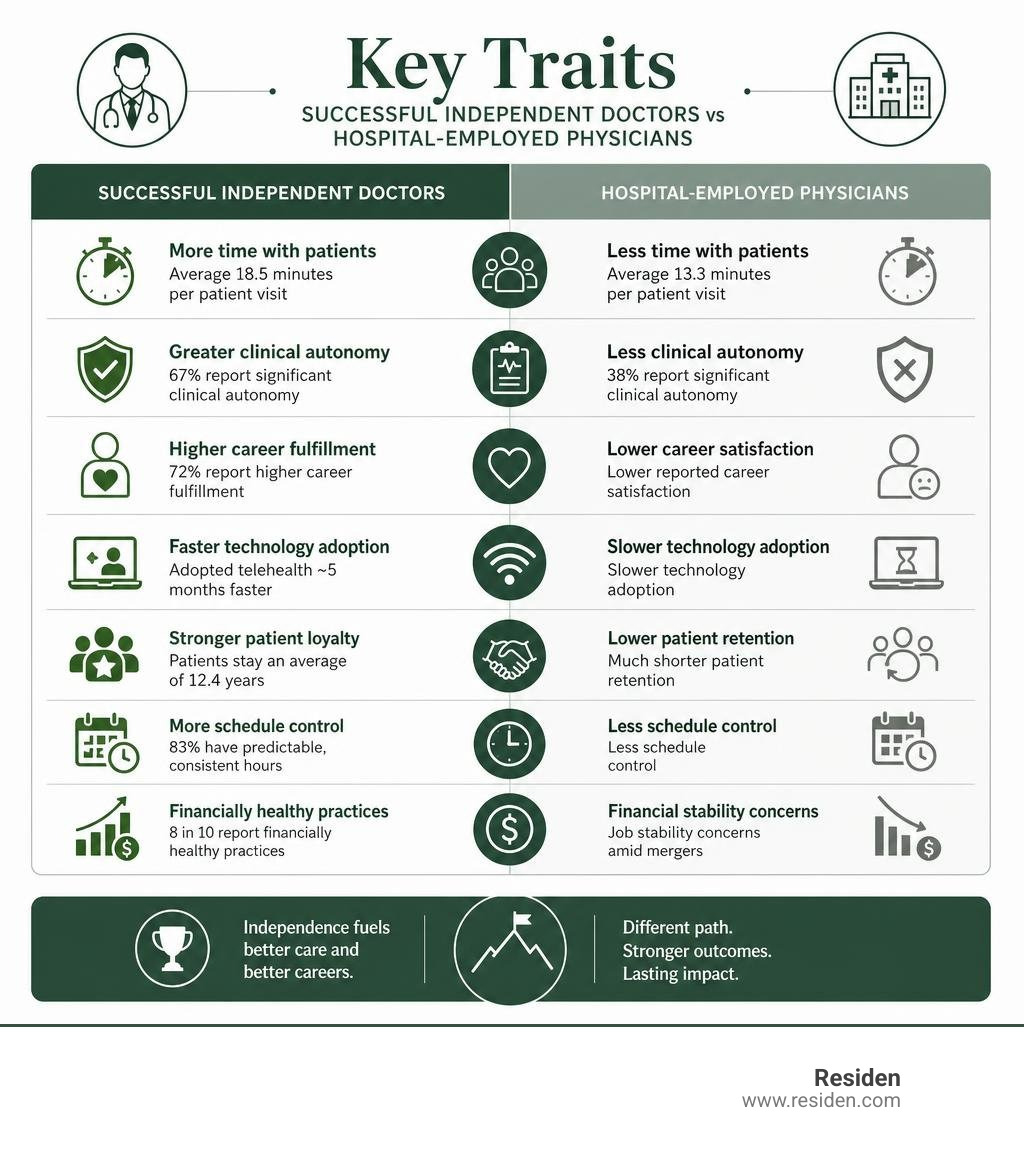
Here's a quick snapshot of the key differences:
| What Successful Independent Doctors Do | What Most Employed Doctors Experience |
|---|---|
| Average 18.5 minutes per patient visit | Average 13.3 minutes per patient visit |
| 67% report significant clinical autonomy | 38% report significant clinical autonomy |
| 72% report higher career fulfillment | Lower reported career satisfaction |
| Adopted telehealth ~5 months faster | Slower technology adoption |
| Patients stay an average of 12.4 years | Much shorter patient retention |
| 83% have predictable, consistent hours | Less schedule control |
| 8 in 10 report financially healthy practices | Job stability concerns amid mergers |
The numbers tell a clear story. Independent physicians are not just surviving — many are thriving. Yet the pressures pushing doctors toward hospital employment are real and relentless. Since 2020, more than 138,000 physicians have left independent practice. By 2024, fewer than half of all U.S. doctors remained in private practice, down from over 60% in 2012.
So what separates the ones who stay independent — and love it — from those who eventually sell to a hospital system or private equity group?
It's not luck. It's not just clinical skill. It's a specific set of business behaviors, mindset shifts, and operational habits that set great independent practices apart from good ones.
I'm Dr. Jessica Wu, a Harvard-trained dermatologist who has run my own independent practice in Los Angeles for over 20 years — and I've had a front-row seat to what successful independent doctors do differently to build careers that are both clinically fulfilling and financially sustainable. In this guide, I'll walk you through the exact strategies, frameworks, and habits that help independent physicians not just survive consolidation pressures, but build practices they're proud of.
Defining the Modern Independent Physician: Autonomy vs. Consolidation
To understand what successful independent doctors do differently, we first have to define what an independent physician actually is in today's landscape. An independent physician is someone who owns the majority of their medical practice and retains key decision-making rights. We aren't bound by corporate quotas, nor are we forced to hit arbitrary Relative Value Unit (RVU) targets set by a hospital board.
However, maintaining this freedom has become increasingly difficult. Healthcare consolidation is at an all-time high. Large health systems and private equity firms have been aggressively buying up smaller practices. In 2024, only 42.2% of physicians remained in private practice, while 34.5% worked directly for hospital-owned practices.
Why is this shift happening? The decline is driven by compounding systemic pressures:
- The Reimbursement Squeeze: Medicare physician payments have fallen by 33% over the last quarter-century when adjusted for inflation.
- The Regulatory Maze: Complex compliance requirements, Stark Law limitations, and administrative reporting eat up valuable hours.
- Unfair Facility Fees: Hospitals are legally permitted to charge "provider-based facility fees" that independent private practices cannot charge, putting independent clinics at a distinct financial disadvantage.
- Negotiating Disadvantages: Independent doctors often struggle to negotiate higher payment rates with major payers on their own, prompting 70.8% of those who sell their practices to cite payer negotiation pressures as their primary reason.
Despite these hurdles, the clinical and personal benefits of remaining independent are massive.
| Operational Dimension | Independent Private Practice | Corporate/Hospital Employment |
|---|---|---|
| Clinical Autonomy | Complete control over treatment plans and referrals | Restricted to internal networks and corporate guidelines |
| Time with Patients | Averages 18.5 minutes per visit | Averages 13.3 minutes per visit |
| Burnout Risk | Significantly lower; high alignment with professional values | High; 60%+ of U.S. doctors report burnout symptoms |
| Schedule Control | High; 83% report predictable hours | Subject to hospital shift demands and overnight call |
When we choose clinical independence, we protect ourselves from the "moral injury" that occurs when corporate policies prioritize profit margins over individualized care. This is why independent practice is often described as the ultimate way to "get your medicine back." For a deeper look at these advantages, check out our guide on The Perks of Private Practice.
What Successful Independent Doctors Do Differently to Thrive
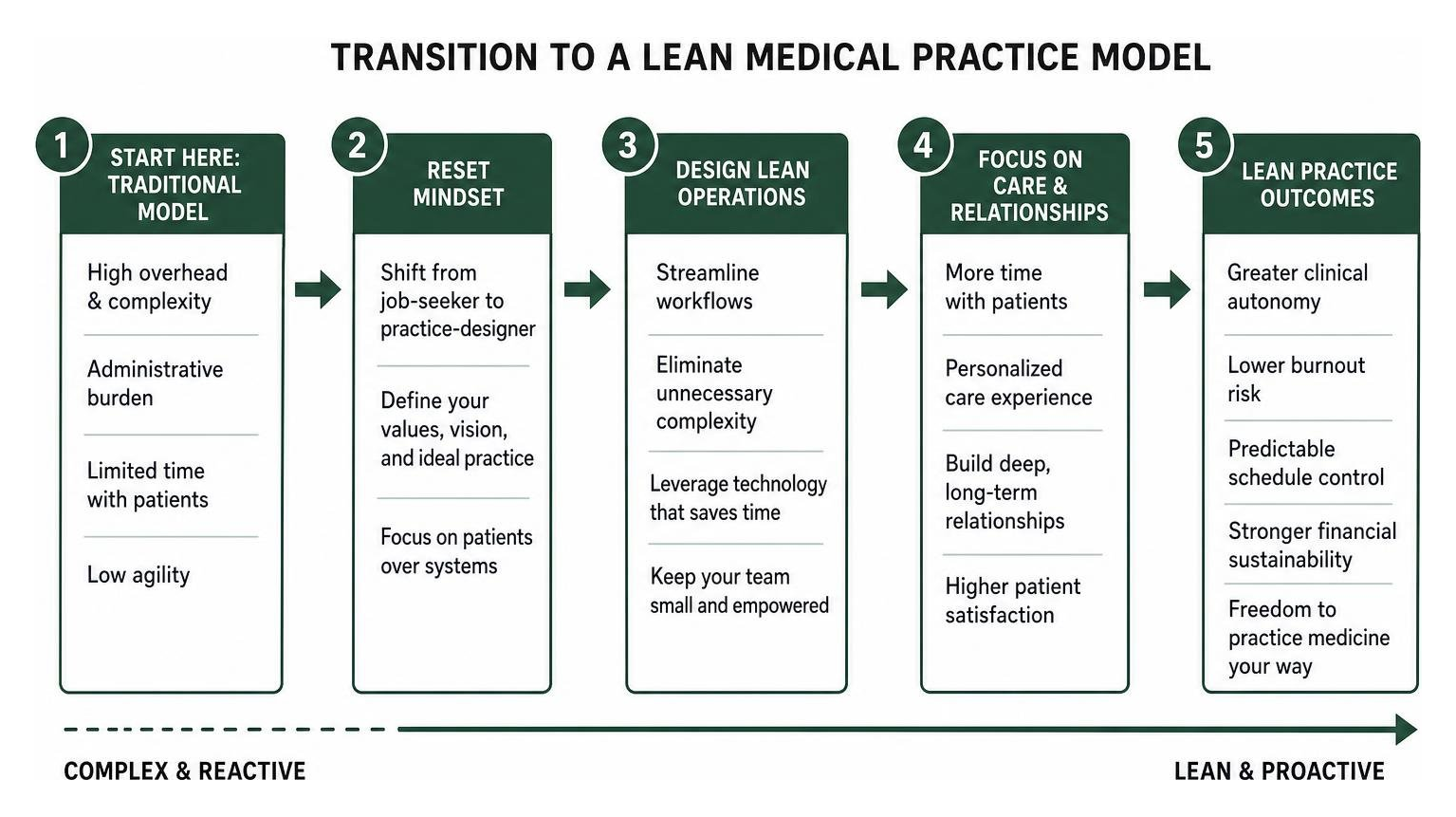
The doctors who build highly successful, enduring practices do not try to replicate the massive, complex infrastructure of giant hospital systems. Instead, they embrace a fundamental mindset shift: they transition from "job-seekers" to "practice-designers."
According to experienced healthcare leaders, many employed physicians falsely assume that going independent requires taking on overwhelming administrative complexity. In reality, successful independent doctors succeed by keeping their practices human-scale, agile, and incredibly focused. They understand that their primary competitive advantage is their agility.
For instance, during the COVID-19 pandemic, independent practices implemented telehealth solutions an average of 4.7 months faster than large healthcare systems. While hospital boards spent months debating software contracts, independent doctors picked a secure platform and started seeing patients virtually within days.
This agility allows independent practices to adapt to clinical innovations, adjust schedules, and pivot business models without navigating endless layers of corporate red tape. To understand the common misconceptions employed doctors have about making this leap, refer to What employed physicians get wrong about going independent - Becker's Physician Leadership.
How They Build Deep Patient Relationships and Personalized Care
At its core, healthcare is an exceedingly personal and intimate service. Patients trust us with their lives, and they want to feel heard. Successful independent doctors leverage this by prioritizing face-to-face patient time to foster deep, multi-generational relationships that corporate models simply cannot replicate.
Because independent doctors are not tethered to rigid corporate productivity metrics, they can afford to spend more time with each patient. In independent settings, visits average 18.5 minutes compared to just 13.3 minutes in hospital-owned practices. This extra five minutes is where the magic happens: it's where we uncover a hidden lifestyle stressor, identify an early symptom that might have been rushed past, and build genuine trust.
This approach delivers measurable results:
- Patients of independent physicians report 26% higher satisfaction rates compared to those in hospital-owned practices.
- 78% of patients receiving care from independent doctors report feeling truly "connected" to their provider, compared to just 41% at large hospital systems.
- This connection translates to incredible loyalty: patients stay with independent primary care physicians for an average of 12.4 years — nearly twice as long as they do with hospital-employed doctors.
In highly competitive areas like Beverly Hills and Brentwood, this relationship-first model has driven the dramatic growth of direct primary care and boutique concierge medicine. These types of local practices show how focusing on personalized care plans builds a fiercely loyal patient base.
To learn more about how tailored treatment plans improve clinical outcomes, explore our resources on The Rise of Personalized Healthcare.
What Successful Independent Doctors Do Differently with Technology
Administrative burden is the number one driver of physician burnout. The average doctor spends hours every day on "pajama time" — the late-night charting, documentation, and inbox management that eats into personal life.
What successful independent doctors do differently is use modern technology to eliminate this administrative cognitive load. Instead of fighting legacy, hospital-mandated Electronic Health Record (EHR) systems, thriving independent practices adopt clinical-first, AI-powered tools.
Specifically, successful practices are increasingly adopting agentic AI and automated note assistants. These tools listen to the patient-doctor conversation in real-time and automatically generate highly accurate clinical notes. This allows the doctor to look the patient in the eye rather than typing on a screen, and it completely eliminates after-hours charting.
Additionally, top-performing practices utilize integrated EHR and billing platforms to streamline workflows. They automate appointment reminders, utilize secure text messaging portals, and offer online scheduling. By automating these repetitive administrative tasks, they free up their staff to focus on direct patient care. To see how clinical autonomy and technology choice directly impact professional fulfillment, review our Physician Happiness Survey: What Makes Doctors Happy.

What Successful Independent Doctors Do Differently to Manage Overhead
Traditional medical practice models often carry massive fixed overhead costs. Between long-term commercial real estate leases, expensive medical equipment, and large administrative staff payrolls, overhead can easily consume 15% to 25% of a practice's revenue.
Thriving modern independent doctors bypass these traditional financial traps by using lean business models and flexible infrastructure:
- The Micro-Corporation Model: Many successful doctors operate as a micro-corporation (such as a Professional LLC or Professional Corporation taxed as an S-corp). This lean structure minimizes administrative expenses, reduces personal financial risk, and provides significant tax advantages.
- Avoiding Long-Term Leases: Instead of signing a 5-to-10-year commercial lease and spending hundreds of thousands of dollars on a custom office build-out, smart doctors utilize flexible, turnkey medical spaces.
- Turnkey Shared Spaces: In the Los Angeles area, successful specialists and primary care doctors are scaling their physical footprint using Residen. Residen provides fully equipped, patient-friendly exam, procedure, and consultation rooms in premium locations like Beverly Hills and Brentwood (including offices at 433 N Camden Dr Suite 610, Beverly Hills CA).
By using flexible daily or hourly bookings with no upfront capital or long-term lease liabilities, independent physicians can start seeing patients immediately while keeping their fixed overhead near zero. This is a game-changer for specialists looking to establish a local presence without massive financial risk. For a practical guide on running a lean practice, read our article on Simple Ways to Run the Lean Medical Practice.
Strategic Business and Financial Playbooks of Thriving Practices
To maintain clinical freedom, a practice must be financially healthy. Eight in ten self-employed physicians report that their practices are financially robust. This stability is achieved by treating the practice as a disciplined business entity.
Payer Negotiations and Revenue Cycle Management
One of the greatest challenges independent practices face is managing payer relationships and securing fair reimbursement rates. Insurance companies rarely offer rate increases voluntarily, and individual doctors have very little leverage when negotiating alone.
To overcome this, successful practices use several distinct strategies:
- Collective Bargaining and MSOs: Many independent doctors band together to form Management Services Organizations (MSOs) or collaborative independent coalitions. This allows them to negotiate payer contracts with the collective bargaining power of a much larger group.
- Value-Based Care Models: Thriving practices are quick to adopt value-based care models, which reward providers for quality outcomes rather than sheer volume. In fact, 63% of independent practices have adopted some form of value-based care, compared to just 51% of hospital-owned practices.
- Specialized Financial Consulting: Navigating complex billing regulations, optimizing the revenue cycle, and reducing claim denials requires specialized expertise. Independent practices that partner with specialized healthcare financial consultants show a 31% higher likelihood of remaining independent and financially viable compared to those trying to manage it entirely in-house.
For an in-depth analysis of how independent practices maintain financial sustainability, read The Importance of Independent Medical Practices in Modern Healthcare | HBK .
Diversifying Revenue with Non-Clinical Income Streams
Successful independent physicians understand that relying solely on insurance reimbursements is a risky business model. To build financial resilience, they actively diversify their revenue through high-value, non-clinical income streams.
One of the most popular and lucrative avenues is performing Independent Medical Examinations (IMEs) and medical-legal consulting.
- What is an IME? An IME is a third-party medical evaluation requested by insurers, employers, or attorneys to resolve workers' compensation, disability, or personal injury claims. Because the physician has no treating relationship with the patient, there is zero ongoing clinical follow-up.
- The Financial Opportunity: Average IME fees run above $2,000 per case, with complex evaluations exceeding $10,000. Additionally, deposition and courtroom testimony work commonly pays between $500 and $1,000+ per hour.
- Operational Strategy: Experienced doctors protect their time by incorporating cancellation clauses and strict no-show fees into their contracts, as patient no-show rates for IMEs can approach 50%.
By scheduling these consultations and legal reviews during dedicated blocks of their week, independent doctors create a highly predictable, cash-based revenue stream. To explore how to build these professional connections, see The Importance of Networking as a Physician.
Building Systems and Long-Term Operational Scalability
What separates a good medical practice from a great one? Great practices are built on systems, not dependencies.
If a practice cannot run smoothly when the owner takes a week-long vacation, it is not a scalable business — it is simply a highly demanding job. Successful independent physicians focus heavily on building Standard Operating Procedures (SOPs) for every non-clinical task, from patient intake and front-desk collections to billing follow-ups and provider onboarding.
Additionally, they follow a disciplined hiring framework:
- Hire Slightly Ahead of Need: Once a predictable patient acquisition funnel is established, successful practices hire staff slightly before they reach maximum capacity to prevent bottlenecks.
- Focus on Your Niche: Great practices lean heavily into their specific "zone of genius." They align their branding and website messaging strictly with their core specialty, avoiding confusing, unrelated service lines that dilute patient trust.
- No One-Off Exceptions: They maintain system integrity by avoiding one-off policy exceptions or patient discounts, which disrupt standardized billing and scheduling workflows.
- Strategic Reinvestment: Instead of pulling all profits out of the business, they consistently reinvest practice capital back into growth, advanced clinical tools, and modern marketing.
To learn more about the operational traits that separate top-tier practices, read What Separates Good Medical Practices From Great Ones: 7 Traits I’ve Seen in 700+ Consultations – InvestingDoc
Frequently Asked Questions about Independent Medical Practices
What is the biggest challenge facing independent physicians today?
The biggest challenge is the administrative burden combined with declining, inflation-adjusted reimbursements. Managing regulatory compliance, billing, and EHR documentation consumes significant time and revenue. Successful practices solve this by using lean business structures, AI-powered automation, and flexible real estate solutions to keep overhead low.
How do independent practices maintain financial viability against hospital systems?
Independent practices stay viable by keeping their operational costs significantly lower than hospitals, allowing them to offer procedures that cost 30% to 40% less while maintaining healthy margins. They also specialize in high-demand niches, adopt value-based care models, and leverage flexible medical co-working spaces to eliminate fixed real estate debt.
Can independent doctors really achieve a better work-life balance?
Yes. 55% of self-employed physicians report having a better work-life balance than their employed peers. Because they control their own schedules, 83% have predictable hours and 41% take zero overnight call per month.
Conclusion: Take Control of Your Practice Journey
Preserving the independent healthcare model is essential to maintaining high-quality, personalized patient care. The data proves that independent physicians deliver better patient satisfaction, experience less burnout, and retain their clinical autonomy.
If you are ready to transition away from corporate hospital constraints or want to scale your existing private practice in Southern California, we are here to support you.
At Residen, we provide premium, turnkey shared medical office rentals in premier Los Angeles locations, including Beverly Hills (at 433 N Camden Dr, Suite 610, Beverly Hills CA) and Brentwood. We offer fully equipped, HIPAA-compliant exam, procedure, and consultation rooms on a flexible hourly or daily booking basis. With no long-term leases, setup costs, or membership fees, we make it simple to run a highly profitable, lean medical practice on your own terms.
Ready to build a practice — and a life — you love? Get started with Residen today and discover how easy starting your own clinic can be.
To explore the logistics of launching your own independent space, read our step-by-step guides on Starting Your Own Practice, The Definitive Guide to Specialized Medical Practice Startup, and How to Start Seeing Patients This Month: 5 Methods.