
A Quick Start Guide to The Physician's Guide to Financial Freedom
The Unique Financial Curve of Modern Medicine

The Physician's Guide to Financial Freedom is a roadmap designed specifically for doctors to overcome delayed earnings, massive student debt, and complex financial risks — and build lasting wealth on a compressed timeline.
Here is what it covers at a glance:
| Topic | What You Need to Know |
|---|---|
| Delayed earnings | Most physicians don't earn a full salary until their 30s |
| Student debt | Average medical school debt exceeds $250,000 |
| Core strategy | "Live Like a Resident" for 2-5 years post-training |
| Savings rate | 35% savings rate can reach financial independence in ~10 years |
| Key insurance | Own-occupation disability + malpractice coverage are non-negotiable |
| Tax tools | Backdoor Roth IRA, HSA, and 401(k)/403(b) are essential |
| Loan strategy | PSLF for nonprofit employers; refinance for private practice |
| Withdrawal rate | 4% rule has a 100% historical success rate over 30 years |
Most financial advice isn't built for doctors. A lawyer, engineer, or MBA graduate starts earning in their mid-20s. A physician often doesn't reach a full attending salary until age 32 or later — after a decade of training, mounting debt, and deferred savings.
That gap is expensive. Very expensive.
As one industry review puts it, basic financial literacy combined with a physician's income is worth millions of dollars over a lifetime. But medical schools rarely teach it. And without a clear guide, even high-earning doctors end up behind.
This article breaks down the essential strategies from the physician financial freedom framework — so you can stop leaving money on the table and start building real wealth, no matter where you are in your career.
I'm Dr. Jessica Wu, a Harvard-trained dermatologist with over 20 years in private practice in Los Angeles — which means I've lived the exact financial pressures that The Physician's Guide to Financial Freedom addresses firsthand, from navigating contracts and overhead to building independent income streams. My experience running a private practice gives me a practical, real-world lens on every strategy covered in this guide.
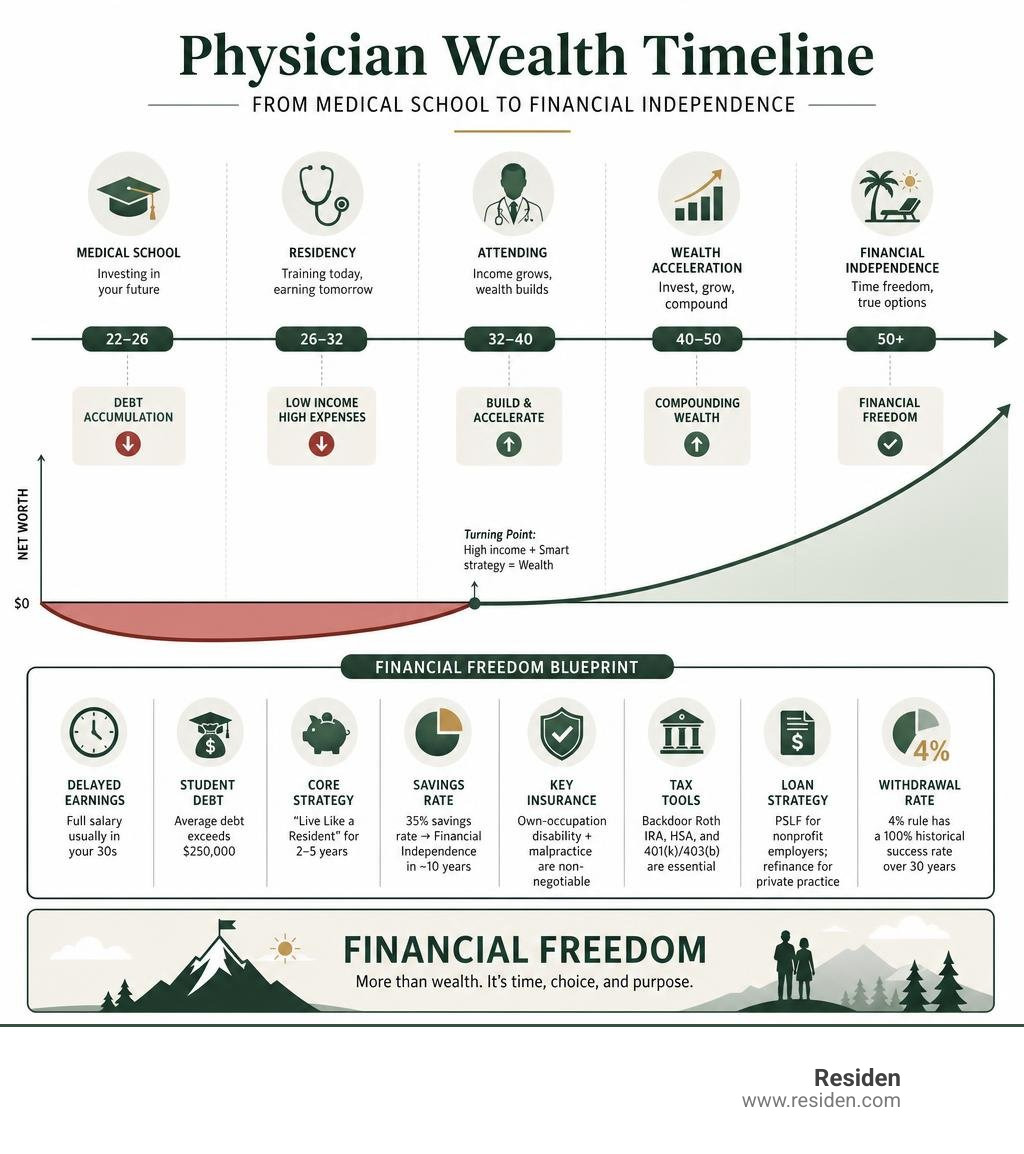
Medical training is a marathon that leaves most of us starting our professional financial lives in a deep hole. While our college peers were climbing corporate ladders, buying homes, and contributing to 401(k) plans, we were collecting degrees, working 50 to 55 hours a week as residents for a modest stipend, and watching interest accrue on our student loans.
The average medical school graduate in 2026 begins their career with approximately $250,000 in student loan debt. Because of this massive overhead, a newly minted doctor often has a lower net worth than a newborn infant. We start our careers with what we call "pretend wealth"—a high earning capacity but a deeply negative net worth.
This delayed start compresses our wealth-building timeline. If you don't become an attending until age 32 or 35, you have missed out on a full decade of compound interest. To make matters worse, we face unorthodox risks that other professionals rarely encounter. For example, the average physician spends roughly 11% of a 40-year career with an open malpractice claim hanging over their head.
If we don't adopt specialized wealth management strategies early, we risk falling into a cycle of high stress and delayed retirement. Many of us find ourselves drowning in debt and working long past the age we planned to retire simply because we lacked a basic financial education. Understanding these structural hurdles is the first step toward reclaiming your autonomy, a concept explored deeply in The Physician's Guide to Investing.
Core Pillars of The Physician's Guide to Financial Freedom
Achieving financial peace of mind requires a balance of offense (earning and saving) and defense (insurance and asset protection). Research shows that only 57% of physicians have a formal financial plan in place, while 19% have only "started thinking about it."

The most critical factor in your financial trajectory is not your investment return or the specialty you chose—it is your savings rate. To illustrate the sheer mathematical power of a high savings rate combined with disciplined investing, let's compare two different paths for a physician earning a $300,000 attending salary:
| Financial Metric | The Low-Savings Path (Dr. Jones) | The High-Savings Path (Dr. EFI) |
|---|---|---|
| Starting Net Worth | -$250,000 | +$250,000 (after early payoff) |
| Annual Savings Rate | 10% ($30,000) | 35% ($105,000) |
| Annual Spending | $150,000 | $75,000 |
| Real Rate of Return | 2% (conservative/cash-heavy) | 6% (diversified index funds) |
| Time to Financial Independence | 72.5 Years | 10 Years |
The difference is staggering. Dr. Jones is trapped on a financial treadmill for a lifetime, while Dr. EFI buys back her time and career autonomy in a single decade.
To navigate these decisions, about 49% of physicians outsource their financial planning to professionals. However, only 18% work with a private wealth manager or advisor on an ongoing basis. If you choose to hire help, it is vital to understand the difference between a fiduciary who is legally bound to act in your best interest and a commission-based salesperson selling high-fee products. You can read more about how to vet these professionals in our breakdown of financial advisor vs financial planner.
The 'Live Like a Resident' Strategy
The absolute cornerstone of physician wealth building is the "Live Like a Resident" strategy. When you transition from residency to your first attending role, your income will likely jump from roughly $68,000 to $250,000 or more.
The temptation to immediately buy the estate home, lease the luxury SUV, and upgrade your lifestyle is incredibly intense. This phenomenon is known as the "Diderot Effect" or lifestyle creep—where a single new possession leads to a spiral of consumption.
Instead, if you maintain your resident lifestyle (or upgrade it only modestly) for the first two to five years of your attending career, you can direct your massive surplus income toward:
- Rapidly wiping out your $250,000 student loan balance.
- Maxing out your tax-advantaged retirement accounts.
- Building a robust emergency fund.
Living like a resident for just a few years acts as a compounding launchpad. It allows you to build a foundation so strong that you can make minor financial mistakes later in your career and still end up completely fine.
Calculating Your Path to Financial Independence
Financial independence (FI) is the point at which your investments generate enough income to cover your living expenses, rendering work entirely optional. To find your "FI Number," you must first understand your annual spending and safe withdrawal rates.
The famous Trinity Study analyzed historical market data to determine how much a retiree can safely withdraw from a portfolio without running out of money. For a 30-year retirement window, a 4% safe withdrawal rate (SWR) from a diversified portfolio of 75% stocks and 25% bonds has a 100% historical success rate. Even a 5% withdrawal rate succeeded over 80% of the time, with portfolios ending up an average of 2.7 times larger than their starting value after 30 years.
If you are planning a shorter retirement window (e.g., 20 years), the historical success rate of a 9% annual withdrawal rate is still about 50%. Alternatively, for those who want to eliminate market risk entirely, a portfolio of 100% Treasury Inflation-Protected Securities (TIPS) at current yields can support a guaranteed 4.36% withdrawal rate for 30 years.
To calculate your FI target, simply multiply your desired annual retirement spending by 25 (which corresponds to a 4% SWR). If you need $100,000 per year to live, your target portfolio size is $2.5 million.
Defensive Planning: Insurance and Contract Negotiation
In medicine, we are trained to prioritize preventive care. The same philosophy must apply to your finances. Before you focus on growing your wealth, you must build a defensive wall around your earning potential.
Essential Insurance Policies for Doctors
There are four non-negotiable insurance policies that every practicing physician must secure:
- Own-Occupation Disability Insurance: Your single largest asset is your future earning potential. For an early-career specialist, that potential can easily exceed $10 million to $20 million. You must secure a specialty-specific, "own-occupation" policy. This ensures that if an injury or illness prevents you from practicing your specific medical specialty, the policy will pay out—even if you are healthy enough to work in a different field.
- Malpractice Insurance with Tail Coverage: Given that the average doctor spends more than 10% of their career with an open claim, appropriate malpractice limits are vital. Equally important is securing "tail" coverage, which protects you against claims filed after you leave an employer.
- Term Life Insurance: If you have dependents or a mortgage, secure $2 million to $5 million in simple, low-cost term life insurance. Avoid complex, high-commission whole life or universal life products, which are highly inefficient wealth-building vehicles.
- Umbrella Insurance: As a high-income earner, you are a natural target for personal liability lawsuits. A $1 million to $5 million personal umbrella policy is incredibly cheap (typically $200 to $500 per year) and protects your personal assets from catastrophic claims.
Navigating Contracts and Tail Coverage
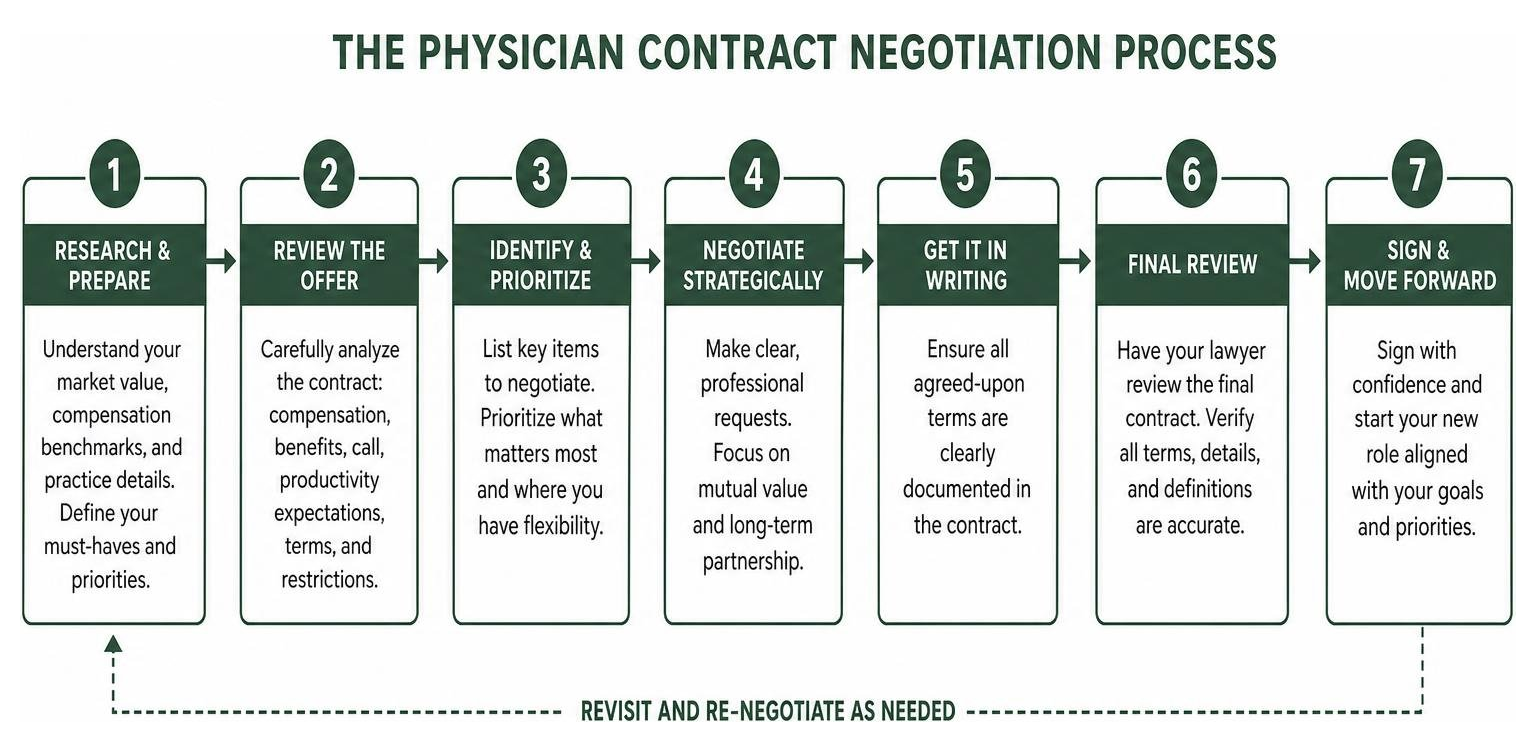
Your employment contract is the foundation of your career autonomy and early wealth. Many new physicians treat contract reviews as a mere formality, which can be an incredibly expensive mistake. A standard attending contract represents millions of dollars in cumulative value, making a professional contract review fee an absolute rounding error.
When reviewing a contract, look closely at:
- Compensation Structure: Understand how wRVU bonuses are calculated and whether base salary guarantees are tied to unrealistic productivity thresholds.
- Malpractice Tail Insurance: Ensure your contract explicitly states who is responsible for paying the tail insurance when you leave. If left to the physician, a tail policy can cost 1.5 to 3 times your annual premium—resulting in an unexpected out-of-pocket bill of $60,000 to $140,000.
- Restrictive Covenants: Negotiate non-compete radiuses down to a reasonable distance. A 25-mile radius in a dense metro area like Los Angeles can force you to relocate your family just to change jobs.
Debt Repayment and Tax Optimization Strategies
Once your defense is secure, you can focus on optimizing your cash flow. High-income physicians face a heavy tax burden, often landing in the 32% to 37% federal tax brackets. Minimizing this drag is essential to accelerating your wealth, a topic covered extensively in Financial Freedom Rx.

Student Loan Repayment Strategies
For physicians with federal student loans, there are three primary paths to debt freedom:
- Public Service Loan Forgiveness (PSLF): If you work for a qualifying 501(c)(3) nonprofit hospital or academic medical center, you can enroll in an Income-Driven Repayment (IDR) plan. After making 120 qualifying monthly payments, your remaining federal student loan balance is forgiven completely tax-free.
- Aggressive Payoff: If you enter private practice or work for a for-profit group, you are not eligible for PSLF. In this case, your best strategy is to refinance your loans to a lower private interest rate and pay them off aggressively within 2 to 5 years using your "Live Like a Resident" surplus.
- The Balanced Approach: This path involves maintaining your loans on an IDR plan while investing your surplus cash flow into the market, hoping your investment returns outpace the interest rate on your debt.
Tax-Advantaged Strategies in The Physician's Guide to Financial Freedom
To keep more of your hard-earned money working for you, you must systematically maximize your tax-advantaged space using the "savings waterfall":
- Employer Match: Always contribute enough to your employer's 401(k) or 403(b) to capture the full match. This is literally free money.
- Health Savings Account (HSA): The HSA is the only triple-tax-advantaged account in existence. Contributions are tax-deductible, growth is tax-free, and withdrawals are tax-free when used for medical expenses.
- Backdoor Roth IRA: High earners are restricted from contributing directly to a Roth IRA. However, you can legally bypass these limits by making a non-deductible contribution to a traditional IRA and immediately converting it to a Roth.
- Mega Backdoor Roth: If your employer's 401(k) plan allows for after-tax contributions and in-service distributions, you can shield an additional $30,000 to $46,000 annually in a tax-free Roth account.
- Tax Location: Keep tax-inefficient assets (like high-yield bonds or real estate investment trusts) inside your tax-sheltered accounts, while keeping tax-efficient assets (like broad-market index funds) in your taxable brokerage accounts.
Overcoming Behavioral Pitfalls and Mindset Blocks
Personal finance is only 20% head knowledge; the other 80% is behavior. As highly educated professionals, we often suffer from "complexity bias"—the belief that a successful financial plan must be highly complicated or involve exotic investments.
Common Financial Mistakes to Avoid
The most common financial traps that derail physicians include:
- Buying Too Much House, Too Soon: Committing to a massive mortgage payment immediately after residency locks up your cash flow and prevents you from investing.
- Whole Life Insurance: Falling for pitch meetings from commission-based advisors selling whole life insurance as an investment.
- Delaying Investing Until Debt is Zero: Waiting until you are completely debt-free to start investing can cost you hundreds of thousands of dollars in lost compounding time.
- Over-reliance on High-Fee Advisors: Paying a 1% Assets Under Management (AUM) fee can cost a physician millions of dollars in compounded fees over a 30-year career.
Mindset and Behavioral Finance in The Physician's Guide to Financial Freedom
The ultimate goal of building wealth is not to buy luxury items—it is to buy optionality. True wealth is the ability to wake up and decide how you want to spend your day.
To prevent burnout and maintain professional longevity, we recommend adopting the SELF Framework:
- Sleep: Prioritize physical restoration.
- Exercise: Keep your body moving to manage stress.
- Look Forward: Schedule regular, pleasant activities outside of medicine.
- Fuel: Feed your mind and body with high-quality inputs.
Using financial independence to buy back your time—whether by dropping to a 4-day workweek, stepping away from night call, or transitioning to private practice—is the ultimate cure for systemic burnout.
Frequently Asked Questions about Physician Wealth
Is a physician mortgage loan a good idea for new attendings?
Yes, but with caveats. A physician mortgage loan is a specialized lending product that allows doctors to purchase a home with 0% to 10% down, no private mortgage insurance (PMI), and the ability to exclude student loans from their debt-to-income (DTI) calculations.
While these loans are incredibly useful for preserving liquidity early in your career, they can be a double-edged sword. Getting approved for a large mortgage does not mean it aligns with your actual cash flow or long-term financial goals. We break down the math and the potential pitfalls in our guide on whether physician mortgage loans are a good idea for your specific situation.
How can independent physicians minimize practice overhead?
Practice overhead is one of the single largest barriers to financial freedom for independent physicians. Traditional brick-and-mortar medical offices require signing restrictive 5-to-10-year commercial leases, paying massive build-out costs, and hiring a full-time administrative staff before you even see your first patient.
Fortunately, modern physicians are bypassing these fixed liabilities by utilizing turnkey, shared medical office spaces. By choosing flexible, hourly or daily clinical space bookings, you can run a lean private practice with zero setup costs and zero long-term lease commitments. To explore the advantages and potential drawbacks of this model, read our comprehensive analysis of shared medical office space.
What is a safe withdrawal rate for early retirement?
If you plan to retire early (e.g., in your 40s or 50s), a traditional 30-year retirement horizon does not apply. You may need your portfolio to support you for 40 to 50 years.
In this case, a safe withdrawal rate of 3.25% to 3.5% is highly recommended to protect against "sequence of returns risk"—the risk of a major market downturn occurring immediately after you retire. Alternatively, you can adopt a dynamic withdrawal strategy, where you adjust your annual spending downward during market downturns and upward during bull markets.
Conclusion
Achieving financial freedom as a physician does not require a degree in finance or a complex portfolio of alternative investments. It requires a commitment to a few simple, time-tested principles: living below your means, maximizing your tax-advantaged space, protecting your assets with the right insurance, and keeping your practice overhead as low as possible.
If you are an independent physician or looking to transition into private practice in Los Angeles, Beverly Hills, or Brentwood, we can help you eliminate your largest fixed expense. Residen provides turnkey, fully equipped, and patient-friendly shared medical office spaces with flexible hourly or daily bookings. No leases, no setup costs, and no hidden fees.
Ready to take control of your practice and your financial future? Get Started with Residen today and build your medical practice on your own terms.