
Simple Ways to Run The Lean Medical Practice
Why Running a Lean Medical Practice Without Full-Time Staff Is the Smart Move in 2026
_compressed.webp?alt=media&token=4c492021-aba1-4a91-b775-d08a4da38eea "lean medical practice minimalist modern medical office - The Lean Medical Practice: How to Run Without a Full-Time Staff")
The Lean Medical Practice: How to Run Without a Full-Time Staff is one of the most practical strategies independent physicians can use right now to cut overhead, reduce burnout, and stay financially sustainable.
Here's the short answer:
- Adopt the 5 Lean Principles — Value, Value Stream, Flow, Pull, and Perfection — to strip out waste and focus only on what patients actually need
- Replace role-based hiring with task-based staffing: automate scheduling, use digital intake, and delegate remotely
- Use part-time, per diem, or virtual staff instead of full-time employees to match actual case load
- Eliminate the 8 types of waste (DOWNTIME) hiding in your daily workflows
- Start small — target 5-10% improvements at a time, not a total overnight overhaul
In April 2026, independent practices faced a familiar pressure: staff costs eat up roughly 32% of revenue in family medicine alone, and replacing a single employee costs around 70% of their annual salary. Meanwhile, reimbursements keep shrinking while wages climb.
The traditional model — front desk, medical assistant, biller, all full-time, all in-office — no longer fits the economics of a small or solo practice.
The good news? Lean methodology, originally developed by Toyota, gives you a clear, repeatable system to do more with less. And physicians across the country are already proving it works — some running thriving solo practices out of a single exam room with monthly overhead as low as $1,600.
I'm Dr. Jessica Wu, a Los Angeles-based dermatologist who has run a lean private practice for over 20 years, navigating the real-world tradeoffs of overhead, staffing, and patient care that define The Lean Medical Practice: How to Run Without a Full-Time Staff. My experience on both the clinical and operational side gives me a grounded perspective on what actually works — and what's just theory.
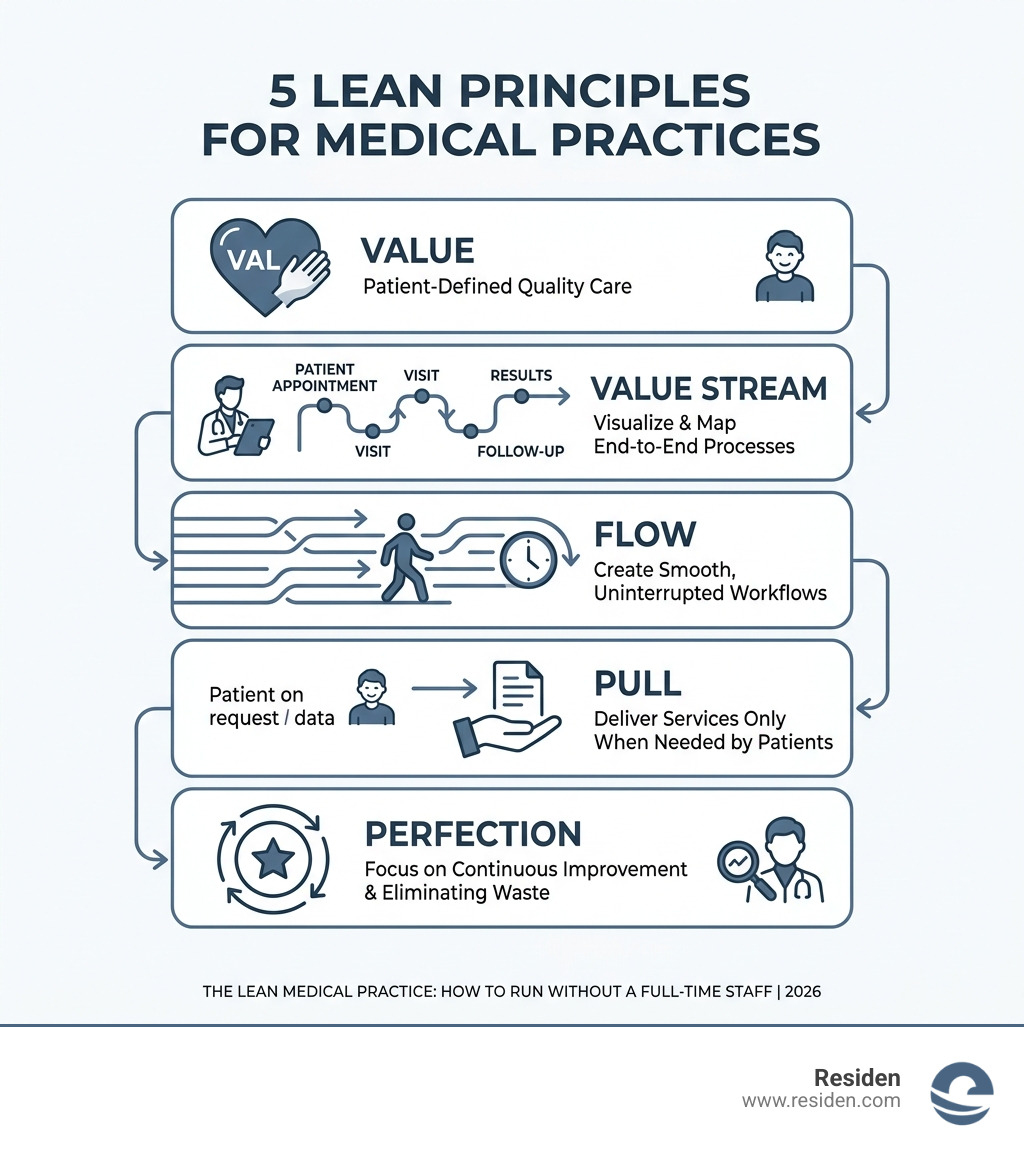
What is The Lean Medical Practice: How to Run Without a Full-Time Staff?
At its core, a Lean medical practice is about maximizing value for the patient while ruthlessly eliminating anything that doesn't contribute to that value. This philosophy stems from the Toyota Production System, which revolutionized manufacturing by focusing on "muda" (waste). In a clinical setting, lean isn't about cutting corners; it’s about Creating the Most Lean, Efficient Medical Practice where every action serves a purpose.
For many of us in Los Angeles, the biggest barrier to The Perks Of Private Practice is the staggering cost of full-time personnel. When we talk about The Lean Medical Practice: How to Run Without a Full-Time Staff, we are looking at a model that prioritizes agility. Instead of a fixed overhead of salaries and benefits—which typically run 22-26% of practice revenues—we shift toward a variable cost model.
By reducing these fixed costs, you directly improve your EBITDA (Earnings Before Interest, Taxes, Depreciation, and Amortization). This isn't just a fancy accounting term; EBITDA optimization is the key to practice valuation. Whether you plan to practice for thirty years or eventually sell to private equity, a Lean practice with high EBITDA multiples is significantly more attractive to buyers. It proves that the practice is a well-oiled machine that doesn't rely on expensive, bloated administrative structures to function.
Identifying and Eliminating Waste with DOWNTIME
To run without a full-time staff, we must first identify where our time and money are leaking. In Lean methodology, we use the acronym DOWNTIME to categorize the eight types of waste in healthcare:
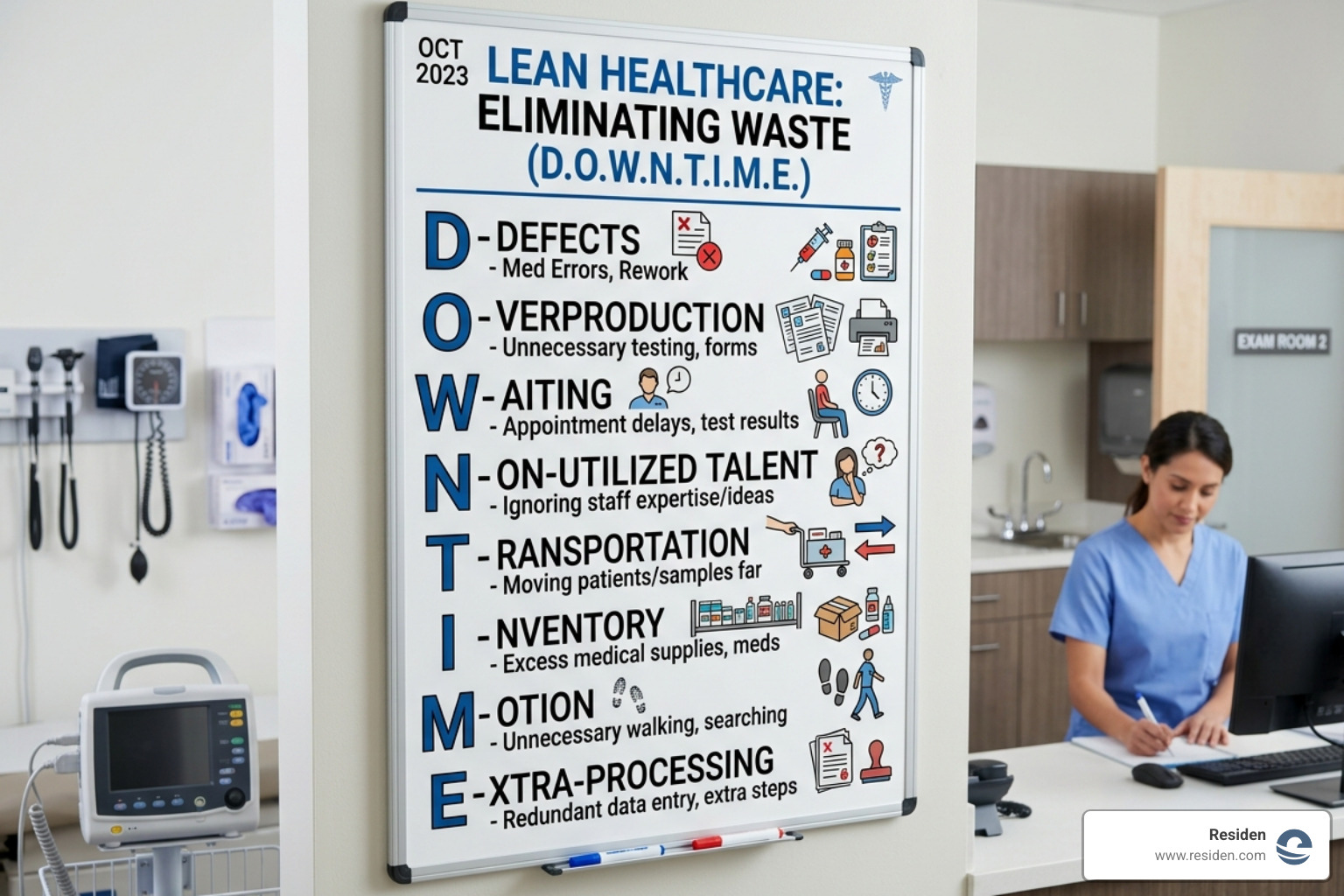
- Defects: Medical errors, incorrect billing codes, or missing information in a chart that requires rework.
- Overproduction: Printing forms that no one reads or performing redundant tests.
- Waiting: Patients waiting in the lobby or physicians waiting for a room to be cleaned.
- Non-utilized talent: This is often the most painful waste. It’s having a highly trained MA spend four hours a day on the phone on hold with insurance companies instead of assisting with patient care.
- Transportation: Moving patients or supplies unnecessarily across a large office.
- Inventory: Stocking $10,000 worth of fillers or Botox that won't be used for three months, tying up your cash flow.
- Motion: Walking back and forth to a central printer or searching for a thermometer because rooms aren't standardized.
- Extra-processing: Entering the same patient data into three different systems.
The Struggles Of Staffing often stem from trying to hire people to manage this waste rather than eliminating the waste itself. By following Starting A Medical Office Your Complete Checklist For Success, you can design workflows that prevent these leaks from the start. Replacing a staff member costs roughly 70% of their annual income when you factor in downtime, recruiting, and training. Eliminating waste is the fastest way to protect your bottom line.
Essential Tools for Redesigning Practice Workflows
Redesigning a practice to function without a full-time team requires specific frameworks. We don't just "guess" our way to efficiency; we use proven tools:
- DMAIC & PDSA: These are the engines of change. DMAIC (Define, Measure, Analyze, Improve, Control) is great for large projects, while PDSA (Plan-Do-Study-Act) is perfect for rapid, small-scale tests.
- 5S System: Sort, Set in Order, Shine, Standardize, and Sustain. This is how you organize an exam room so that any physician can walk in and find exactly what they need in seconds.
- SIPOC: (Suppliers, Inputs, Process, Outputs, Customers). This high-level map helps you see the entire journey of a patient visit or a billing claim.
- Kanban: Using visual cues (like a digital dashboard or physical cards) to manage the flow of work and supplies.
- Value Stream Mapping: Drawing out every single step in a process to see where the "Wait" time is happening.
When Nurse managers implementing the lean management system - PMC use these tools, they often find that "standard work" is the secret sauce. By creating Built In Expertise through checklists and visual systems, you ensure that even a per diem or part-time staff member can step in and perform at a high level immediately. Use a "Five Whys" analysis to get to the root of any problem—if a chart is missing, ask why five times until you find the systemic failure, not just the person to blame.
Implementing Flexible Staffing and Micropractice Models
The most radical—and effective—part of The Lean Medical Practice: How to Run Without a Full-Time Staff is the shift toward the "micropractice." This model, famously documented in Going Solo: One Doc, One Room, One Year Later | AAFP, proves that a physician can run a high-quality practice with zero full-time employees.
Transitioning to The Lean Medical Practice: How to Run Without a Full-Time Staff
To make this transition, we move from "role-based" staffing (hiring a "Front Desk Person") to "task-based" staffing.
- Virtual Assistants (VAs): Instead of an in-office receptionist, use a remote VA to handle phones, scheduling, and prior authorizations. They are often more cost-effective and can be scaled up or down based on your volume.
- Automation is Your Best Employee: In 2026, if you are still paying a human to call patients for appointment reminders, you are wasting money. Use online scheduling and digital intake forms that sync directly with your EHR.
- Task-Based Outsourcing: Use a third-party billing service. Yes, they take a percentage, but you avoid the salary, benefits, and office space costs of an in-house biller.
- Shared Resources: If you are in a shared medical space, utilize the provided receptionists for patient greeting. This eliminates the need for you to have a dedicated person sitting at a desk.
Before you post a job ad, check our Before You Hire Checklist. Often, a workflow tweak or a software integration can "hire" the help you need for a fraction of the cost.
Measuring ROI: Financial Gains and Practice Valuation
The shift to a Lean model isn't just about peace of mind; it's about significant financial returns. Research shows that Lean implementation can reduce primary care physicians' total daily work time by 20%—nearly two hours saved every day.
| Expense Category | Traditional Practice (60% Overhead) | Lean Practice (30-40% Overhead) |
|---|---|---|
| Staff Salaries | 26% | 10-15% (Virtual/Part-time) |
| Staff Benefits | 5-6% | 1-2% |
| Rent/Occupancy | 7-10% | 3-5% (Shared/Flexible) |
| Total Overhead | ~60% | ~35% |
By achieving Lower Overhead, you aren't just taking home more money; you are increasing the value of your business. When Starting Your Own Practice, every dollar saved in operating expenses is a dollar added to your EBITDA. In the current M&A landscape, private equity buyers look for "operational excellence." A practice that runs efficiently without being dependent on a specific, expensive staff cohort is considered lower risk and commands a higher sale multiple.
Overcoming Challenges and Sustaining Long-Term Success
The biggest hurdle to The Lean Medical Practice: How to Run Without a Full-Time Staff isn't technology; it's culture. Staff resistance (even among your part-time or per diem team) can be high if they feel "Lean" is just code for "working harder for less."
Sustaining The Lean Medical Practice: How to Run Without a Full-Time Staff
To sustain success, you must embrace Kaizen—the philosophy of continuous, incremental improvement. Instead of trying to fix everything at once, aim for 5-10% improvements.
- Incentivize Efficiency: If your part-time staff finds a way to shave 10 minutes off the intake process, share some of those savings with them through bonuses.
- Maintain Benefits: If you do have a small core team, don't strip their benefits to save pennies. High-quality, flexible employees are worth their weight in gold.
- Transparency: Be open about the practice's goals. When staff understand What is Lean Private Practice? - Lean Private Practice Solutions, they become partners in the process rather than obstacles.
Choosing the right environment is also key. Shared Medical Office Space Pros And Cons For Healthcare Professionals often reveals that the "Pro" side heavily outweighs the "Con" when it comes to Lean operations. In a shared environment, the "waste" of maintaining a waiting room, breakroom, and utility closet is handled for you, allowing you to focus entirely on the value-add: the patient encounter.
Frequently Asked Questions about Lean Staffing
How does Lean staffing improve physician work-life balance?
By automating administrative tasks and using task-based staffing, physicians can reduce their "pajama time"—the hours spent on the EHR after clinic. Studies show Lean can save up to two hours of work daily, allowing you to actually leave the office when your last patient does.
Can a medical practice really run without any full-time staff in 2026?
Yes. By leveraging AI for documentation, virtual assistants for administration, and flexible office rentals like Residen, many solo practitioners in Los Angeles are operating highly profitable "micropractices" with zero full-time employees.
What is the first step to implementing Lean in a small practice?
Start by identifying one "pain point"—like a messy supply closet or a slow check-in process—and apply the 5S system. Small wins build the momentum needed for larger workflow redesigns.
Conclusion
Running The Lean Medical Practice: How to Run Without a Full-Time Staff is no longer a radical experiment; it is a necessity for the modern independent physician. By focusing on value, eliminating DOWNTIME, and utilizing flexible staffing models, you can reclaim your time and maximize your practice's valuation.
At Residen, we provide the physical foundation for your Lean practice. Our turnkey, shared medical office rentals in Beverly Hills and Brentwood allow you to eliminate the waste of a long-term lease and expensive facility management. With flexible hourly bookings and fully equipped, patient-friendly spaces, we help you focus on what matters most: your patients.
Experience the Benefits Of Medical Coworking For Healthcare Professionals Enhance Collaboration And Efficiency by joining our community at 433 N Camden Dr. Ready to see how a Lean space can transform your practice? Learn more about our turnkey medical spaces and get started today.