
The Definitive Guide to Specialized Medical Practice Startup
Why a Specialized Medical Practice Startup Is One of the Most Rewarding — and Complex — Career Moves a Physician Can Make

Starting a specialized medical practice startup means taking on two roles at once: clinician and business owner. That combination is exciting, but it comes with a steep learning curve.
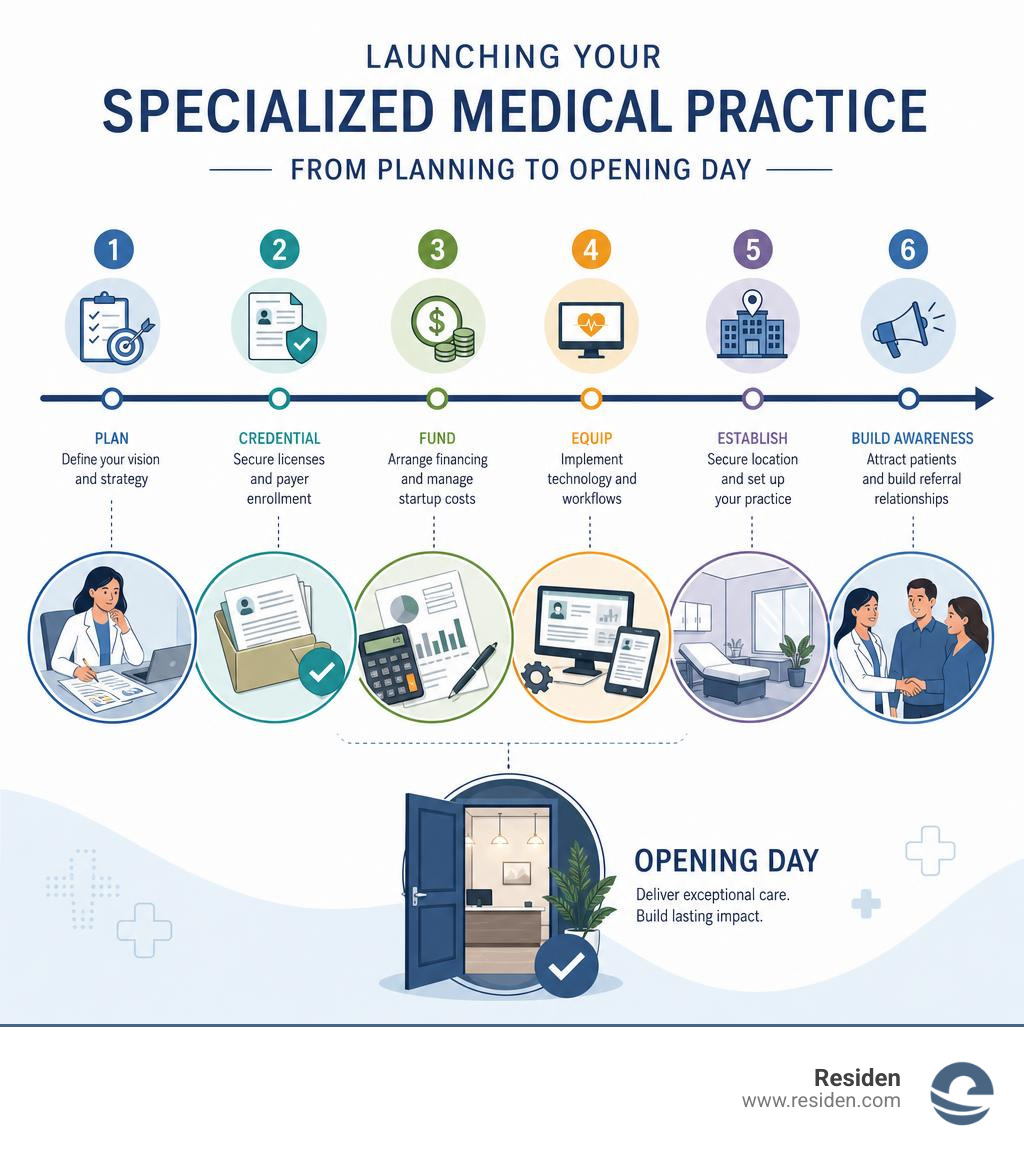
Here's a quick overview of what launching a specialized practice actually involves:
- Business planning — Define your vision, legal structure, and financial projections
- Credentialing and licensing — Expect 90–120 days minimum for insurance payer enrollment
- Funding — Startup costs typically range from $150,000 to $500,000 depending on specialty and location
- Technology — Choose an EHR, billing software, and patient engagement tools early
- Location — Decide between a traditional lease, build-out, or flexible medical coworking space
- Marketing — Build referral networks and an online presence before you open your doors
The good news? You are not starting from zero. With 44% of patient-care physicians working in private practice, there's a well-worn path — and real tools to make the journey faster and less costly.
The challenge is that specialized practices face higher barriers than primary care. More expensive equipment, narrower patient pipelines, longer credentialing timelines, and tighter referral dependencies all add complexity. And for physicians who've spent years in employed or group settings, the business side can feel overwhelming.
That's exactly what this guide is designed to solve.
I'm Dr. Jessica Wu, a Harvard-trained dermatologist who has run my own private practice in Los Angeles for over 20 years — navigating every phase of a specialized medical practice startup firsthand, from credentialing to building a referral network to scaling without losing clinical quality. In the sections below, I'll walk you through each step of the process with the clarity and practicality I wish I'd had when I started.
Planning and Legal Foundations

Every successful specialized medical practice startup begins with a clear, written business plan. This isn't just a document you draft to satisfy a bank manager; it is your practice's operational blueprint. A comprehensive business plan defines your practice vision, conducts a deep dive into local market demographics, analyzes your competitors, and sets realistic financial projections.
For specialists moving from a large group practice or hospital system to independent ownership, this planning phase is also a psychological transition. You are moving from a system where operational decisions were made for you to one where you have total control. To navigate this shift successfully, we highly recommend mapping out the entire patient journey—from the moment a patient finds your website to their clinical check-out and follow-up billing.
If you are wondering if taking this leap is right for you, read our guide on Starting Your Own Practice to understand the personal and professional milestones involved in going independent.
Legal Structures for a Specialized Medical Practice Startup
Choosing how to structure your business is one of the first and most critical decisions you will make. This choice dictates your personal liability, tax obligations, and how you can distribute profits or bring on future partners.
While general businesses might opt for a standard Limited Liability Company (LLC), medical practices face unique regulatory constraints. In California, for example, the "corporate practice of medicine" doctrine prohibits general corporations or standard LLCs from practicing medicine. Instead, physicians in Los Angeles and Beverly Hills must establish a Professional Corporation (PC) or operate as a Sole Proprietorship or Partnership.
- Sole Proprietorship: The simplest structure to set up, but it offers zero personal liability protection. Your personal assets are tied directly to the practice's liabilities.
- Partnership: Suitable if you are launching with another physician, but it requires a airtight partnership agreement to govern decision-making and profit-sharing.
- Professional Corporation (PC): The gold standard for independent specialists. A PC protects your personal assets from the business debts and general liabilities of the practice (though it does not shield you from personal malpractice liability).
Because the tax and liability implications are complex, seeking Expert guidance on physician business solutions from legal and financial professionals who specialize in medical practices is a vital step in protecting your clinical future.
Regulatory and Compliance Requirements
Healthcare is one of the most heavily regulated industries in the United States. When you launch a specialized practice, compliance cannot be an afterthought. You must establish robust protocols from day one to protect your patients and your license.
Key regulatory frameworks include:
- HIPAA Compliance: You must secure Protected Health Information (PHI) across all digital and physical systems. This means signing Business Associate Agreements (BAAs) with every software vendor, encrypting patient records, and training your staff on privacy protocols.
- OSHA Standards: Your physical office must comply with safety regulations, including biohazard waste disposal, infection control, and workplace safety training.
- DEA and State Licensing: You must update your Drug Enforcement Administration (DEA) registration and state medical board licenses to reflect your new business address.
- California Medical Board Regulations: Ensure your practice advertising, patient consent forms, and record retention policies fully align with California state laws.
Financial Planning for a Specialized Medical Practice Startup
The financial reality of launching a specialized clinic depends heavily on your field. A child psychiatrist may only need a quiet office and an EHR, while a gastroenterologist or cardiologist faces massive capital requirements for specialized diagnostics and procedure suites.
Nationwide, startup costs for a new medical practice typically range from $150,000 to $500,000. In high-cost metro areas like Los Angeles, Beverly Hills, and Brentwood, those numbers can climb significantly higher if you opt for a traditional commercial lease and custom clinic build-out.
To fund your launch, you will likely need to explore a combination of personal capital, traditional medical practice loans, and Small Business Administration (SBA) loans. When presenting your business plan to lenders, you must include a realistic working capital reserve to cover your operating expenses during the first 6 to 12 months, as insurance reimbursements can take months to flow in.
| Expense Category | Traditional Commercial Lease (Beverly Hills / LA) | Residen Flexible Medical Coworking |
|---|---|---|
| Upfront Security Deposit | 3–6 months rent ($15,000 – $45,000+) | $0 |
| Clinic Build-Out & Permits | $100,000 – $250,000+ | $0 (Move-in ready) |
| Medical & Office Equipment | $50,000 – $150,000+ | Included (Exam tables, basic supplies) |
| Monthly Fixed Rent & CAM | $5,000 – $15,000/month | $0 (Pay-as-you-go hourly/daily rates) |
| IT & HIPAA Utilities | $1,500 – $3,000 upfront | Included (High-speed secure Wi-Fi) |
| Time to First Patient | 6 – 12 months | Same month |
Estimating Initial Capital and Equipment Costs
When estimating your startup costs, separate your "must-haves" from your "nice-to-haves." High-end diagnostic machines can often be leased rather than purchased outright, which preserves your cash flow. Additionally, you must allocate funds for clinical infrastructure—such as medical-grade refrigeration, sterilization equipment, and a secure IT network.
Always build a 15% to 20% contingency fund into your initial capital estimates. Unexpected construction delays, credentialing lag, or delayed equipment shipments can quickly drain your reserves if you haven't planned for a buffer.
Despite the upfront financial hurdle, the long-term rewards of autonomy and financial upside are immense. To learn more about why so many doctors are choosing this path, explore the perks of private practice.
Credentialing, Insurance, and Revenue Cycle Management

Getting paid for clinical care has never been more challenging. In fact, 60% of medical group leaders reported an increase in claim denial rates in 2024 compared to 2023. For a new specialized practice, a high denial rate in your first few months can be financially devastating.
To protect your cash flow, you must establish a highly efficient revenue cycle management (RCM) system. This starts with understanding the nuances of commercial insurance, Medicare, and patient billing. Before you see your first patient, make sure you read up on what new physicians need to know about billing insurance to avoid common coding and submission pitfalls.
Navigating the Credentialing Timeline
Insurance credentialing and provider enrollment is the single biggest bottleneck for a specialized medical practice startup. On average, insurance credentialing can take 90 to 120 days—and in many cases, it can stretch to four to six months.
To expedite the process:
- Keep your CAQH profile updated: Ensure your Council for Affordable Quality Healthcare (CAQH) profile is completely up-to-date and re-attested.
- Apply for your new NPI: You will need a Type 2 National Provider Identifier (NPI) for your business entity, in addition to your individual Type 1 NPI.
- Submit applications early: Do not wait for your physical office build-out to finish. You can often begin the credentialing process as soon as you have a verified business address.
Because navigating payer contracts and fee schedules is incredibly tedious, many specialists choose to work with a Full-service practice startup consulting firm to handle negotiations and secure higher initial reimbursement rates.
Infrastructure and Technology Decisions
Modern specialized practices must leverage digital tools to remain competitive and efficient. Gone are the days of bulky on-premise servers; today's independent practices run on agile, cloud-based systems that reduce upfront hardware costs and ensure your data is accessible from anywhere.
One of the most exciting shifts in practice infrastructure is the rise of clinical AI. Forward-thinking specialists are using Innovative clinical AI solutions to automate administrative tasks, draft prior authorizations, and streamline patient communications, freeing up hours of clinical time each week.
Technology Essentials for a Specialized Medical Practice Startup
Your digital stack should be fully integrated to prevent administrative fragmentation. When selecting your core systems, prioritize:
- EHR and Practice Management: Choose a specialty-specific Electronic Health Record (EHR) system that templates the specific workflows, clinical codes, and charts you use daily.
- Patient Portals: A secure portal allows patients to schedule appointments, fill out intake forms, and view lab results online, significantly reducing inbound phone calls.
- Telehealth Integration: Ensure your clinical platform supports secure, HIPAA-compliant video visits for follow-ups or initial consultations.
- Automated Patient Engagement: Implementing automated text reminders and follow-up emails can reduce patient no-shows by 30% to 50%, protecting your daily schedule.
Location Selection and Facility Planning
Your physical location is more than just an address—it is a critical driver of patient acquisition and operational flow. When searching for medical office space in Los Angeles, you must consider local patient demographics, parking availability, public transit access, and medical zoning laws.
For a complete breakdown of what to look for in a physical space, read our comprehensive guide on everything you need to know about medical office rental space.
Traditional Leases vs. Flexible Medical Coworking
Historically, starting a specialized practice meant signing a 5- to 10-year commercial lease, paying hundreds of thousands of dollars for construction, and waiting months for permits. For new specialists, this represents an immense financial risk.
Fortunately, there is a modern alternative: flexible medical coworking.
At Residen, we provide turnkey, shared medical office rentals (including fully equipped exam, procedure, and consultation rooms) designed specifically for healthcare professionals in Los Angeles. Located in prime medical hubs like Beverly Hills (433 N Camden Dr Suite 610) and Brentwood, our spaces allow you to book rooms on an hourly or daily basis.
There are no long-term leases, no hidden fees, and no setup costs. You get access to a beautifully designed, patient-friendly space with secure high-speed Wi-Fi, clinical supplies, and a professional medical environment from day one.
If you want to compare your local options, check out our Medical office space for rent Los Angeles area guide to see how flexible spaces compare to traditional real estate.
Marketing and Building Referral Networks
Unlike primary care clinics that attract patients through general geographic convenience, specialized practices rely heavily on targeted referral networks and specialized digital marketing.
To build a robust patient pipeline:
- Nurture Physician Referral Networks: Visit local primary care doctors, introduce your specialty, and explain how you can help their patients. Make the referral process as friction-free as possible.
- Optimize Local SEO: Ensure your Google Business Profile is fully optimized for your specific location (e.g., "Neurologist in Beverly Hills").
- Build a Professional Website: Your website should clearly outline your clinical expertise, accepted insurances, and patient testimonials.
If you want to start generating revenue quickly, read our guide on how to start seeing patients this month for actionable patient acquisition strategies.
Frequently Asked Questions about Specialized Medical Practice Startups
How much does it cost to start a specialized medical practice?
Startup costs typically range from $150,000 to $500,000. However, by leveraging flexible medical coworking spaces like Residen, you can bypass upfront construction, security deposits, and long-term lease commitments, reducing your initial setup costs by up to 80%.
How long does the insurance credentialing process take for specialists?
The credentialing and commercial insurance contracting process typically takes 90 to 120 days. Because delays are common, we recommend starting this process at least 4 to 6 months before your planned opening date.
How can new specialists maintain work-life balance during the startup phase?
Maintaining balance requires delegating non-clinical tasks, utilizing integrated clinical technology, and avoiding the administrative burden of managing a massive, empty physical office. For practical tips on avoiding burnout, read our strategies for maintaining work-life balance.
Conclusion
Launching a specialized medical practice startup is a profound step toward professional autonomy, clinical excellence, and business sustainability. While the traditional path to private practice is filled with financial risk and administrative hurdles, you don't have to navigate it alone.
With Residen, you can launch your practice in Los Angeles, Beverly Hills, or Brentwood without the burden of a traditional commercial lease. Our turnkey, shared medical office rentals give you the flexibility to see patients in fully equipped, professional suites on your own terms.
Ready to take control of your medical career? Get started with Residen today and build the practice you've always envisioned.