
The Ultimate Checklist for AI Tools for Independent Physicians
Why Independent Physicians Can't Afford to Ignore AI in 2026

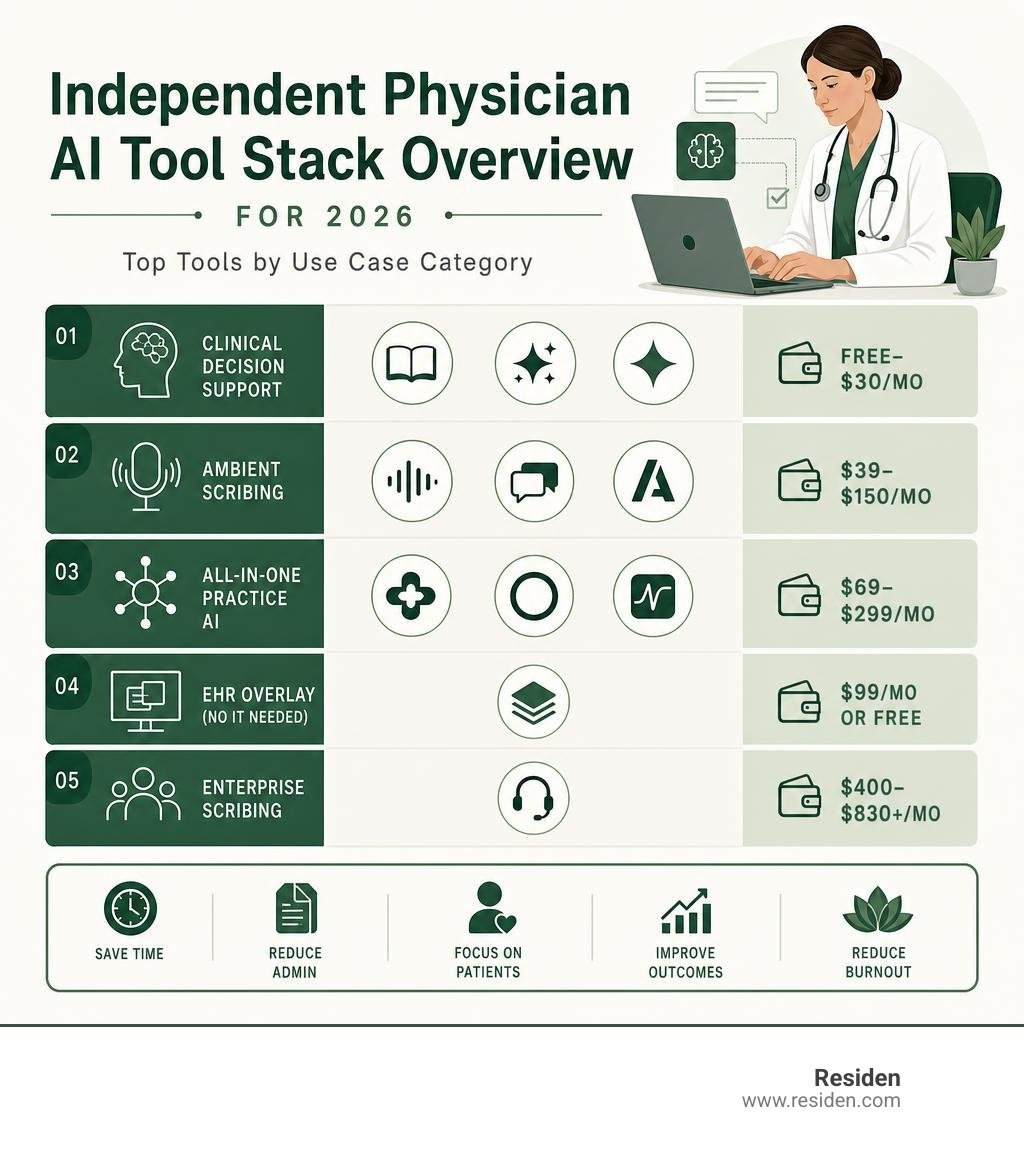
The best AI tools for independent physicians in 2026 come down to a short list of high-impact platforms — here's a quick snapshot before we dive deeper:
| Use Case | Top Tools | Estimated Cost |
|---|---|---|
| Clinical decision support | OpenEvidence, GPT-5.2, Gemini 3.1 Pro | Free–$30/mo |
| Ambient scribing | Freed AI, Heidi Health, Abridge | $39–$150/mo |
| All-in-one practice AI | DeepCura, OmniMD, Synic AI | $69–$299/mo |
| EHR overlay (no IT needed) | Medroid | $99/mo or free |
| Enterprise scribing | DAX Copilot | $400–$830+/mo |
Running an independent practice in 2026 means wearing every hat — clinician, admin, and IT department all at once.
And the documentation never stops.
For every hour spent with patients, physicians spend nearly two hours on charts, coding, and paperwork. A lot of that spills into evenings and weekends. It's one of the biggest drivers of burnout among solo and small-practice physicians.
AI is changing that — but not always in the way you'd expect.
The tools making the biggest difference aren't coming from hospital IT departments. According to a survey of 1,000+ physicians, 67% now use AI daily, and 81% say their employer's AI rollout is too slow. So doctors are solving the problem themselves, building their own personal tech stacks with subscriptions they pay for out of pocket.
The challenge? There are dozens of tools to choose from — scribes, agents, clinical search tools, all-in-one platforms — and they vary wildly in cost, accuracy, and how well they actually fit an independent practice workflow.
I'm Dr. Jessica Wu, a dermatologist with over 20 years of private practice experience in Los Angeles, and I've spent considerable time evaluating the best AI tools for independent physicians to separate the genuinely useful from the overhyped. In this guide, I'll walk you through exactly what works — and what to skip.
The Grassroots AI Shift: Why Independent Doctors Are Building Personal Tech Stacks
We are seeing a major bottom-up revolution in how medical technology is adopted. Historically, healthcare IT was defined by multi-million dollar, top-down enterprise software rollouts that left clinicians pulling their hair out. In 2026, the story is entirely different. Frontline clinicians are bypassing slow institutional review boards to assemble their own personalized AI stacks using personal subscriptions.
A massive 67% of physicians now use AI in their daily work, spanning 71 unique AI tools across 106 specialties. The driver behind this grassroots shift is simple: 81% of physicians express dissatisfaction with their employer's AI rollout speed. When you are drowning in charts at 9:00 PM in your home office in Beverly Hills, you cannot afford to wait eighteen months for a hospital committee to approve a pilot program.
For the independent physician, building a lean, highly efficient practice is the only way to survive and thrive. When you run a private practice, you must find Simple Ways to Run the Lean Medical Practice to keep overhead low while keeping patient care standards exceptionally high. By adopting nimble, self-serve AI tools, solo practitioners can eliminate hours of administrative busywork without hiring more support staff. According to The 10 AI Tools Doctors Actually Use Daily (Ranked by Real Physicians), physicians are taking control of their own technology stacks because their immediate workflow needs — specifically documentation and decision support — are not being met by legacy EHR vendors.
The Best AI Tools for Independent Physicians: Grassroots vs. Enterprise Solutions
When evaluating the best AI tools for independent physicians, it is critical to understand the divide between grassroots, self-serve applications and enterprise-locked systems.
Enterprise solutions like Microsoft Nuance's DAX Copilot or enterprise-tier Abridge are designed for massive hospital systems. They are incredibly powerful, but they come with significant friction for a solo practitioner:
- High Financial Commitments: DAX Copilot is estimated to cost between $400 to $830+ per provider per month, often requiring a 12-month contract.
- Implementation Bottlenecks: They typically require deep, native EHR integrations that demand a dedicated IT department to configure and maintain.
- Sales Walls: You cannot simply enter a credit card and start using them; you must go through lengthy sales calls and enterprise procurement cycles.
On the other side of the fence are grassroots tools like OpenEvidence, Freed AI, Heidi Health, Claude, and ChatGPT. These tools are built for immediate value:
- Affordable and Transparent Pricing: Freed AI ranges from $39 to $119 per month, while Heidi Health has a highly functional entry tier starting around $99 per month.
- Zero IT Required: They operate as web applications, mobile apps, or browser overlays that you can set up in under five minutes.
- No Contract Lock-ins: Most offer monthly subscriptions that you can cancel at any time, allowing independent practices to remain financially agile.
Clinical Decision Support: General LLMs vs. Specialized Medical AI
One of the most fascinating developments in 2026 is the head-to-head battle between general-purpose frontier Large Language Models (LLMs) and specialized, domain-specific clinical AI tools.
For years, the conventional wisdom was that healthcare required highly specialized, medically tuned AI models. However, recent benchmark data has completely debunked this myth. Frontier general-purpose LLMs — such as GPT-5.2, Gemini 3.1 Pro, and Claude Opus 4.6 — consistently outperform specialized clinical AI tools like OpenEvidence and UpToDate Expert AI across multiple rigorous evaluation benchmarks:
- MedQA Benchmark (Medical Knowledge): Gemini 3.1 Pro achieved an astonishing 97.4% accuracy, outperforming GPT-5.2 (94.2%), Claude Opus 4.6 (90.2%), OpenEvidence (89.6%), and UpToDate Expert AI (88.4%).
- HealthBench Benchmark (Clinical Safety & Alignment): On a scaled 0–100 rubric, GPT-5.2 scored 88.0, whereas OpenEvidence scored 62.6 and UpToDate Expert AI scored 61.3.
- Real Clinical Queries (RCQ): When evaluated on real-world questions submitted by practicing physicians in live clinical environments, Gemini scored 3.62 out of 4, while specialized tools like OpenEvidence (3.24) and UpToDate Expert AI (3.17) lagged behind.
Why do general-purpose LLMs outperform tools designed specifically for medicine? The answer lies in scale, alignment, and superior cross-domain reasoning. Frontier models benefit from billions of dollars of continuous investment, allowing them to synthesize complex clinical scenarios and coordinate multi-step logic better than smaller, medically tuned models.
Furthermore, specialized clinical tools often rely heavily on Retrieval-Augmented Generation (RAG) to anchor their answers to specific medical journals or databases. While RAG is excellent for preventing completely fabricated answers, it can sometimes degrade performance if irrelevant material is poorly integrated by the base model. Additionally, specialized tools are often overly conservative to avoid liability. For example, UpToDate Expert AI refused to answer 19% of real clinical queries, compared to a refusal rate of just 1% to 3% for frontier LLMs.
Evaluating the Best AI Tools for Independent Physicians for Clinical Research
While general-purpose LLMs win on raw reasoning benchmarks, specialized clinical AI tools still hold a massive practical advantage in daily clinical workflows: verifiable evidence mapping.
If you use ChatGPT to help formulate a differential diagnosis for a complex patient presentation in your Brentwood clinic, you cannot easily verify where it got its information without manually double-checking the medical literature. This is where OpenEvidence shines. OpenEvidence accounts for 44.9% of all reported physician AI usage, making it the single most-used AI tool among doctors. It pairs a sophisticated search layer with an AI interface, providing direct, peer-reviewed citations for every single claim it makes.
For independent practices, using a platform like Medroid allows you to run these evidence lookups directly alongside your active patient chart via a secure web overlay. This ensures that you can practice evidence-based medicine at lightning speed without constantly switching tabs or risking hallucination-driven errors.
Ambient Documentation and the Rise of Reflective Ambient Intelligence (RAI)
It is no surprise that 65% of physicians prioritize documentation and scribing support as their top AI use case. Charting is the single greatest administrative drain on our time.
Traditional ambient AI scribes work by listening to the conversation between the doctor and the patient, transcribing the dialogue, and formatting it into a standard SOAP (Subjective, Objective, Assessment, Plan) note. While this saves clinicians an estimated 1 to 2 hours per day, it often introduces a new problem: the "glorified editor" trap.
Because traditional scribes simply transcribe what is spoken aloud, they often miss the physician's underlying clinical reasoning. If you do not verbally state every detail of your medical decision-making (MDM) process during the encounter, the scribe cannot document it. This leaves the physician spending valuable after-hours time heavily editing, correcting, and rewriting the generated notes to ensure they are medically accurate and legally defensible.
This is where Reflective Ambient Intelligence (RAI) represents a massive paradigm shift.
RAI (pioneered by systems like Praxis EMR) goes beyond simple ambient transcription. Instead of merely recording words, RAI understands clinical context, physician intent, and medical judgment. It learns from your unique clinical patterns template-free. When you use an RAI system, it reflects your actual clinical reasoning in real time. It minimizes the editing burden because it captures not just what was said, but what you intended based on your historical charting patterns and clinical expertise.
By shifting from a basic transcription tool to an intelligence tool that preserves physician authorship, you can reclaim true joy, Blog: What is Joy in Medicine? — which is about spending your day focused on the patient in front of you, rather than acting as a data entry clerk or an AI proofreader.
Comparing Scribes, Agents, and All-in-One Platforms
To help you navigate the highly fragmented marketplace, we have broken down the primary categories of clinical AI tools available to independent practices in 2026:
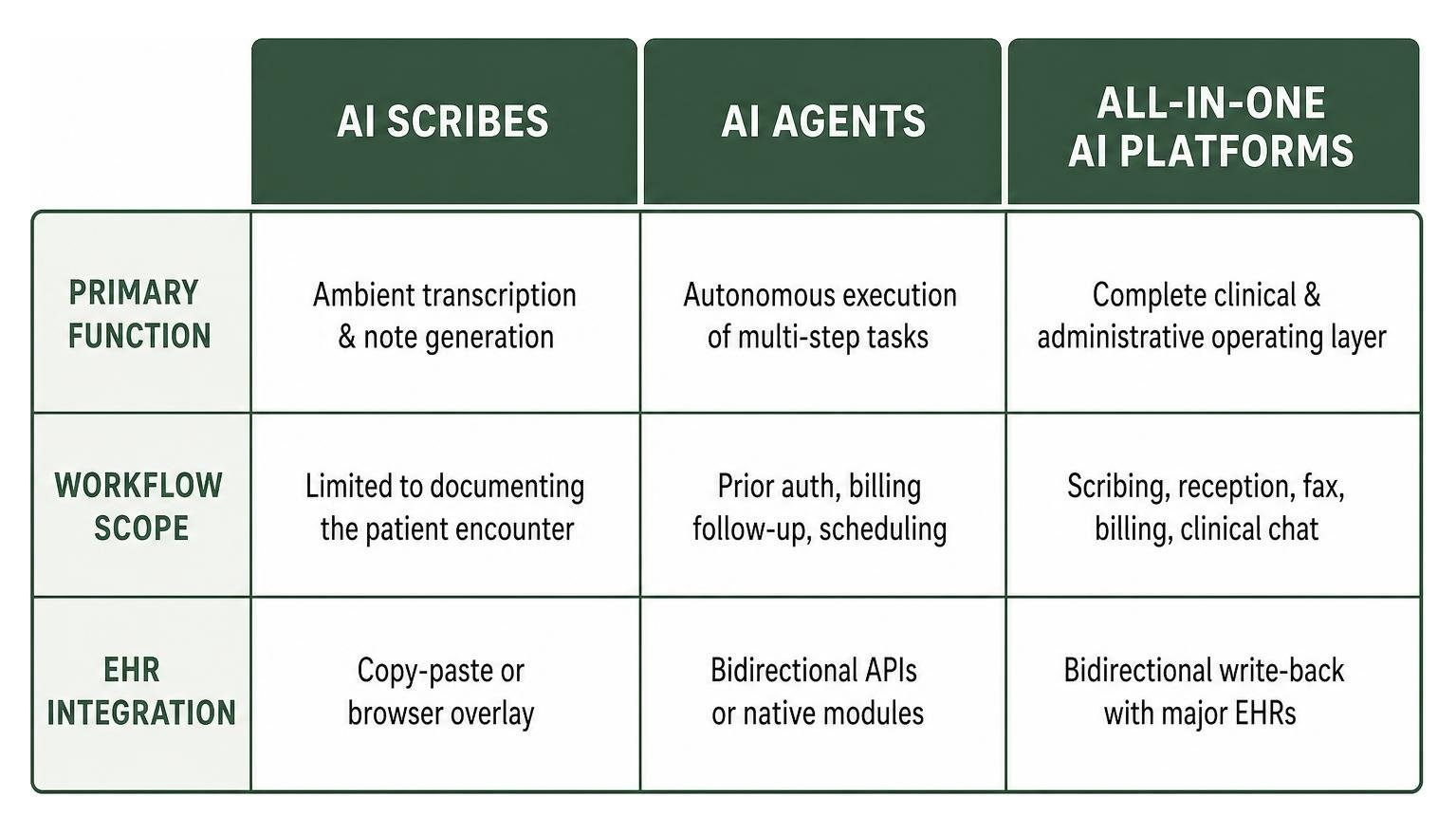
| Feature | AI Scribes (e.g., Freed AI, DocuMed AI) | AI Agents (e.g., OmniMD, Prosper AI) | All-in-One AI Platforms (e.g., DeepCura, Synic AI) |
|---|---|---|---|
| Primary Function | Ambient transcription & note generation | Autonomous execution of multi-step tasks | Complete clinical & administrative operating layer |
| Workflow Scope | Limited to documenting the patient encounter | Prior auth, billing follow-up, scheduling | Scribing, reception, fax, billing, clinical chat |
| EHR Integration | Copy-paste or browser overlay | Bidirectional APIs or native modules | Bidirectional write-back with major EHRs |
| Cost Profile | $39–$119/month | Enterprise pricing / custom quotes | $69–$129/month |
| IT Requirement | None (Self-serve) | Moderate to High | Low (Chrome extensions & desktop apps) |
For solo practices looking for a highly reliable, clinician-led option focused purely on documentation, The Best AI Medical Scribe for Physicians – DocuMed AI stands out. It delivers 99%+ clinical accuracy in understanding complex medical terminology across multiple specialties and saves clinicians upwards of 40 hours monthly by automating progress notes, referral letters, and after-visit summaries.
The Best AI Tools for Independent Physicians: Scribes, Agents, and All-in-One Platforms
As we move through 2026, the trend is shifting away from single-purpose "point tools" and toward software consolidation. The average small-to-midsize US medical practice currently runs between 8 and 12 separate software platforms (EHR, scheduling, billing, patient portal, fax, etc.). This fragmentation is a primary driver of staff burnout and revenue leakage.
This is why agentic AI and all-in-one platforms are gaining rapid traction. Unlike a passive AI scribe that simply documents a visit and stops, an AI agent can execute multi-step workflows autonomously. For example, an AI billing agent can review a generated SOAP note, automatically assign the correct ICD-10 and CPT codes, check the patient's insurance rules, submit the claim, and follow up on payer denials without requiring manual intervention from your billing staff.
Several standout platforms are leading this consolidated charge for independent practices:
- DeepCura ($129/month): This is currently the only platform on the market that combines ambient scribing, an AI receptionist, AI faxing, billing, clinical chat, and bidirectional write-back with 9+ EHR systems in a single subscription. It completely eliminates the need to pay for multiple separate software subscriptions.
- Synic AI ($69/month): Positioned as the "AI operating layer for independent physicians," Synic AI - Clinical Workflow AI for Physicians replaces the fragmented tech stack by connecting pre-visit intake, ambient scribing, medical coding, and prior authorization into a single, cohesive, secure system.
- Longevity AI (Florence): For practices focusing on preventive, functional, or precision medicine, AI Medical Assistant for Solo & Independent Doctors | Longevity AI is a game-changer. Rather than just transcribing visits, its AI assistant, Florence, integrates continuous lifestyle data from wearables (Apple Watch, Oura, Dexcom) with clinical lab PDFs to automatically extract biomarkers, track health trajectories, and draft comprehensive, 100-page white-labeled patient longevity reports in seconds.
EHR Integration and Workflow Optimization Without IT Support
The absolute biggest hurdle for any independent physician adopting new technology is integration. We do not have IT departments to write custom APIs or negotiate with legacy EHR vendors.
Fortunately, modern AI tools have solved this through browser overlay technology.
By using secure Chrome extensions or lightweight desktop applications, tools like Medroid run directly on top of your existing web-based EHR (such as Athenahealth, Elation, or web-based Epic). You do not need vendor approval, complex API setups, or IT support. You simply install the extension, log in, and the AI assistant appears as a sidebar next to your charting screen. It can capture the audio from your patient encounter, draft the note, and allow you to transfer the finalized text into your EHR with a single click.
If you are Starting Your Own Practice in the Los Angeles area, leveraging these overlay technologies allows you to keep your initial software implementation costs incredibly low while matching the technological capabilities of a major health system from day one.
Frequently Asked Questions About Healthcare AI
Choosing the right AI platform requires careful due diligence, especially regarding security and regulatory compliance.
Is ChatGPT HIPAA compliant for medical use?
No, standard ChatGPT is not HIPAA compliant. To use any software with Protected Health Information (PHI), the vendor must sign a Business Associate Agreement (BAA) promising to uphold HIPAA-aligned administrative, physical, and technical safeguards. OpenAI does not offer a BAA for its standard consumer or ChatGPT Plus tiers. Inputting patient names, clinical histories, or identifiable details into standard ChatGPT is a direct violation of federal law.
If you want to use frontier models like GPT-5.2 or Claude Opus 4.6 for clinical tasks, you must do so through a dedicated medical interface (like DeepCura or Medroid) that has a signed BAA in place, or use enterprise-grade APIs configured specifically for HIPAA compliance.
How do independent physicians integrate AI without an IT department?
Independent physicians can integrate AI in minutes by selecting tools that utilize browser extensions (like Chrome overlays) or standalone mobile apps. These tools require zero backend integration with your EHR. They capture the audio via your smartphone or computer microphone, generate the structured clinical note in their own secure portal, and allow you to copy and paste the text directly into your EHR chart. It requires no technical expertise and is completely self-serve.
What is the difference between an AI scribe and an AI agent?
An AI scribe is a passive tool. It listens to a conversation and generates a static summary or clinical note. It does not take any actions outside of documentation.
An AI agent is an active, autonomous workflow engine. Once the clinical note is created, the agent can automatically execute follow-up tasks, such as sending a referral letter to a specialist, submitting a prior authorization request to an insurance payer, scheduling the patient's next follow-up appointment, or analyzing billing codes to prevent claim denials.
Conclusion: Designing a Modern, Lean Private Practice
Deploying the best AI tools for independent physicians is only half the equation when building a highly efficient, modern medical practice. The other half is optimizing your physical footprint and overhead costs.
For independent physicians, specialists, and wellness practitioners in Southern California, traditional long-term commercial medical office leases are a massive financial burden. They require years of commitment, expensive build-outs, and heavy administrative staffing to manage.
That is where we come in. At Residen, we provide turnkey, shared medical office rentals in premier Los Angeles locations, including Beverly Hills (at 433 N Camden Dr Suite 610) and Brentwood.
Our spaces are fully equipped, beautifully designed, and completely patient-friendly. We offer flexible hourly or daily bookings with absolutely no long-term leases, membership fees, or setup costs. Whether you are seeing patients one day a week or building a full-time private practice, Residen allows you to run an incredibly lean operation.
By pairing the flexible medical real estate of Residen with the cutting-edge efficiency of modern clinical AI tools, you can eliminate up to 80% of traditional practice overhead. You get to focus entirely on what you do best: providing exceptional, personalized care to your patients without the administrative and financial burnout.
Ready to see how simple running a modern private practice can be? Get Started with Residen today and book your premium medical space in Beverly Hills or Brentwood on your own terms.