
How to Start Seeing Patients This Month: 5 Methods
You Don't Need a Long-Term Lease to Start Seeing Patients This Month

How to Start Seeing Patients This Month (Without a Long-Term Lease) is entirely possible in 2026 — and faster than most physicians realize.
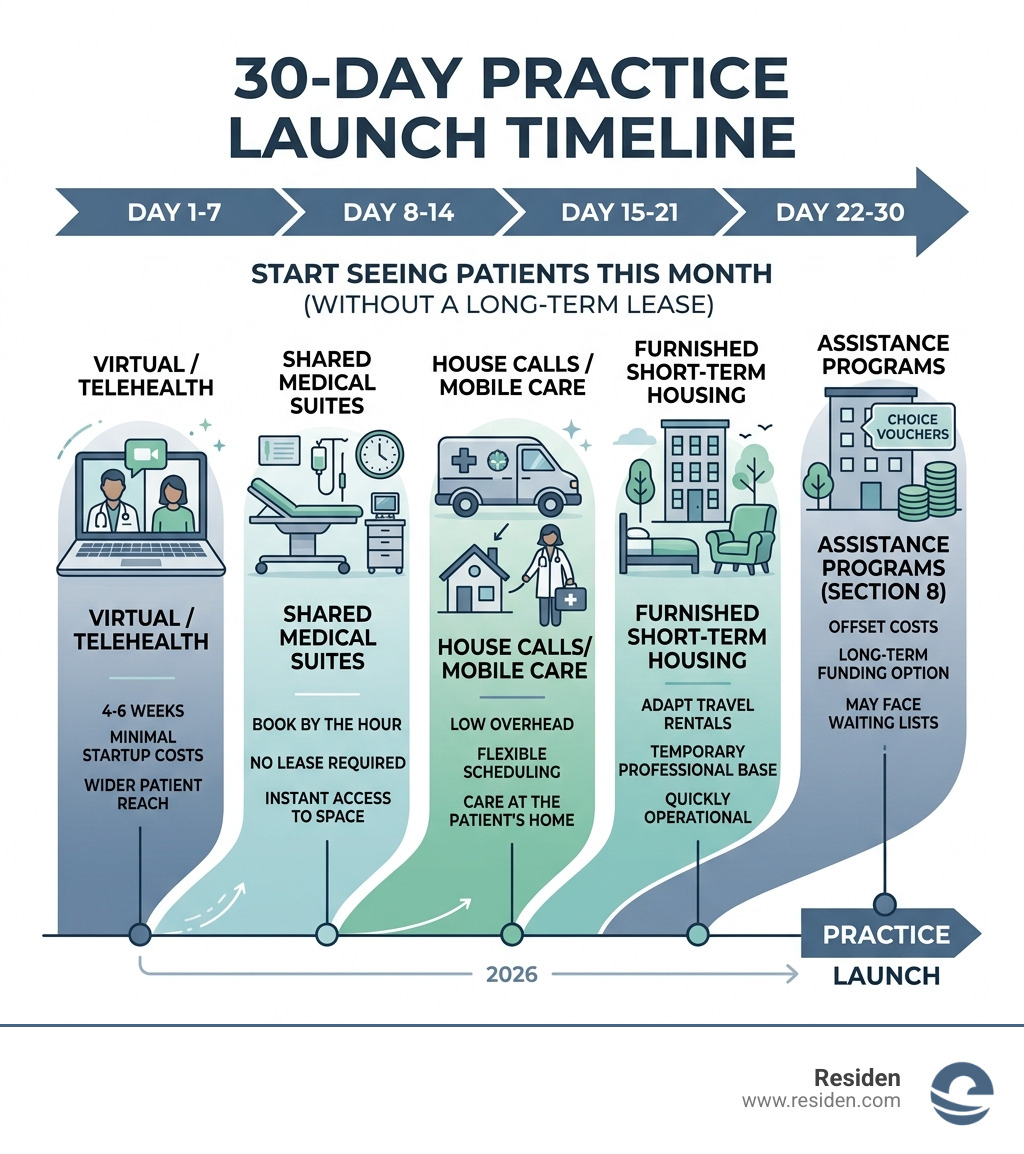
Here are the five main ways to do it:
- Launch a virtual/telehealth practice — see patients in 4-6 weeks with minimal startup costs
- Book a shared medical suite — rent exam or consultation rooms by the hour, no lease required
- Make house calls or use mobile care — low overhead, flexible scheduling
- Use furnished short-term housing — adapt travel nurse-style rentals for a temporary professional base
- Access assistance programs — Housing Choice Vouchers (Section 8) can offset costs, though waiting lists apply
Traditional practice setup can take 90 days or more — and cost $70,000 to $500,000 to launch. But these methods let you skip the long lease, skip the buildout, and start caring for patients this month.
The biggest barrier most independent clinicians face isn't clinical — it's logistical. Where do you see patients when you're not ready to sign a five-year lease? How do you keep overhead low while you build your panel? These are real questions, and they have real answers that don't require a massive upfront commitment.
I'm Dr. Jessica Wu, a Los Angeles-based dermatologist who has practiced privately for over 20 years — including making house calls to Hollywood film sets — so I understand what it takes to start seeing patients this month without a long-term lease by building a flexible, autonomous practice from the ground up. In the sections below, I'll walk you through each method so you can choose what fits your specialty, budget, and timeline.
Methods 1 & 2: Virtual Practice and Medical Coworking
The fastest way to open your doors this month is to remove the physical door entirely—or share one with someone else. Digital and collaborative models allow you to bypass the 90-day "operational slog" of traditional real estate.
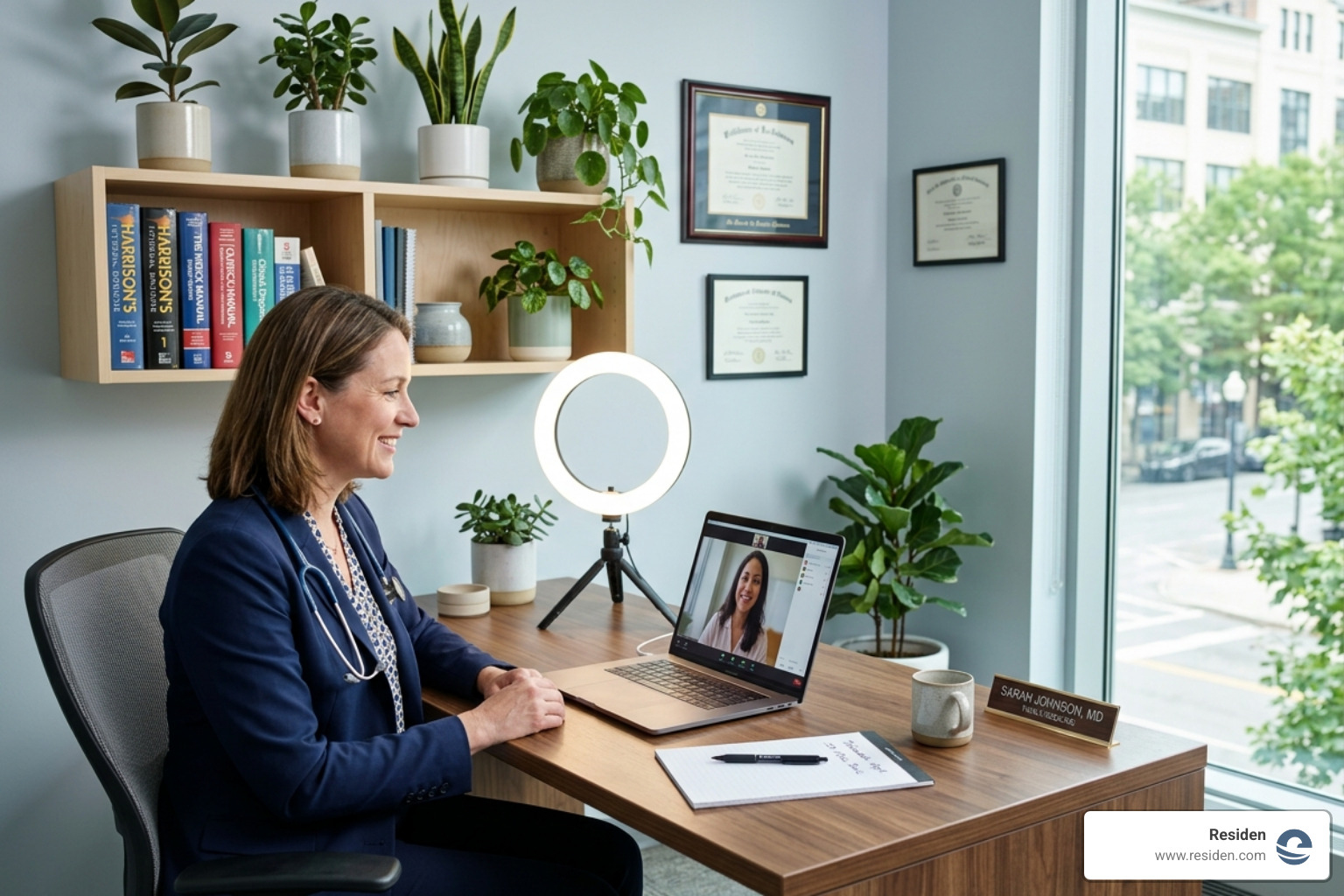
How to Start Seeing Patients This Month (Without a Long-Term Lease) via Telehealth
If you focus on a private-pay or "cash-pay" model, you can build a telehealth private practice from scratch in 2026 in as little as four to six weeks. Telehealth is no longer just for "urgent care" sniffles; it is a viable long-term model for psychiatrists, neurologists, dermatologists, and even cardiologists using remote monitoring tools.
To hit the ground running this month, we recommend focusing on niche selection. Trying to be a "generalist for everyone" makes marketing expensive and slow. Instead, pick a hyper-specific niche—like postpartum anxiety or adult ADHD—which allows you to command higher rates and find patients faster through targeted directories.
Your "tech stack" is your new office. Rather than stitching together Zoom and PayPal, use an all-in-one platform. According to research on how to launch a virtual medical practice for any specialty in under 30 days, using a unified system for scheduling, HIPAA-compliant video, and billing reduces your setup time by 70%. When starting your own practice, your biggest asset is your time; don't waste it playing IT support for yourself.
How to Start Seeing Patients This Month (Without a Long-Term Lease) with Shared Suites
For many of us, physical exams are non-negotiable. You can't palpate an abdomen or perform a biopsy through a webcam. This is where medical coworking or shared suites become a game-changer.
Instead of signing a five-year commercial lease that requires a personal guarantee and a $100,000 buildout, you can utilize medical office space for rent in the Los Angeles area on an as-needed basis. These are turnkey, fully furnished spaces that meet all clinical standards.
At Residen, we provide medical exam rooms, consultation rooms, and medical procedure rooms that you can book by the hour or day. There are no membership fees or long-term commitments. This "on-demand" model is perfect for:
- New Physicians: Launching a practice without debt.
- Specialists: Who only need physical space one or two days a week.
- Surgical Specialists: Who need a professional setting for pre-op and post-op visits.
Understanding the shared medical office space pros and cons for healthcare professionals is vital. The "pro" is obvious: zero overhead when you aren't seeing patients. The "con" is that you share a waiting room, but in a premium environment like Beverly Hills or Brentwood, this often feels more like a luxury lounge than a cramped clinic.
How to Start Seeing Patients This Month (Without a Long-Term Lease) Using Flexible Infrastructure
If you aren't ready for a suite but need to see patients in person, you can take the "office" to the patient. This method has the lowest barrier to entry because your "lease" is essentially your car and a high-quality medical bag.
Adapting Short-Term Housing for Professional Use
While it sounds unconventional, the travel nurse industry has created a massive market for furnished, short-term housing that clinicians can leverage. Platforms like Furnished Finder or Airbnb are frequently used by traveling professionals who need a "home base" that is professional and clean.
In areas like Beverly Hills, short-term rentals are regulated, but month-to-month furnished apartments can serve as a temporary administrative office or a place to conduct virtual visits. Travel nurse housing stipends, which can range from $700 to $5,000 per month, prove that the market is designed for high-income professionals who need flexibility. By opting for these rentals, you maintain lower overhead while you scout for a more permanent (but still flexible) solution.
Negotiating Flexible Rental Terms
If you do find a small space you love, don't assume the "Standard 5-Year Lease" is your only option. We've seen many five mistakes physicians make when leasing medical office buildings, and the biggest is failing to negotiate for a shorter "test" period.
When talking to landlords for small, non-traditional spaces, emphasize that you are a low-impact, high-credit tenant. Offer to pay a slightly higher monthly rate in exchange for a month-to-month or six-month term. In 2026, many landlords are more open to "flexible" tenants than they were a decade ago. Use a starting a medical practice checklist to ensure any space you consider has the right zoning and "HQS" (Housing Quality Standards) if you intend to see patients there.
For a comprehensive look at the legalities, check out our complete checklist for starting a medical office.
Method 5: Utilizing Subsidized Housing and Assistance Programs
For some practitioners, especially those serving specific demographics or starting in lower-income areas, government programs can provide a surprising amount of stability. The Housing Choice Voucher (HCV) program, often called Section 8, isn't just for long-term residents; it includes "portability" features that allow for movement.
| Feature | Housing Choice Voucher (HCV) | Private Short-Term Rental |
|---|---|---|
| Cost | 30-40% of adjusted income | Market rate (can be high) |
| Commitment | Usually 1 year, then flexible | Month-to-month |
| Inspection | Strict (HQS Standards) | Varies by platform |
| Speed | Slow (Waiting lists apply) | Immediate (1-7 days) |
While HCV programs are generally for residential use, understanding how they work is helpful if you are helping patients find housing near your clinic or if you are a clinician qualifying for specific assistance during a practice launch. In Colorado, for example, waiting lists may only open for 2-3 days a year, but in other regions, there are emergency protections for those facing foreclosure or domestic violence that can fast-track housing.
HCV Application Steps for Quick Access:
- Find your local PHA: Use the HUD directory to find the Public Housing Agency in your target city.
- Verify Eligibility: Based on income and family size (usually "very low income" limits).
- Submit Documentation: Social Security cards, bank statements, and citizenship proof are required.
- Attend Briefing: Once selected, you'll receive a voucher and have 60-120 days to find a unit.
- Pass Inspection: The unit must meet Housing Quality Standards (HQS) before any funds are paid.
Frequently Asked Questions about Rapid Practice Launches
How can I find housing near major medical centers like MD Anderson without a lease?
While MD Anderson is in Houston, the logic applies to any major medical hub, including those in Los Angeles. Look for "Corporate Accommodations" or "Patient Housing" providers. These companies offer fully furnished apartments starting at around $95/day for 30+ day stays. They are usually located within 0.5 to 1.5 miles of the medical center and do not require long-term leases, making them perfect for clinicians who need to be "on-call" near a specific hospital during a launch phase.
What are the best platforms for finding scam-free furnished rentals?
For medical professionals, Furnished Finder is the gold standard because it is specifically designed for travel nurses and doctors. Unlike Airbnb, which can have high "cleaning fees," Furnished Finder listings are usually month-to-month with no booking fees. Other reliable platforms include Blueground for premium apartments and Landing, which offers a membership model that lets you move between cities with just a few days' notice.
How do I handle pets or disabilities in temporary professional housing?
Under the Fair Housing Act, Service Animals and Emotional Support Animals (ESAs) are protected. You generally cannot be charged a "pet deposit" or "pet rent" for a documented service animal. For physical disabilities, you can request "Reasonable Accommodations," such as a ground-floor unit or grab bars. Always get these agreements in writing before signing a short-term occupancy agreement.
Conclusion
Starting your practice shouldn't feel like you're signing your life away to a landlord. Whether you choose the digital route or use a shared suite, the goal is the same: How to Start Seeing Patients This Month (Without a Long-Term Lease) while maintaining your clinical autonomy.
At Residen, we’ve removed the "mountain" of paperwork and overhead. You can view our pricing and on-demand pricing online—no hidden fees, no "triple net" costs, and no five-year commitments.
If you are ready to see patients in a professional, fully equipped environment in Southern California, we invite you to explore our locations in Brentwood and Beverly Hills.
Ready to launch?
Whether you are one of the new physicians entering the market or a seasoned pro looking for a more flexible lifestyle, we are here to help you start seeing patients this month.