
All About the True Cost of an Empty Appointment Slot
Why an Empty Appointment Slot Costs More Than Lost Revenue
The True Cost of an Empty Appointment Slot is not just the missed visit fee. It also includes paid clinical and front-desk time, room and equipment overhead, follow-up work, and the lost chance to serve another patient. A missed appointment is often estimated at about $200 on average, but the real number depends on your specialty, visit type, and how quickly you can refill the time.
For a simple starting estimate, calculate:
- Scheduled visits per month
- Times your no-show and late-cancellation rate
- Times average reimbursement or production per visit
- Times 12 months
Then add the costs that do not stop when the patient does: payroll, rent, supplies, technology, and staff time spent trying to confirm or reschedule appointments.
Clinical time is a perishable asset. Once a 2 p.m. exam room sits empty, that hour cannot be stored and sold tomorrow. The impact also reaches beyond the budget: patients who needed earlier care remain on a waitlist, provider schedules become less predictable, and repeated gaps can hurt morale.
For independent clinicians, a flexible medical office can reduce some of this exposure by aligning room costs with actual patient demand. But the first step is still clear: measure every empty slot, identify why it happened, and build a fast way to offer it to another qualified patient.
I am Dr. Jessica Wu, a Harvard-trained dermatologist with more than 20 years in private practice, where protecting clinical time and maintaining reliable patient access are daily operational concerns. In this guide to The True Cost of an Empty Appointment Slot, I will help you look beyond the missed fee and understand what schedule gaps mean for a growing practice.
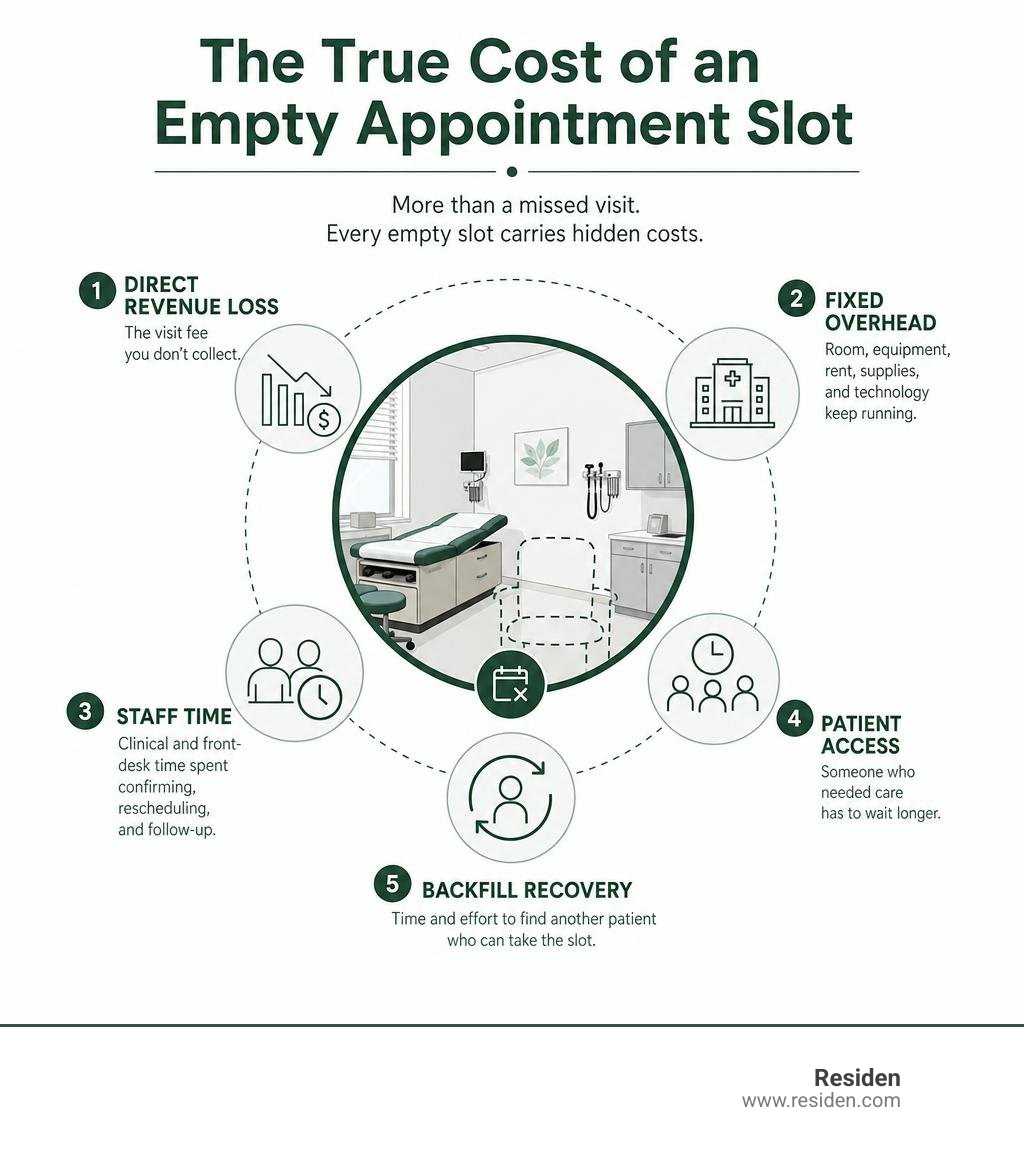
Direct Revenue Loss vs. Second-Order Operational Waste
When a patient misses a scheduled consultation, the immediate financial loss is obvious: the fee or reimbursement attached to that specific encounter vanishes. Across the broader healthcare landscape, these absences create a staggering $150 billion annual drag on the industry. Yet, the primary billing deficit represents only the tip of the iceberg.
The real financial damage stems from second-order operational waste. When an exam room sits dark, your staff expenses do not pause. Front-desk personnel, medical assistants, and registered nurses are still on the clock. Instead of assisting in procedures or handling productive patient care, their labor shifts toward manual outreach, leaving voicemails, and reconciling scheduling grids.
Beyond idle payroll, unmanaged appointment vacancies trigger severe patient churn and retention decay. Longitudinal studies show that patients who miss even a single appointment have an attrition rate approaching 70%, compared to just 19% for patients who attend reliably. When a patient breaks clinical momentum, they often delay care, fail to adhere to treatment plans, or abandon the practice entirely. Reviewing an economic analysis of appointment vacancy and allocative loss underscores that unfilled clinical capacity deprives urgent patients of access while destroying lifetime patient value. Establishing robust systems to streamline medical practice operations is the foundation for safeguarding both provider continuity and revenue resilience.
How Fixed Overhead Multiplies the True Cost of an Empty Appointment Slot
In private practice, fixed overhead accounts for 70% to 85% of total operating expenses. Your facility rent, long-term equipment leases, malpractice premiums, and baseline staff salaries remain entirely static regardless of whether your schedule is 100% full or 25% empty.
When an appointment goes unfilled, your fixed expenses do not adjust downward. Instead, the overhead burden per attended patient increases, shrinking your net profit margins. For high-overhead environments such as surgical suites or procedural clinics, an idle room burns cash continuously. An empty operating room incurs approximately $1,000 per hour in fixed facility, equipment, and staffing expenses.
| Medical Specialty | Average Direct Revenue Loss | Estimated Fixed Overhead Drag per Slot | Total Estimated Financial Impact |
|---|---|---|---|
| Primary Care (Family Medicine) | $150 – $350 | $50 – $100 | $200 – $450 |
| Dermatology | $250 – $600 | $75 – $150 | $325 – $750 |
| Cardiology | $300 – $700 | $100 – $200 | $400 – $900 |
| Orthopedic Surgery | $350 – $800 | $150 – $300 | $500 – $1,100 |
| Gastroenterology (Procedural) | $400 – $900 ($1,450+ for colonoscopy) | $200 – $400 | $600 – $1,850+ |
| Mental Health / Psychiatry | $180 – $400 | $40 – $80 | $220 – $480 |
Calculating the True Cost of an Empty Appointment Slot for Your Practice
To understand your specific exposure, you must move beyond generic industry estimates. Establishing a baseline assessment begins by looking at your schedule volume, typical attendance patterns, and net collections per visit. Detailed research on specialty-specific empty slot economics confirms that calculating schedule risk requires accounting for both direct clinical fees and fixed operational overhead.
You can calculate your practice's baseline annual revenue at risk using the following sequence:
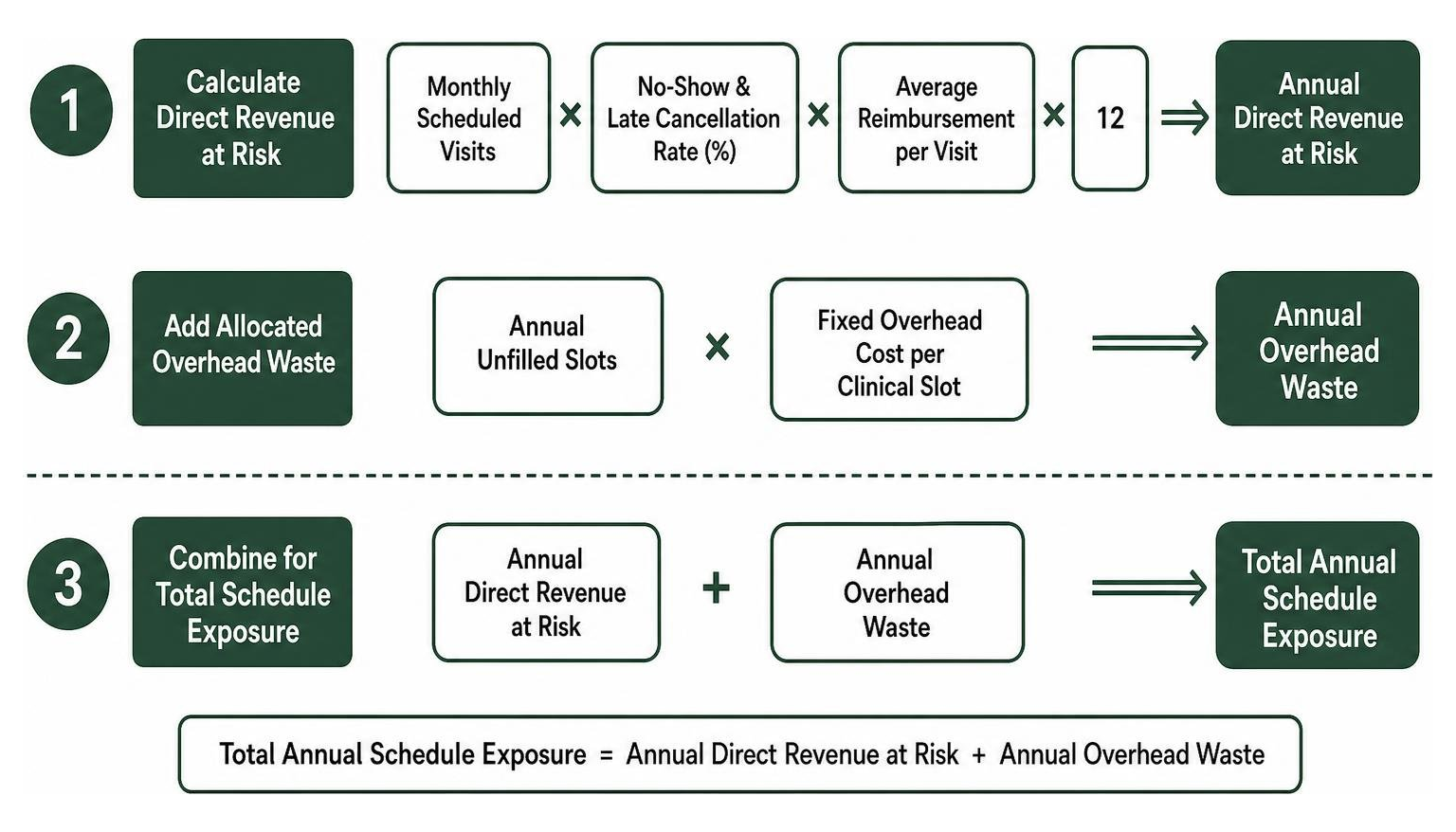
Consider a multi-provider family medicine clinic seeing 4,000 monthly visits with an average visit reimbursement of $130. At a standard 15% no-show rate, that practice loses roughly $936,000 in direct gross revenue annually. Factoring in secondary labor and operational friction increases the actual balance sheet exposure past $1.2 million.
The True Cost of an Empty Appointment Slot in Primary Care vs. Surgical Specialties
The financial dynamics of an empty slot shift dramatically depending on clinical specialty and procedural margins:
- Primary Care & Pediatrics: With lower average margins ($150 to $350 per visit) and high patient volume (20 to 30 encounters daily per clinician), missed visits erode volume-based profitability. A solo primary care physician experiencing an industry-standard 20% no-show rate easily loses over $225,000 in gross annual revenue.
- Orthopedics & Interventional Cardiology: Procedural fields face significant initial losses ($350 to $800 per clinical slot) compounded by downstream impacts. A missed initial consult eliminates high-margin imaging, physical therapy referrals, and surgical interventions.
- Gastroenterology: A missed endoscopy or colonoscopy slot carries an acute loss ranging from $1,450 to $1,850 when factoring in specialized suite prep, endoscopy nursing teams, and recovery bay allocations.
- Dermatology & Medical Aesthetics: Procedure-heavy dermatology practices balance volume medical checks with high-yield aesthetic slots ($250 to $600+). Unfilled gaps disrupt room turnover and cause significant production losses.
The Compounding Effect of Cancellation Lead Times
How far in advance an opening appears determines your ability to salvage the schedule. Advance bookings made months out exhibit an average no-show rate of 33%, whereas same-day bookings drop to an attendance failure rate of just 2%.
- 48+ Hours Notice: High recovery potential (60% to 75% fill rate). Administrative teams have sufficient time to coordinate with waitlisted patients.
- 24 to 47 Hours Notice: Moderate recovery potential. Requires rapid communication channels to confirm replacements.
- Same-Day Cancellations (<24 Hours): Low recovery potential (5% to 15% fill rate via manual phone outreach), turning into complete financial loss without automated backfill technology.
- No-Shows (Zero Notice): 100% loss of direct billable production and committed clinical overhead.
Modern Strategies to Recover Revenue and Eliminate Schedule Gaps

Eliminating schedule gaps requires modern engagement channels rather than outdated manual workflows. Practices relying solely on manual phone calls struggle with low connection rates, as over 30% to 40% of inbound and outbound office calls go unanswered.
Modern practices solve this through automated, omnichannel outreach. Deploying a strategic communication cadence across two-way SMS, email, and voice drastically cuts missed appointments:
- 72 Hours Prior: Initial automated prompt with one-click confirmation or rescheduling links.
- 24 Hours Prior: Action-oriented SMS reminder verifying time, location, and prep instructions.
- 2 Hours Prior: Day-of alert providing parking, directions, or intake status.
Practices utilizing omnichannel outreach cut no-show rates by up to 39% compared to single-channel reminders. Integrating the best AI tools for independent physicians creates intelligent patient pathways that update schedules instantly without overloading administrative staff.
Automated Waitlist Backfilling and Real-Time Slot Fillers
Manual waitlist management is too slow for same-day schedule changes. When a patient cancels two hours before their visit, a medical assistant playing manual phone tag rarely fills the chair in time.
Automated waitlist systems resolve this by monitoring electronic health records (EHR) in real time. The moment an opening appears:
- The system queries a prioritized waitlist based on clinical urgency, visit type, and patient location.
- An automated SMS notification is distributed to qualified candidates simultaneously or in rapid succession.
- The first patient to confirm with a single click is instantly placed onto the live calendar.
An effective automated backfill workflow can recapture 60% to 80% of canceled appointments, recovering between $93,600 and $124,800 in annual revenue for a single full-time provider.
Transforming Practice Models to Mitigate Schedule Risk
Beyond scheduling software, the structural defense against empty slot losses lies in shifting from rigid commercial liabilities to variable operational models. In a traditional long-term commercial lease, your facility overhead is fixed whether you see 20 patients a day or zero.
Modern clinicians are protecting their margins by applying proven strategies to run a lean medical practice. By utilizing a flexible medical coworking space, providers can rent fully equipped exam rooms, procedure suites, and consultation offices on an hourly or daily basis. This aligns clinic space costs with actual patient demand, eliminating unused overhead during lighter scheduling days.
Frequently Asked Questions About Appointment No-Shows
What is the average no-show rate across healthcare practices?
Across outpatient healthcare settings, the average no-show rate sits around 23%, with specialty-specific benchmarks ranging between 5% and 30%. Well-optimized private practices aim to maintain a no-show rate below 5% to 8%.
Why do traditional reminder phone calls and punitive fees fail?
Manual reminder phone calls fail because modern patients rarely answer unsaved numbers, leading to endless games of phone tag that exhaust staff time. Meanwhile, punitive no-show fees create patient friction, damage rapport, and fail to recoup the true financial value of the lost clinical time. Shifting toward low-friction, automated two-way SMS communication resolves logistical hurdles without alienating patients.
How much revenue can automated waitlist backfilling realistically recover?
An automated waitlist system consistently recovers 60% to 80% of canceled appointment slots. For a solo provider practice averaging 200 monthly visits with a 10% cancellation rate, backfilling those openings recovers $90,000 to $125,000+ in annual gross revenue.
Conclusion
An empty appointment slot is an unrecoverable operational loss that ripples across your balance sheet, clinic morale, and patient outcomes. Protecting your practice requires a two-part approach: deploying automated, omnichannel communication to keep attendance high, and adopting operational models that prevent fixed overhead from draining your profits.
For healthcare providers seeking to build a resilient, modern practice in Southern California, Residen offers a flexible medical office solution. We provide turnkey, fully equipped exam rooms, procedure suites, and consultation spaces rentable hourly, daily, or long-term across premier medical districts in Brentwood, CA and Beverly Hills, CA—without long-term commercial leases, membership fees, or complex administrative overhead.
To discover how variable clinical space can optimize your overhead and protect your practice margins, review our comprehensive medical office space for rent Los Angeles area guide and explore our modern healthcare workspaces today.