
Detailed Guide to Building Systems That Run Your Practice Without You
Why Your Practice Still Needs You for Everything (And What That's Really Costing You)

How to build systems that let your practice run without you is one of the most important questions any independent healthcare professional can ask — and the answer is more actionable than most people expect.
Here is a quick overview of how it works:
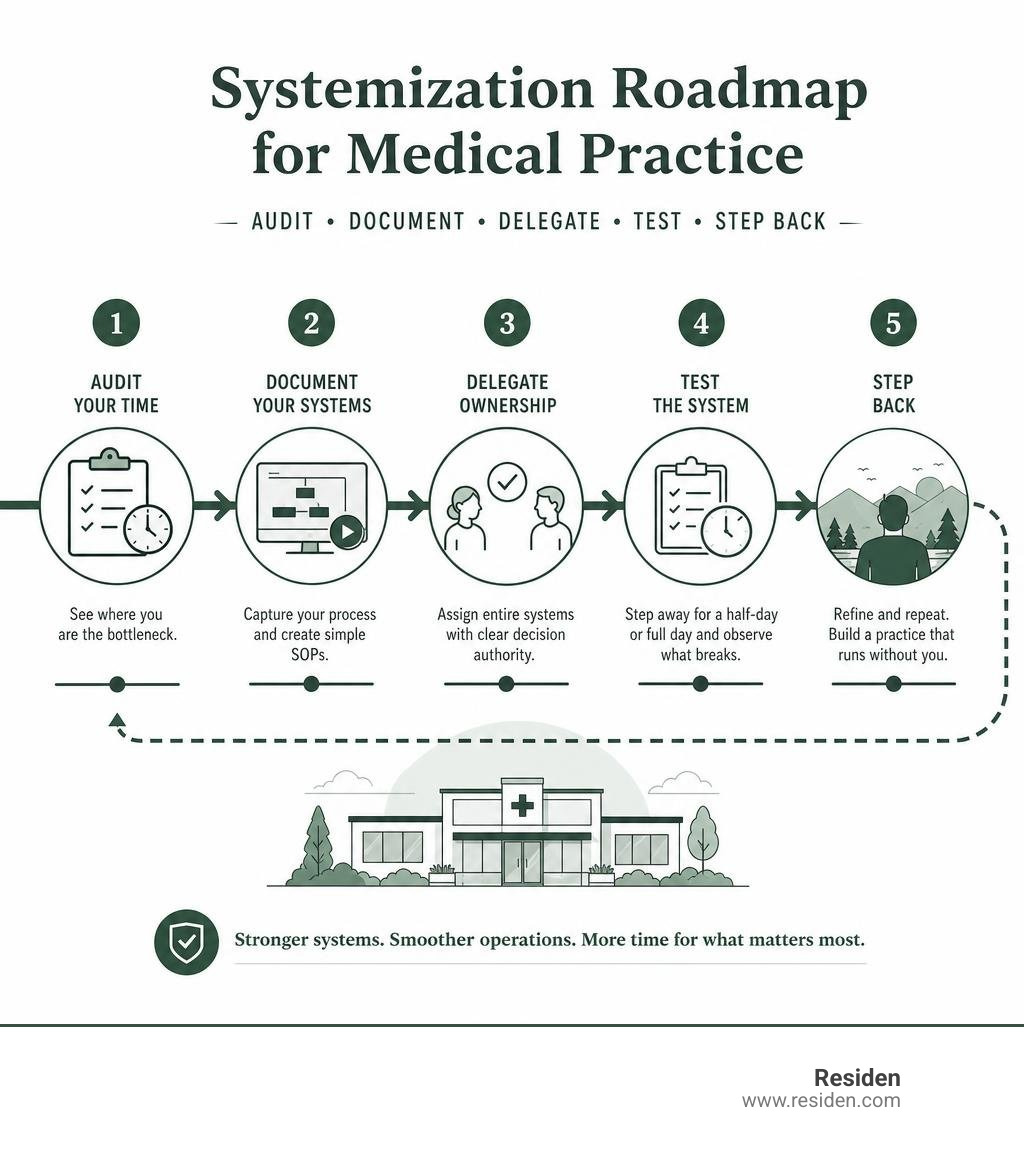
- Audit your time — Log every task you handle for two weeks to see where you are the bottleneck.
- Define your core systems — Prioritize client intake, billing, scheduling, and internal communication first.
- Document as you work — Use screen recording tools to capture processes in real time, then convert them into simple SOPs.
- Assign ownership — Delegate entire systems (not just tasks) to team members with clear decision authority.
- Test with a step-back — Take a half-day or full day offline and observe what breaks.
- Refine and repeat — Treat gaps as process problems to fix, not reasons to stay involved.
Most practices can see meaningful improvements in cashflow and daily operations within weeks of implementing even basic systems.
The hard truth is this: if your practice stops when you stop, you do not own a practice — you own a very demanding job.
Many independent healthcare professionals reach a point where stepping away feels genuinely impossible. Decisions pile up. Staff wait for answers. Patients experience inconsistency. And the owner — the most expensive, most skilled person in the building — spends their day answering questions that a good checklist could have handled.
As James Clear writes in Atomic Habits: "You do not rise to the level of your goals. You fall to the level of your systems."
That is not a motivation problem. It is an architecture problem.
I'm Dr. Jessica Wu, a Harvard-trained dermatologist with over 20 years in private practice, and I've seen how the right operational infrastructure — or the painful lack of it — shapes whether a practice thrives or traps its owner. My experience building and refining clinical workflows directly informs this guide on how to build systems that let your practice run without you, and I'll walk you through exactly where to start.
The Cost of Owner Dependency and the Solver's Trap

When we first open our doors, being involved in everything feels natural. We are the clinical engine, the chief marketer, and the ultimate problem solver. But as the practice grows, this hands-on approach shifts from a strength into our biggest vulnerability.
The Solver's Trap: Why Being the "Chief Question Answerer" Kills Growth
Many of us fall victim to the "Solver's Trap" (or "rescuer trap"). This is a psychological cycle where we solve every problem brought to us by our staff. While it feels like supportive, empathetic leadership, it actually trains our team to stop finding solutions. They learn that the fastest way to resolve an issue is simply to hand it to us.
By constantly stepping in to rescue the team from minor operational friction, we become the "Chief Question Answerer" (CQA). We trap ourselves in the tactical center of the practice instead of stepping back to act as the strategic architect. This constant stream of micro-decisions creates a massive bottleneck, capping our practice’s growth at our personal bandwidth and leaving us exhausted.
The Financial and Operational Toll of a Practice That Can't Scale
Owner dependency is not just exhausting; it acts as a silent tax on our bottom line. When every decision must run through us, operations slow down whenever we are in a patient session or away from the office. This operational friction quickly translates into real financial leaks:
- Cashflow Leaks: Invoices go out late because we are too busy to approve them, and patient copays are missed at the front desk because there is no systemized check-in protocol.
- Administrative Overhead: We hire more staff to handle the chaos, but without clear systems, new hires simply turn to us for more answers, increasing payroll without improving efficiency.
- Margin Erosion: Micro-leaks like inconsistent billing, double-booked slots, and wasted clinic space quietly eat away at our profit margins.
When we build a structured operational framework, we protect the very clinical freedom we sought when starting out. Transitioning away from day-to-day chaos allows us to truly experience The Perks Of Private Practice rather than feeling trapped by them.
How to Build Systems That Let Your Practice Run Without You

Building a practice that runs without you does not mean losing the personal touch your patients expect. In fact, systems protect that personal touch. By automating and standardizing administrative tasks, we free up cognitive bandwidth for our clinical team to focus entirely on patient care.
Systems vs. Processes vs. Tasks: Defining the Hierarchy
To build a self-sustaining practice, we must first understand the relationship between systems, processes, and tasks.
- System: A combination of processes that work together to deliver a predictable, consistent outcome (e.g., our Patient Acquisition System).
- Process: A sequence of steps within that system (e.g., our Patient Intake Process).
- Task: The individual action required to complete a step in the process (e.g., entering patient insurance details into the EHR).
To make this practical, we can use the "Trigger-Data-Output" framework. Every process must have a clear trigger (what starts it), specific data (what is needed to complete it), and a defined output (what the finished result looks like).
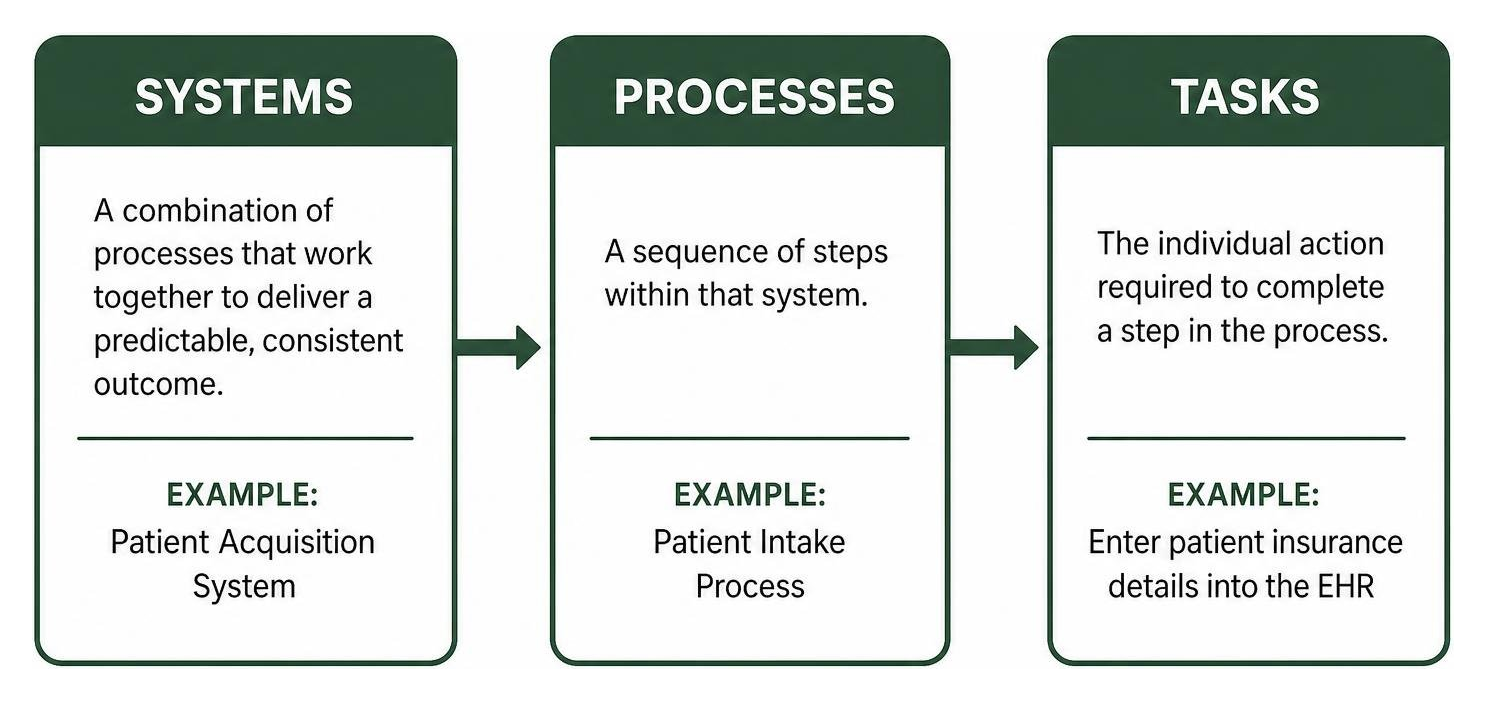
Understanding this hierarchy prevents us from overcomplicating our documentation, a concept thoroughly explored in How to Build a Business That Runs Without You, Not on You.
The 4 Core Systems to Build First for Cash Flow and Operational Stability
We do not need to document all 200+ micro-processes in our practice overnight. Instead, we focus on the four core systems that have the greatest impact on cash flow, margins, and daily operations:
- Patient Intake and Onboarding: The step-by-step journey from a patient’s first inquiry to their clinical consultation. Standardizing this ensures we gather insurance and medical history upfront, reducing downstream administrative delays.
- Billing and Revenue Cycle Management: Automated payment reminders, clear copay pre-collection rules, and consistent insurance claim submission timelines to stabilize cash flow.
- Scheduling and Calendar Management: Rules that prevent double-booking, protect clinical blocks, and automate appointment reminders to minimize no-shows.
- Internal Communication and Team Coordination: Clear guidelines on how the team shares patient updates, escalates issues, and coordinates handoffs between clinical and administrative staff.
By focusing on these four areas, we can easily run a highly efficient, lean clinic. For practical strategies on keeping operations simple, see our guide on Simple Ways To Run The Lean Medical Practice.
Step-by-Step Guide to Rapid SOP Creation and Team Ownership
To successfully step back, we must transition from delegating simple tasks to delegating decision-making authority.
| Task Delegation (The Operator Trap) | Decision Delegation (The Systemized Practice) |
|---|---|
| "Call this patient and confirm their appointment." | "Manage the daily schedule to ensure we maintain a 90% utilization rate." |
| "Send this invoice out today." | "Execute the billing process every Tuesday and handle collections up to $500." |
| "Ask me before you issue any refunds." | "You are authorized to resolve patient billing disputes up to $100 independently." |
How to Build Systems That Let Your Practice Run Without You in Under 35 Minutes
The biggest barrier to creating standard operating procedures (SOPs) is the belief that they must be 20-page textbook documents. In reality, we can build highly effective SOPs in under 35 minutes by documenting while we work:
- Step 1: Record in Real-Time (10 Mins): The next time you perform a routine task — like processing a patient refund or generating a weekly report — record your screen and narrate your actions using a tool like Loom.
- Step 2: Transcribe and Extract (15 Mins): Use an AI transcription tool to convert your video narration into written steps. Break these steps down into a simple checklist.
- Step 3: Define the Triggers and Tools (5 Mins): Clearly state the Trigger (when to do this), the Tools (what software or forms to use), and the Output (what success looks like).
- Step 4: Store Accessibly (5 Mins): Save the video and written checklist in a centralized, shared digital space (like a shared drive or clinical wiki) where any team member can find it instantly.
This realistic approach is highly effective because it captures real-world nuances rather than hypothetical, idealized workflows.
Assigning System Ownership and Empowering Your Team to Make Decisions
Once our core SOPs are documented, we must assign clear ownership. A system without an owner will eventually fail. When we assign ownership, we are not just asking someone to perform tasks; we are giving them the responsibility to monitor the process, manage minor errors, and suggest improvements.
To prevent the team from constantly seeking our approval, we build a "leadership funnel" with clear authority levels and escalation thresholds:
- Level 1 (Independent Action): The team member executes the process and makes decisions within defined rules (e.g., resolving a scheduling conflict).
- Level 2 (Action with Notification): The team member makes the decision but logs it or notifies us (e.g., ordering routine clinical supplies within a set budget).
- Level 3 (Escalation): The issue falls outside standard rules and requires our direct strategic input (e.g., a major patient compliance issue).
Empowering our team this way dramatically boosts staff confidence and reduces turnover, helping us overcome The Struggles Of Staffing.
Testing and Refining Your Practice Systems
A system is only as good as its performance when you are not in the room. To build a practice that truly runs without you, we must put our systems to the test.
How to Build Systems That Let Your Practice Run Without You: The 14-Day Vacation Test
The ultimate diagnostic tool for owner dependency is the "Vacation Test." We start small and gradually increase our absence to see where our systems break:
- The Half-Day Test: Step out of the clinic for a single afternoon. Turn off your phone and do not check emails. When you return, note every question that had to wait for your answer.
- The 3-Day Test: Take a long weekend completely offline. This will expose any gaps in weekly processes, like billing cycles or inventory management.
- The 14-Day Test: Take a two-week, phone-free vacation. This is the gold standard of system testing. It forces your team to handle monthly cycles, patient escalations, and administrative tasks independently.
Any operational failures that occur during these tests are not people problems; they are system design flaws. We use these gaps as a roadmap to refine our SOPs and adjust our decision trees.
Knowing When Your Practice is "Systemized Enough"
You do not need to systemize every single corner of your practice to regain your freedom. Your practice is "systemized enough" when:
- Your team can resolve 90% of daily operational questions using existing documentation.
- Patient outcomes and clinical experiences remain consistent, regardless of which administrative staff member is on duty.
- Onboarding a new team member takes days rather than weeks because they have a clear manual to follow.
- You can easily transition to a highly balanced, flexible schedule, such as learning How To Work 3 Days A Week As A Doctor In 5 Simple Steps.
Frequently Asked Questions about Practice Systemization
What is the difference between delegating tasks and delegating decisions?
Delegating tasks means assigning specific, step-by-step actions to a team member while retaining all decision-making authority. Delegating decisions means giving them a rule-based framework (like an authority matrix) and empowering them to choose the best course of action independently within those boundaries.
How do I handle HIPAA compliance when documenting clinical systems?
When recording SOPs or creating screenshots of clinical workflows, never include real patient health information (PHI). Use dummy accounts or test patient profiles in your EHR to demonstrate processes. Ensure all documented SOPs are stored in a secure, access-controlled digital environment that complies with HIPAA regulations.
How long does it take to transition a practice to run without the owner?
Most independent practices see significant operational relief within 90 days of documenting their core systems. A complete transition — where the owner steps back to a purely strategic or part-time clinical role — typically takes 6 to 12 months of consistent, step-by-step implementation.
Conclusion
Building systems that run your practice without you is the ultimate key to clinical freedom, long-term profitability, and personal wellness. When we shift our identity from the constant day-to-day problem solver to the strategic architect of our business, we unlock the true potential of private practice.
At Residen, we understand that physical office management and rigid real estate commitments are often the heaviest administrative burdens holding healthcare professionals back. That is why we provide turnkey, shared medical office rentals in premier Los Angeles locations, including Beverly Hills and Brentwood.
Our fully equipped, patient-friendly exam, procedure, and consultation rooms are available for flexible daily or hourly bookings with no long-term leases, setup costs, or hidden fees. By removing the operational headaches of traditional medical real estate, we make it easier than ever to build a lean, systemized practice that works for you.
Ready to step out of the operational grind and scale your practice on your own terms? Get Started with Residen today.