
A Quick Start Guide to Knowing When to Hire Your First Employee
Know When Your Lean Practice Needs Its First Employee

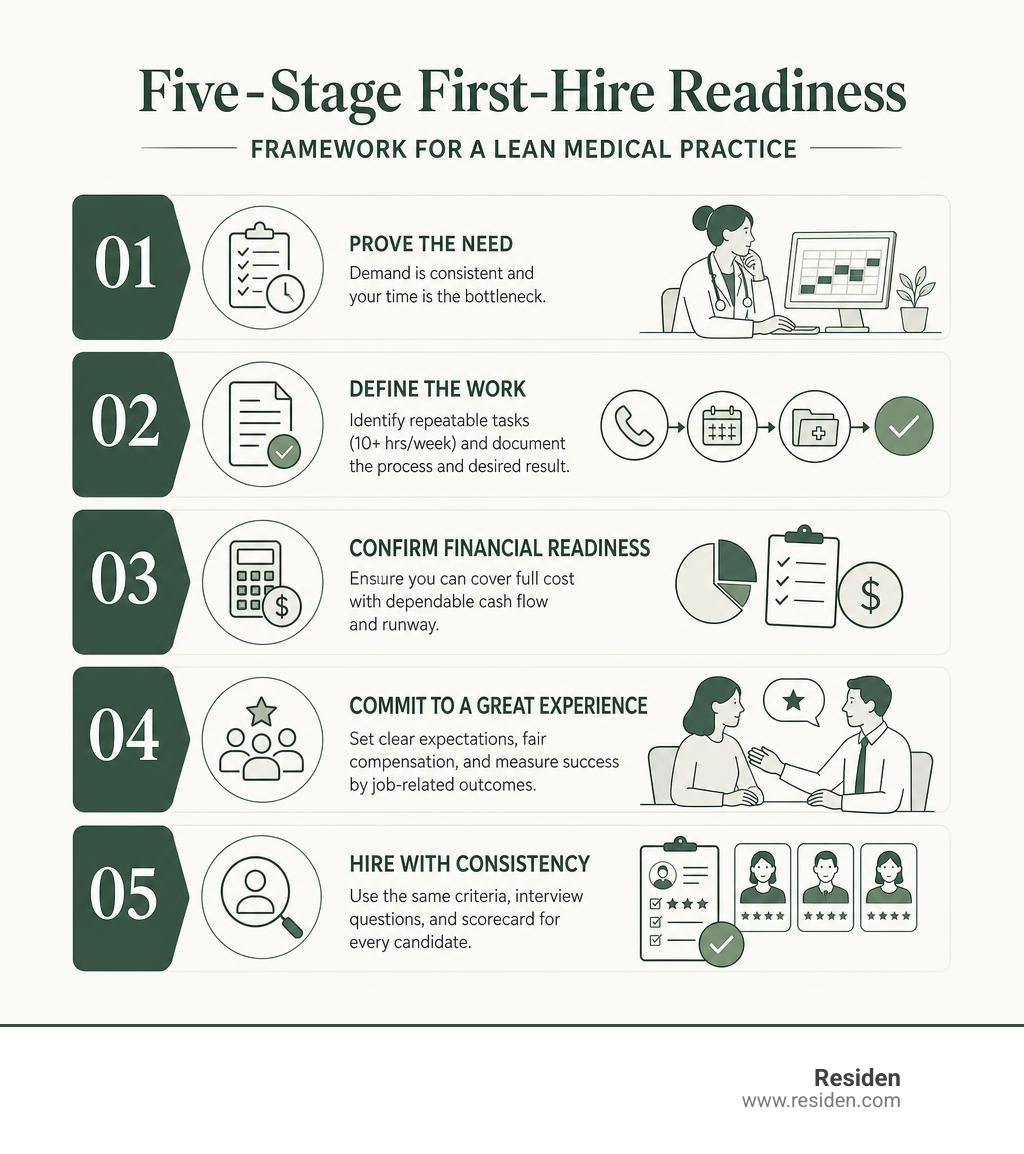
It is time to hire your first employee when demand is proven, your time has become the clear bottleneck, and you can define work that another person can own. Before posting a job, take these three steps:
- Track your work for one to two weeks and identify repeatable tasks that take 10 or more hours each week.
- Document the process and define the result you expect, such as fewer patient scheduling delays or billing completed within a set timeframe.
- Confirm you can cover the employee's full cost - wages, payroll taxes, benefits, tools, and training - with dependable cash flow and runway if revenue stays flat.
For an independent healthcare professional, the first hire is often not a growth trophy. It is a practical answer to a capacity problem: patient calls go unanswered, follow-up runs late, or administrative work crowds out clinical care. A flexible medical office can keep fixed overhead lower while you test demand, but it cannot replace a clear staffing plan.
Just as important, do not treat commitment as being available after paid hours. Set reasonable schedules, pay for all time worked, and measure success by job-related outcomes. From the first job post through onboarding, use the same criteria, interview questions, and scorecard for every candidate. This helps you choose well and build a fair, legally defensible process from day one.
I am Dr. Jessica Wu, a dermatologist who has run a private practice for more than 20 years while balancing patient care, operations, and growth. In this guide to When Is It Time to Hire Your First Employee? Natural next step after Residen's existing lean-practice content., I will help you assess whether delegation will protect your time, patient experience, and practice finances.
When Is It Time to Hire Your First Employee? Natural next step after Residen's existing lean-practice content.
Operating solo gives you absolute control over every patient interaction and operational detail. In our previous guides, we explored Simple Ways to Run the Lean Medical Practice by streamlining overhead, adopting agile booking schedules, and cutting non-essential administrative layers.
Yet, even the most disciplined solo practitioner eventually runs into hard physical limits. A practice cannot scale when the clinician is simultaneously diagnosing patients, sanitizing exam rooms, managing digital records, answering intake calls, and processing insurance claims.
Hiring your first team member becomes essential when capacity constraints begin eroding your patient experience or preventing you from seeing billable cases. The decision should never rest on intuition alone; it requires monitoring objective hiring signals that prove your business model is functioning and that delegation will yield a positive return on investment.
When you spend hours on tasks that do not require your advanced clinical license or founder judgment, you incur massive opportunity cost. If your clinical time is worth $200 to $400 an hour, spending 15 hours a week manually entering data or confirming appointments costs your practice thousands of dollars in lost patient revenue every month. Evaluating your delegatable hours and comparing them against your opportunity costs will clarify whether it is time to expand.

Operational Indicators: When Is It Time to Hire Your First Employee? Natural next step after Residen's existing lean-practice content.
Operational readiness is about pinpointing exact workflow bottlenecks. If your schedule is full for the next six weeks, but you are turning down new patients because you lack the administrative bandwidth to process intakes, you are experiencing an operational bottleneck.
Review these operational red flags:
- Administrative Burden: You spend more than 15 to 20 hours each week on non-clinical, repeatable tasks such as patient intake, insurance verification, appointment reminders, and basic chart preparation.
- Patient Experience Slippage: Wait times in your waiting area begin to creep past acceptable thresholds, patient messages sit unreturned for over 24 hours, or post-treatment follow-up calls are skipped entirely.
- Bottlenecked Growth: You want to add another half-day of clinic hours at your turnkey location, but doing so would leave zero time for necessary charting and compliance paperwork.
- Process Repeatability: You have mapped out your core workflows. As we detail in our guide on How to Build Systems That Let Your Practice Run Without You, a task cannot be delegated effectively until it has a clear standard operating procedure (SOP).
If you have already automated everything possible through modern practice management software and still cannot keep up with demand, adding human support is your logical next step.
Financial Thresholds: When Is It Time to Hire Your First Employee? Natural next step after Residen's existing lean-practice content.
Bringing on an employee introduces ongoing payroll obligations that cannot be paused when patient volume fluctuates. Before extending an offer, stress-test your financials against realistic operating margins.
A widely respected benchmark in lean business operations is the 3x revenue rule: your monthly revenue should comfortably equal at least three times the fully loaded monthly cost of the new employee. The fully loaded cost includes the gross base wage, employer payroll taxes (FICA, FUTA, SUTA), mandatory workers' compensation insurance, benefits, payroll processing fees, and software licenses.
| Cost Component | Part-Time Medical Assistant / Admin (20 hrs/wk @ $25/hr) | Full-Time Clinical Admin / MA ($52,000 Base Salary) | Specialized Contractor / Virtual Assistant (10 hrs/wk @ $35/hr) |
|---|---|---|---|
| Base Compensation | $2,167 / month ($26,000/yr) | $4,333 / month ($52,000/yr) | $1,517 / month ($18,200/yr) |
| Taxes & Mandatory Ins. | ~$238 / month (FICA/SUI/WC) | ~$476 / month (FICA/SUI/WC) | $0 (Handled by contractor) |
| Software & Equipment | $100 / month | $150 / month | $50 / month |
| Total Fully Loaded Cost | ~$2,505 / month | ~$4,959 / month | ~$1,567 / month |
| Recommended Cash Runway | 3 to 6 months ($7,500 – $15,000) | 6 to 12 months ($30,000 – $60,000) | 1 to 2 months ($1,500 – $3,100) |
Never hire based on speculative, optimistic projections. Ensure your existing, recurring clinical revenue can absorb this line item for at least six to twelve months under flat-growth conditions.
Common Founder Mistakes and Workload Expectations

First-time employers often stumble not during the candidate search, but in how they manage their new hire. When solo operators bring on their first staff member, they often carry unconscious expectations that lead to friction, quick burnout, and unnecessary turnover. Navigating The Struggles of Staffing starts with recognizing these early management traps.
The most frequent misstep is the "mini-me trap"—attempting to hire someone who thinks, acts, and works exactly like the founder. As the business owner, you hold equity and direct financial upside; expecting an hourly or salaried team member to match your level of personal sacrifice is unrealistic.
Setting Realistic Work Hours and Commitment Levels
A common issue among first-time founders is expecting employees to stay connected outside of regular business hours. True commitment from an employee is demonstrated through focus, accuracy, empathy with patients, and adherence to protocols during paid hours.
Demanding 50- or 60-hour workweeks from an administrative hire without clear overtime compensation damages morale and violates labor regulations. Overworking staff leads directly to clinical errors, elevated stress, and high turnover. In healthcare operations, turnover is exceptionally costly; replacing an administrative team member can cost significant recruiting time and disrupt clinical workflows.
Treat your staff as professionals by establishing strict boundaries:
- Set defined start and end times for shifts.
- Do not send non-urgent communications after clinic hours expecting immediate answers.
- Compensate non-exempt hourly employees for every minute spent on patient records or administrative tasks.
Defining Roles by Measurable Outputs Instead of Arbitrary Tasks
Avoid handing a new hire an ambiguous list of disconnected chores. Define the role using specific, measurable outputs that clearly indicate operational success.
When adopting structured onboarding practices, map out a progressive 90-day roadmap:
- Days 1–30 (Foundation & Compliance): Complete all compliance paperwork, master EHR check-ins, learn patient room turnover protocols, and shadow clinical encounters.
- Days 31–60 (Independent Execution): Independently manage patient scheduling, handle standard intake workflows, coordinate supply inventories, and maintain on-time room preparation.
- Days 61–90 (Full Ownership & Efficiency): Proactively identify scheduling gaps, reduce check-in bottlenecks, resolve basic billing inquiries, and suggest workflow improvements.
Focusing on tangible outcomes provides your employee with a clear understanding of their role while giving you an objective framework to assess performance.
Structuring a Legally Defensible, Bias-Free Hiring Process

Many solo practitioners treat their first hire casually, relying on informal interviews or personal referrals. However, small practices must remain mindful of employment regulations. Building a standardized, legally compliant process from your very first hire protects your practice and ensures you bring on the most capable talent.
Workplace discrimination remains a persistent challenge across industries. Research indicates that 60% of Black workers and 53% of women report experiencing workplace discrimination or unfair treatment. Furthermore, only 1 in 5 employees with disabilities have disclosed their condition to their supervisors, and only 1 in 20 CEOs of S&P 500 companies are women.
Building an inclusive, equitable recruitment process from day one creates a strong, resilient foundation. Organizations with diverse teams consistently demonstrate stronger operational results: gender-diverse companies are 21% more likely to outperform peers, ethnically diverse companies are 33% more likely to do so, and inclusive teams make sound business decisions up to 87% of the time—often twice as fast in half the meeting time. Additionally, 69% of Millennial and Gen Z professionals indicate they are far more likely to stay long-term with an employer committed to workforce diversity.
Failing to implement fair, objective hiring practices creates substantial exposure. The Equal Employment Opportunity Commission (EEOC) secures approximately $505 million annually from employers for discrimination claims, with average out-of-court settlements hovering around $40,000. For an independent medical practice, an avoidable settlement of that size can threaten financial viability.
Review our practical Before You Hire Checklist to confirm your foundational documentation before publishing a job listing.
Balancing Culture Fit with Objective Selection Criteria
"Cultural fit" is often used as shorthand for subjective comfort, which can inadvertently introduce unconscious bias. Hiring someone simply because they share your personal interests does not predict how effectively they will coordinate patient care or handle sensitive medical records.
To select candidates objectively while building a cohesive team:
- Focus on "Culture Add": Look for candidates who bring valuable communication skills, empathy, and organizational habits that elevate your clinic environment.
- Standardize Interview Guides: Ask every applicant the exact same sequence of job-related, behavioral questions (e.g., "Describe a situation where an upset patient arrived late for their procedure. How did you resolve the situation while keeping our clinic schedule on track?").
- Use Scoring Rubrics: Grade answers using predetermined benchmarks (1 to 5 scale) based on job competencies rather than personal impressions.
- Conduct Practical Assessments: Administer a short, paid simulation—such as drafting a response to a complex patient inquiry or organizing a sample day of appointments—to evaluate hands-on aptitude.
Essential Compliance Steps for Small Practices Without Dedicated HR
Even without an in-house human resources team, you can maintain compliance by establishing a consistent hiring checklist:
- Federally Compliant Documentation: Ensure every new hire completes Form I-9 (Employment Eligibility Verification) within three business days of their start date, verifying acceptable identity and work authorization documents. Complete Form W-4 for federal income tax withholding.
- State & Local Registrations: Register your employee with state new-hire reporting agencies, establish state payroll tax accounts, and secure statutory workers' compensation insurance.
- Structured Role Descriptions: Draft detailed job descriptions that explicitly outline physical requirements, essential duties, and non-discriminatory performance expectations.
- Strict Record Retention: Maintain all job applications, interview notes, evaluation rubrics, and resumes in a secure, confidential file for at least one year to preserve legal defensibility.
- Clear Workplace Policies: Provide a straightforward employee handbook detailing meal breaks, rest periods, overtime rules, anti-harassment policies, and patient privacy (HIPAA) protocols.
Frequently Asked Questions About Hiring Your First Employee
How many hours of delegatable work justify hiring a first employee?
A solo practitioner should generally identify at least 10 to 15 hours per week of consistent, delegatable administrative or clinical-support tasks before hiring a part-time employee, or 20+ hours per week for a full-time hire.
Conduct a daily time audit for two consecutive weeks. Categorize every task into clinical care, business strategy, or routine administration. If routine tasks—such as scheduling, intake forms, room sanitization, and supply tracking—regularly consume 15+ hours of your week, your clinical capacity is artificially constrained. Offloading those hours to an employee allows you to open additional patient slots, easily covering the payroll expense.
What is the biggest legal risk when hiring a first employee without an HR team?
The most common legal pitfall is inconsistent, informal interview questioning that touches on protected characteristics. Asking candidates about marital status, childcare plans, age, national origin, or personal health during casual conversation violates federal and state employment laws.
To eliminate this liability:
- Use a written, standardized interview guide.
- Evaluate candidates exclusively on objective, job-related criteria.
- Document candidate evaluations immediately using structured scorecards.
- Retain all interview documentation for at least twelve months.
Should I hire a contractor or a full-time employee first?
The choice depends on the nature of the work and the degree of behavioral control you require:
- Independent Contractor (1099): Ideal for specialized, project-based needs where you do not control how, when, or where the individual works (e.g., an independent web developer, outsourced medical billing service, or specialized IT consultant).
- Employee (W-2, Part-Time or Full-Time): Necessary if you set specific working hours, require on-site presence at your medical office, direct step-by-step clinical support workflows, and supply all clinical equipment.
Misclassifying an on-site clinical or administrative assistant as an independent contractor can result in significant tax penalties, back wages, and legal liability under federal and California labor guidelines.
Summary of First-Hire Milestones
Expanding your practice from a solo operation to a supported clinical team marks an exciting operational transition. By grounding your staffing choices in objective capacity metrics, protecting your cash runway, and establishing structured hiring workflows, you can build a sustainable practice that serves patients exceptionally well.
- Audit Before You Post: Confirm at least 10–20 hours of recurring administrative tasks that can be delegated through written SOPs.
- Run the Numbers: Ensure your recurring revenue covers 3x the employee's fully loaded cost and maintain a 6-month cash reserve.
- Respect Clear Boundaries: Focus on measurable outputs during paid working hours rather than expecting unpaid availability.
- Standardize Candidate Evaluation: Use structured interview rubrics and job-related scoring to eliminate bias and maintain full legal compliance.
- Protect Your Overhead: Pair your smart staffing strategy with agile, flexible facility costs to scale sustainably.
Scaling Your Practice Sustainably
Building a resilient, independent medical practice requires managing two major overhead drivers: staffing and physical space. While adding your first employee expands clinical capacity, locking your business into an expensive, multi-year commercial lease can restrict your financial flexibility.
Residen offers a modern flexible medical office solution for healthcare practitioners in Los Angeles. With turnkey medical coworking spaces located in Brentwood, CA (11620 Wilshire Blvd) and Beverly Hills, CA (433 N Camden Dr), we provide fully equipped, beautifully designed exam, consultation, and procedure rooms.
Our spaces can be booked hourly, daily, or long-term without long-term commercial lease commitments or unexpected fees. By pairing lean, agile clinical spaces with smart staffing decisions, you keep your fixed overhead predictable while building an independent practice designed for sustainable growth.