
Why Is Physician Personal Branding Critical in Today's Healthcare Landscape?

Building a professional brand as a physician starts with four concrete actions: define a focused clinical niche, optimize your core digital profiles, batch-create educational content that answers real patient questions, and align your physical practice environment with the authority you present online. When these elements work together, prospective patients can quickly understand who you help, how you practice, and why they should trust you with their care.
In the past, clinical excellence alone was often enough to sustain a full patient panel through hospital referrals and informal word-of-mouth. Today, consumer behavior has shifted permanently toward digital evaluation. Modern healthcare consumers do not simply accept geographic proximity or health system assignments. Research shows that 85% of patients check a doctor's online presence before booking an appointment, and 94% of U.S. healthcare consumers consult online reviews when evaluating providers. Furthermore, 65% of prospective patients search online before contacting a medical office, with 58% beginning their search directly on Google. If your digital footprint is nonexistent, outdated, or poorly managed, prospective patients routinely redirect their care to colleagues who present a clear, credible, and accessible brand.
Despite this shift, a massive gap remains in the medical community. While 60% of doctors report that personal branding has had a positive impact on their careers, 53% of physicians have not yet started building a personal brand, and 31% report having no plans to do so. This disconnect creates an extraordinary opportunity for clinicians willing to take proactive ownership of their professional identity.
Beyond patient acquisition, professional branding plays a profound role in clinical autonomy and career longevity. With 42% to 62% of physicians experiencing clinical burnout, building a distinct professional identity provides an essential hedge against institutional dissatisfaction. A strong medical brand allows you to transition away from high-volume, commoditized clinical shifts by opening doors to independent private practice, industry consulting, advisory boards, expert witness work, and medical media.
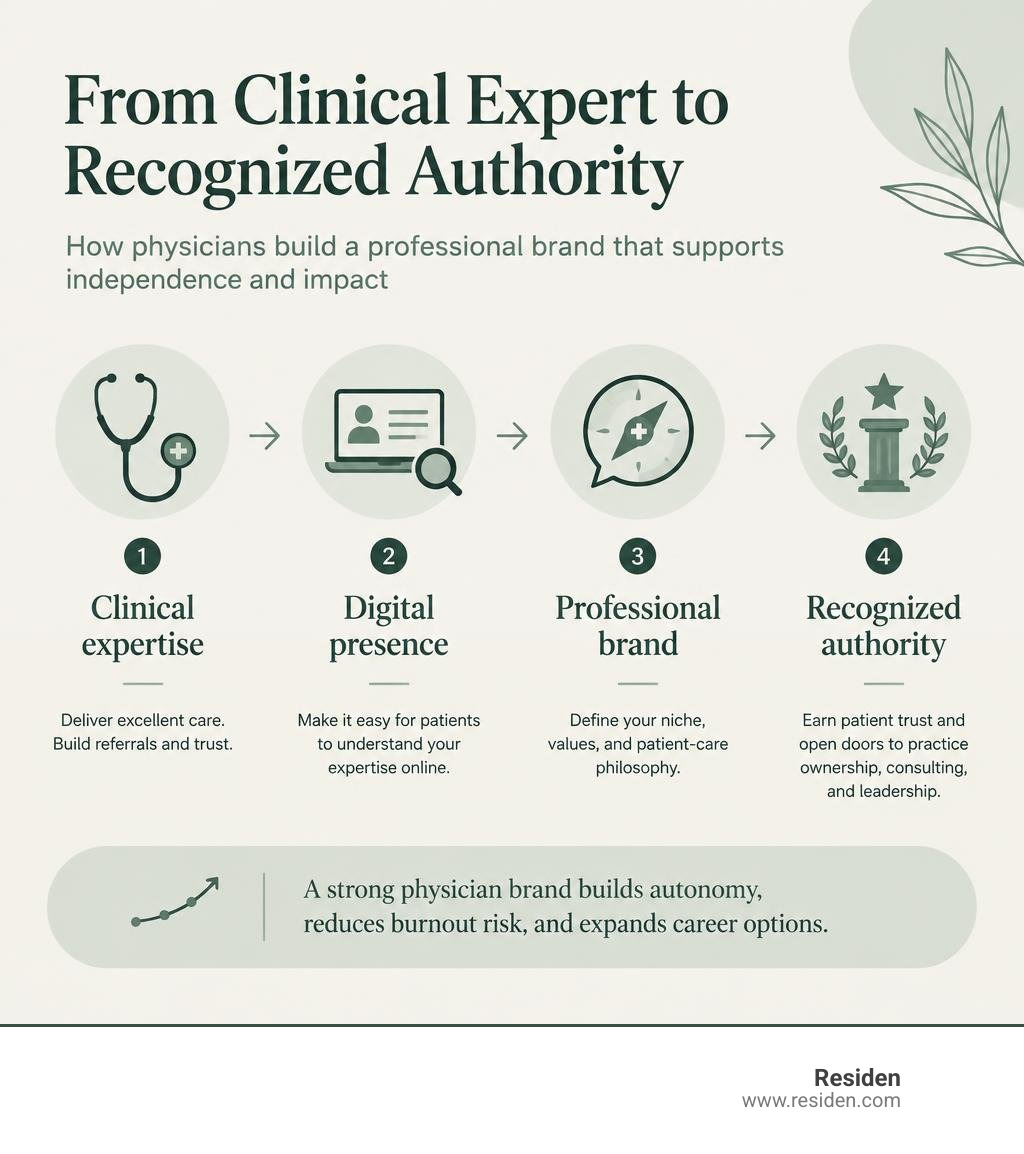
When you control your professional narrative, you dictate how your time and expertise are valued in the broader healthcare ecosystem.
What Are the Core Pillars of an Authentic Medical Brand Identity?

A successful physician brand is not built on flashy marketing gimmicks; it is built on clinical integrity and intentional communication. At its foundation, an authentic medical brand rests on four core pillars:
- Clinical Authority: Demonstrating your specialized knowledge, training, board certifications, and evidence-based problem-solving.
- Authentic Storytelling: Communicating why you practice medicine, your patient-care philosophy, and the real-world perspective you bring to clinical encounters.
- Audience Differentiation: Clearly defining who you serve and what sets your clinical diagnostic or treatment approach apart from standard care.
- Omnichannel Visibility: Ensuring that your reputation is cohesive across web searches, social platforms, medical directories, and in-person patient encounters.
Your brand identity must bridge the gap between your digital presence and the physical care you provide. When patients transition from reading your educational content online to sitting across from you in an exam room, every interaction must reinforce the same standard of empathy and professionalism. Integrating attentive bedside manner with clear digital communication is essential to create a five-star patient experience that cultivates lifelong patient loyalty.
To crystallize your identity, formulate a concise, one-sentence physician brand statement:
"I help [target patient demographic] resolve [primary clinical challenge] through [unique clinical approach or philosophy] so they can achieve [desired health outcome]."
For example: "I help active adults overcome chronic joint pain through non-surgical regenerative orthopedics so they can return to sport without prolonged surgical downtime."
Differentiating Your Clinical Focus and Niche
To establish a distinctive brand, you must move beyond broad medical labels like "internist" or "general surgeon" and identify your specific sub-specialization and target patient personas. Specialization reduces marketing friction because patients searching for answers to specific, distressing conditions seek out dedicated authorities rather than generalists.
Consider which clinical brand archetype aligns with your professional strengths:
- The Academic Educator: Focuses on breaking down complex clinical trials, medical literature, and emerging protocols for both peers and curious patients.
- The Innovative Specialist: Focuses on cutting-edge techniques, minimally invasive procedures, or advanced diagnostics within a targeted surgical or procedural niche.
- The Holistic Wellness Advocate: Integrates lifestyle medicine, nutrition, preventive screening, and longevity protocols alongside standard clinical care.
- The Patient-Empowerment Champion: Specializes in demystifying chronic illnesses, advocating for patient self-efficacy, and providing empathetic, jargon-free health literacy.
Translating complex medical concepts into clear, empathetic language is what builds trust. When patients feel understood before they even step foot in your office, the clinical relationship begins on a foundation of mutual confidence.
How Can Doctors Build Authority Across Digital and Strategic Channels?
Physicians often hesitate to build a brand because they assume it requires becoming a full-time content creator. In practice, building sustainable authority requires a focused, high-leverage content distribution model designed for time-constrained clinicians.
Rather than producing daily ad-hoc posts, implement a batch-creation and repurposing workflow. Dedicate two hours once a month to draft or record a single piece of comprehensive, high-value clinical content—such as an in-depth article or video addressing a frequent patient question. That single asset can then be adapted into:
- Three short-form educational videos for platforms like YouTube Shorts or Instagram
- Two text-based insights or case breakdowns for professional networks
- A detailed patient education FAQ page on your website
Short-form educational video has become one of the most effective tools for building clinical trust. 90% of healthcare consumers report wanting more video content from healthcare providers, and physicians with an active video presence generate 3 to 5 times more patient inquiries than those who rely solely on static text.
Alongside public-facing content, long-term discoverability depends heavily on robust search presence. Applying foundational strategies in SEO for doctors ensures that when prospective patients search for treatments in your geographic area, your practice website and profiles rank at the top of organic search results.
Simultaneously, building strong peer-to-peer referral relationships remains critical. Utilizing structured physician networking strategies allows you to establish credibility among local specialists who direct complex cases to trusted colleagues. Peer-reviewed literature confirms that intentional social media engagement enables medical professionals to effectively brand themselves, expand professional networks, educate the public, and advocate for patients.
Selecting the Right Platform Mix for Your Career Goals
Attempting to maintain an active presence on every digital channel leads to rapid fatigue. Instead, select two or three primary platforms aligned directly with your career objectives:
| Platform | Target Audience | Primary Content Format | Strategic Value |
|---|---|---|---|
| Google Business Profile | Local prospective patients actively seeking care | Practice details, verified patient reviews, updates | Non-negotiable anchor for local clinical trust and patient conversion |
| Personal Website | Prospective patients, media, institutional partners | Long-form clinical guides, bio, treatment philosophies | Central hub for brand ownership, SEO, and appointment bookings |
| Healthcare executives, physician peers, industry recruiters | Professional commentary, case studies, career milestones | B2B consulting, medical advisory roles, speaking invitations | |
| YouTube | Patients researching health conditions and procedures | In-depth educational videos, procedural explanations | Evergreen search authority and long-term organic discoverability |
| Instagram / TikTok | General public, lifestyle and aesthetic consumers | Short-form video, myth-busting, behind-the-scenes | High engagement for visual and wellness-oriented specialties |
Your Google Business Profile serves as your foundational local asset. When patients search for care, your verified listing—complete with accurate hours, location details, and authentic patient reviews—is often the definitive factor in their booking decision.
How Can Physicians Navigate Ethical, Legal, and Reputation Challenges?
Medical professionals are held to higher standards of communication and privacy than traditional business owners. Navigating these ethical and regulatory boundaries is not an obstacle to branding; when handled with rigor, compliance becomes one of your strongest brand differentiators.

To maintain ethical and legal compliance across all channels, adhere to the following core parameters:
- Strict HIPAA Compliance: Never reveal Protected Health Information (PHI). Do not share patient photographs, identifiable case details, dates, or surgical footage without explicit, written, HIPAA-compliant marketing consent. Even when responding to public patient reviews, never confirm or deny that the reviewer is a patient of your practice.
- Educational Boundaries vs. Medical Advice: Include clear disclaimers across all digital touchpoints stating that your content provides public health education and does not constitute an individualized physician-patient relationship.
- FTC Disclosure Standards: If you consult for medical device companies, endorse skincare formulations, or partner with healthcare brands, clearly disclose these relationships using visible and unambiguous labeling (such as
#AdorSponsored) to maintain credibility and comply with federal regulations. - No Guarantees of Clinical Outcomes: Avoid language that promises specific surgical or therapeutic results. Focus on explaining standard protocols, risks, evidence, and typical recovery pathways.
Online reputation management requires a proactive, structured framework. Because 72% of patients consider online reviews the most critical factor when selecting a healthcare provider, monitoring your ratings is non-negotiable.
When addressing negative reviews, never engage in defensive public arguments. Respond promptly with a neutral, professional standard statement:
"Thank you for your feedback. We are committed to delivering high-quality, patient-centered care. Due to federal privacy regulations, we cannot discuss individual patient care in a public forum. Please contact our practice manager directly at [Phone/Email] so we can look into your experience and assist you."
Understanding what makes patients choose one doctor over another reinforces that patients do not expect a spotless record of perfection—they evaluate how professionally, empathetically, and consistently a physician handles feedback and communicates care standards.
How Can You Leverage Your Brand to Launch an Independent Practice and Diversify Income?
A well-established professional brand is the single most valuable asset for a physician transitioning from institutional employment toward independent practice or diversified career avenues. When you build brand equity in your own name rather than an employer's hospital system, your patients, referral networks, and industry opportunities follow you wherever you practice.
A strong medical brand opens doors to multiple non-clinical revenue streams, including:
- Health-tech startup advisory roles and medical device consulting
- Paid expert witness testimony and independent medical examinations
- Keynote speaking engagements and continuing medical education (CME) lectures
- Digital health courses, wellness publications, and editorial advisory boards
For actionable roadmaps on building these non-clinical opportunities, review our detailed guide on the physician's guide to financial freedom as well as our analysis of how to build multiple income streams as a physician.
When building an independent practice, your physical clinical setting must match the high standard of your digital reputation. Traditionally, opening a private practice meant signing a 5-to-10-year commercial lease, spending hundreds of thousands of dollars on tenant improvements, and taking on massive financial risk.
Modern medical workspace models eliminate this operational barrier. In Los Angeles, independent physicians in Brentwood (11620 Wilshire Blvd) and Beverly Hills (433 N Camden Dr) leverage Residen's premium medical coworking spaces to establish an elevated physical presence without traditional overhead.
By booking fully equipped medical exam rooms, procedure rooms, and consultation suites on flexible hourly or daily terms, physicians can practice medicine on their own terms, focus entirely on patient care rather than facility management, and achieve substantial capital efficiency by lowering operational overhead.
Transitioning From Employed Physician to Sovereign Practice Brand
Employed clinicians often worry about the friction of starting an independent practice. However, leveraging the perks of private practice provides unmatched scheduling autonomy, customized clinical protocols, and direct control over patient volume.
To capture patient demand efficiently:
- Deploy an Online Booking Engine: With 95% of patients willing to book medical appointments online if available, integrate digital scheduling directly on your website and social profiles.
- Utilize Technology-Enabled Clinical Spaces: Choose medical office providers that utilize seamless technology to enable a no-admin medical workspace, allowing you to run a modern, lean practice without maintaining heavy full-time administrative staffing.
- Scale as Demand Grows: Start with one or two clinic days per week, utilizing hourly or daily medical office rentals, and scale your physical room usage as your patient roster expands.
What Are Frequently Asked Questions About Building a Physician Brand?
How can busy physicians build a brand with limited weekly time?
Physicians do not need to spend hours each day on marketing. By setting aside two hours once a month to record clinical FAQs or write educational summaries, you can generate all the content needed for multiple platforms. Utilizing turnkey clinical workspaces that eliminate facility management and maintenance frees up additional weekly hours, allowing you to invest time directly into your clinical brand and professional growth.
Is personal branding ethical for licensed medical professionals?
Yes, provided it is conducted within professional medical guidelines. Ethical personal branding focuses on improving public health literacy, debunking harmful medical misinformation, and explaining treatment options transparently. It avoids sensationalism, false guarantees, and aggressive commercial sales tactics, positioning the clinician as a trusted, evidence-based authority.
How long does it take to see measurable ROI from physician branding efforts?
Most physicians begin seeing leading indicators—such as increased website visits, direct patient inquiries, and peer referral outreach—within 3 to 6 months of consistent branding. Establishing a dominant, highly recognizable regional or specialty brand typically requires 12 to 18 months of steady execution.
What Is the Next Step to Establish Your Medical Authority?
Building a professional brand as a physician is not an exercise in vanity; it is a strategic framework for protecting your clinical independence, connecting with patients who need your specialized expertise, and establishing long-term career resilience.
By defining your unique value proposition, publishing consistent educational insights, upholding rigorous ethical standards, and matching your digital reputation with an elevated in-person clinical environment, you position yourself as a recognized authority in your field.
Whether you are launching an independent practice, transitioning away from hospital employment, or expanding your clinical reach in Southern California, we invite you to explore our medical coworking spaces in Beverly Hills and Brentwood to see how flexible, turnkey healthcare workspaces can support your sovereign medical career.
Reference List
Patricia P. Bloom, Rajitha D. Venkatesh, Evan S. Dellon, Joy W. Chang. "Making Social Media Work for You." Digestive Diseases and Sciences, 2021. DOI 10.1007/s10620-021-06912-8.