
How to Build Multiple Income Streams as a Physician
Why Every Physician Needs More Than One Income Source

Learning how to build multiple income streams as a physician is no longer a luxury — it's a financial survival strategy. Clinical income alone leaves doctors exposed to risks that most never see coming: sudden hospital acquisitions, malpractice suits, credentialing delays, or a disability policy that runs out after two years.
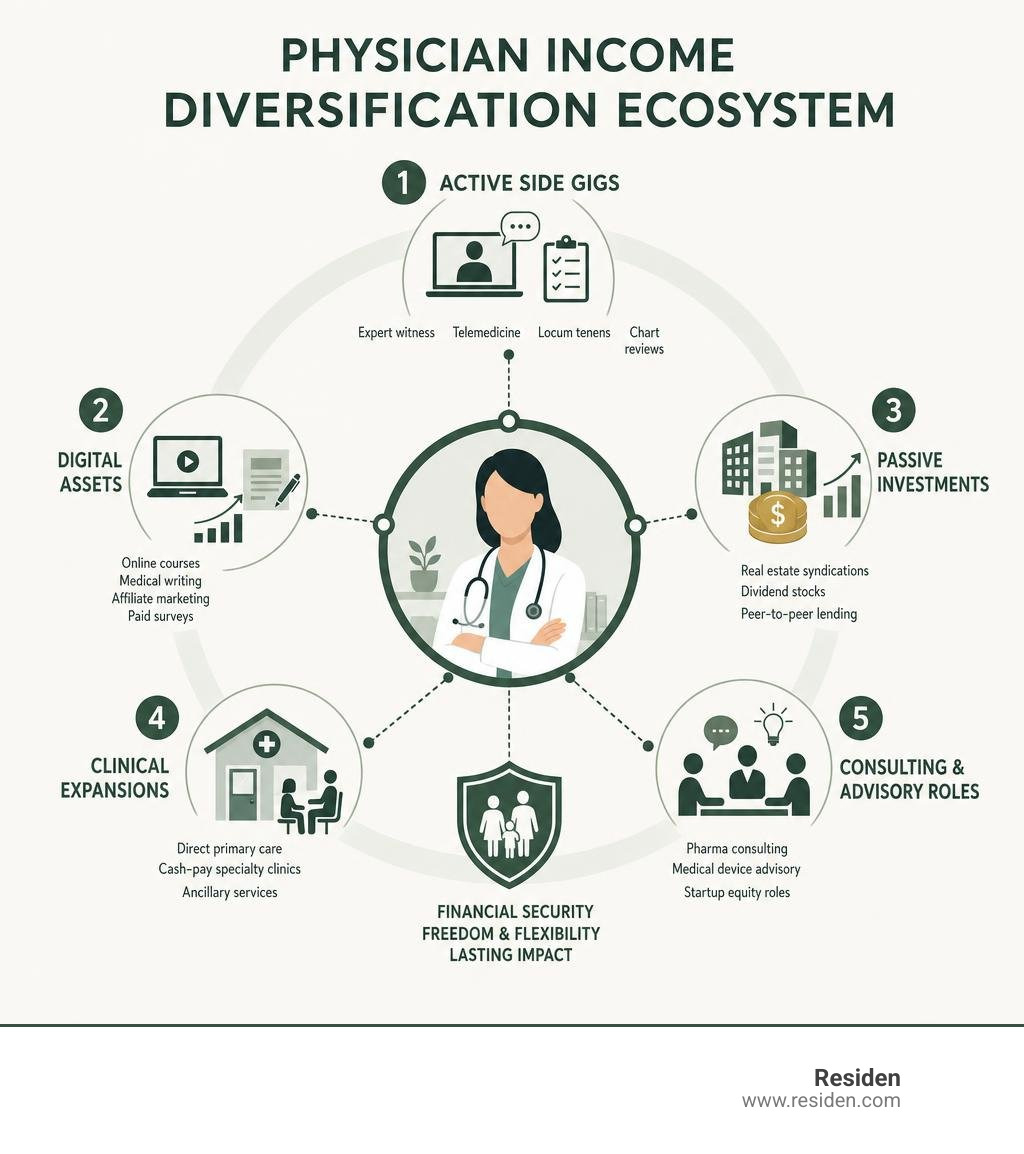
Here's a quick overview of the most effective income streams physicians use to diversify:
- Active side gigs — expert witness work ($300–$600/hr), telemedicine moonlighting, locum tenens, chart reviews
- Digital assets — online courses, medical writing, affiliate marketing, paid surveys ($500–$2,000/month)
- Passive investments — real estate syndications, dividend stocks, peer-to-peer lending
- Clinical expansions — direct primary care (DPC) micro-practices, cash-pay specialty clinics, ancillary services
- Consulting and advisory roles — pharma consulting, medical device advisory boards, startup equity roles
Physicians who dedicate just 5–10 hours per week to side gigs typically earn an extra $2,000–$8,000 per month. And the benefits go beyond the paycheck — having alternative income reduces financial stress, prevents burnout, and gives you real negotiating power over your clinical schedule.
I'm Dr. Jessica Wu, a Harvard-trained dermatologist who has spent over 20 years building a private practice in Los Angeles while developing two skincare lines, writing a bestselling book, and consulting on FDA clinical trials — all concrete examples of how to build multiple income streams as a physician beyond the exam room. The strategies I'll walk you through are ones I've seen work firsthand, both for myself and for colleagues across specialties.
Why Relying on a Single Clinical Income is Risky for Doctors
For decades, landing an attending position was seen as the ultimate financial finish line. You trade a decade of your youth for a steady, high-paying W-2 salary, and your financial security is guaranteed—or so the story goes. But in today's volatile healthcare environment, relying on a single clinical paycheck is a high-wire act without a safety net.
Consider the non-insurable events that can instantly disrupt or terminate a physician's primary income. A sudden hospital acquisition can result in rapid, unfavorable contract renegotiations where doctors are given an ultimatum: accept worse terms or resign. Because the credentialing process at a new facility typically takes several months, finding a new job is a painfully slow process, leaving you vulnerable to massive income gaps.
Furthermore, administrative vulnerabilities—such as disruptive physician accusations, false harassment claims, or loss of hospital privileges—can halt your income overnight. Even standard disability policies have severe limitations, often covering mental health conditions for only up to two years. When you factor in the constant threat of malpractice suits, declining insurance reimbursements, and systemic burnout, the vulnerability of a single-income stream becomes clear.
Diversification does more than protect your downside. As highlighted in Doximity's Op-Med, Having Multiple Income Streams Makes You a Better Physician. When you are not entirely dependent on your next clinical shift to pay your mortgage, your relationship with medicine changes. You gain "walkaway money", which shifts the negotiating power back to you during contract discussions. You practice medicine on your own terms, bring a broader skill set of business and negotiation back to the wards, and return to your clinical shifts rested and energized rather than depleted.

Active vs. Passive Income: How to Build Multiple Income Streams as a Physician
To successfully build a multi-stream portfolio, you must understand the operational difference between active and passive income.
- Active Income ("Now Money"): This involves directly trading your time for dollars. If you stop working, the cash flow stops. Gigs like telemedicine moonlighting, expert witness testimony, and chart reviews fall under this category. They provide immediate, high-yield cash flow, making them excellent for paying down student loans or funding initial investments.
- Passive Income ("Later Money"): This is income that decouples your earnings from your active hours. It requires a significant upfront investment of either capital or time to set up, but once established, it generates recurring cash flow with minimal ongoing maintenance. Examples include real estate syndications, dividend portfolios, and digital assets.
To balance your time and energy, it helps to compare these options side-by-side:
| Income Category | Typical Time Commitment | Earning Potential | Setup Friction | Best For |
|---|---|---|---|---|
| Expert Witness Testimony | 2–5 hours/week (unpredictable) | $300–$600 / hour | High (Requires 5–10 years post-training experience) | Immediate, high-yield active cash flow |
| Paid Medical Surveys | 1–2 hours/week (flexible) | $500–$2,000 / month | Extremely Low (Sign up and start immediately) | Low-friction downtime monetization |
| Real Estate Syndications | < 1 hour/month (passive) | 8%–15% annual returns | Medium (Requires significant capital) | Hands-off wealth building and tax sheltering |
| Digital Courses / Assets | 20–40 hours upfront (then passive) | Scalable ($500–$10,000+/mo) | High (Requires content creation and marketing) | Scalable asset leverage of medical expertise |
| Telemedicine Moonlighting | 5–10 hours/week (scheduled) | $100–$200 / hour | Low to Medium (Requires state licensing) | Predictable, flexible active income |
For a comprehensive breakdown of active opportunities, check out this ranked guide on the 10 Best Physician Side Gigs for Extra Income in 2026.
Step-by-Step Roadmap: How to Build Multiple Income Streams as a Physician
Building multiple income streams is a marathon, not a sprint. If you try to launch a podcast, buy a rental property, sign up for five telemedicine platforms, and write a book all in the same month, you will burn out before making your first dollar.
Instead, follow a structured 12-month income-stacking plan:
- Assess Your Capital and Time: Determine how many hours per week you can realistically dedicate (typically 3–5 hours is a safe starting point) and what investment capital you have available.
- Pick One "Now Money" and One "Later Money" Stream: Start with a single low-friction active gig to build immediate momentum, paired with a long-term passive project.
- Block Your Time Rigorously: Treat your side gig hours like a non-negotiable clinical shift. Dedicate specific blocks in your calendar for building your alternative streams.
- Build Simple Systems First: Before scaling, create basic Standard Operating Procedures (SOPs) and set up your legal and financial foundations.
By systematically stacking your income, you can gradually buy back your time, allowing you to transition to a more flexible lifestyle, as outlined in our guide on How to Work 3 Days a Week as a Doctor in 5 Simple Steps.
High-Yield Active Side Gigs for Immediate Cash Flow
If you need to generate cash quickly to build an investment nest egg or pay off high-interest debt, active side gigs are your best tool.
- Expert Witness Work: At $300 to $600 per hour, this is the highest-paying active side gig for physicians. It involves reviewing medical records, writing reports, and providing deposition or trial testimony for malpractice cases. While highly lucrative, it is less predictable than other gigs and typically requires 5 to 10 years of post-residency clinical experience to be preferred by attorneys. To maintain professional and ethical standards, many physicians choose to stick strictly to defense work within their own specialty.
- Medical-Legal Consulting & Chart Reviews: If you want to avoid the courtroom, utilization management and chart reviews for insurance companies or legal firms offer a highly predictable, remote alternative. You review cases to determine medical necessity and compliance, earning a steady hourly rate without any malpractice risk.
- Telemedicine Moonlighting: The rise of virtual care has made telemedicine a highly accessible side gig. By utilizing the Interstate Medical Licensure Compact (IMLC), you can easily secure licenses in multiple states to maximize your patient volume, though you must factor in $500 to $1,500 in licensing costs per state.
Passive Income Streams for Long-Term Wealth Creation
True passive income allows you to build wealth while you sleep, offering superior tax treatment and shielding you from the physical limitations of clinical work.
- Real Estate Syndications and Private Equity: For busy physicians who want the benefits of real estate (cash flow, equity growth, and massive tax write-offs through depreciation) without the headache of managing tenants or fixing toilets, real estate syndications are a premier choice. You pool your capital with other investors as a limited partner, leaving the active property management to a professional sponsor.
- Dividend Growth Investing: Building a portfolio of high-quality, dividend-paying stocks or index funds is a highly liquid, low-maintenance passive income stream. In a taxable account, long-term capital gains and qualified dividends enjoy favorable tax treatment compared to ordinary W-2 income.
- Peer-to-Peer (P2P) Lending & High-Yield Accounts: While offering lower yields, high-yield savings accounts and structured P2P lending platforms provide low-risk, highly liquid options to park your tax reserves or investment capital.
For a deeper dive into hands-off wealth building, review these 4 Ways to Create Passive Income as a Physician.
Monetizing Medical Expertise Through Digital Assets and Affiliate Marketing
As a physician, your most valuable asset is not your physical labor—it is your clinical expertise. The internet allows you to package that expertise into highly scalable digital assets that can be sold repeatedly across the globe.
- Online Courses and Workshops: If you are in a specialty with broad, recurring patient-education needs (such as pediatrics, psychiatry, or family medicine), you can create structured digital courses. For instance, a pediatrician can create a $49 workshop on infant sleep training, which can later scale into a $299 comprehensive parental course.
- Digital Products and E-Books: Creating downloadable guides, clinical templates, or patient-education materials allows you to monetize your knowledge with zero inventory or shipping logistics.
- Medical Writing: Health tech startups, pharmaceutical brands, and continuing medical education (CME) providers are constantly searching for credentialed medical writers to create accurate, engaging content. This not only provides solid side income but also builds your personal brand and online authority.
To see how clinicians in lower-earning fields leverage these exact strategies to out-earn higher-paid proceduralists, read this comprehensive guide on How to Build Multiple Income Streams in Low-Paid Specialties.

Leveraging Affiliate Marketing and Surveys for Low-Friction Income
If you want to monetize your medical credentials with almost zero setup friction, affiliate marketing and medical surveys are the easiest entry points.
- Ethical Affiliate Marketing: Physicians possess unique universal attributes—trusted authority and dense professional networks—that make them highly effective at affiliate marketing without needing to become traditional social media influencers. You can enroll in affiliate programs for medical devices, software, or clinical products that you already use and trust in your daily practice. By sharing honest reviews and unique affiliate links on professional networks like LinkedIn or within specialized medical forums, you earn a recurring commission on every sale.
- Paid Medical Surveys: This is the fastest way to earn extra cash during administrative downtime. Major healthcare market research platforms like Sermo and M3 Global Research pay physicians for their expert opinions on new pharmaceuticals and medical devices. Sermo paid out $25 million last year alone to doctors for their clinical insights. By spending just 2 to 4 hours per week completing micro-surveys during lunch breaks or between patient visits, you can easily generate $500 to $2,000 per month with zero malpractice risk.
Tax and Legal Foundations for Multi-Income Physicians
Once your side income begins to grow, you must transition from an amateur side hustler to a structured business owner. Failing to establish the proper legal and tax foundations can lead to massive "tax drag" and unnecessary liability exposure.
- Entity Formation (LLC vs. PLLC): As soon as your side income exceeds $10,000 to $15,000 annually, you should form a single-member Limited Liability Company (LLC) or Professional LLC (PLLC) in your home state. Registering a professional entity with a boring, corporate name (e.g., "Camden Medical Consulting, LLC") protects your personal assets from business liabilities and makes you look highly professional to corporate partners.
- The S-Corp Election: If your net self-employment earnings scale past $80,000 to $100,000, consult with a medical CPA to evaluate an S-Corporation tax election. This structure allows you to split your earnings between a "reasonable compensation" salary (subject to payroll taxes) and shareholder distributions (exempt from self-employment taxes), potentially saving you thousands of dollars annually.
- Solo 401(k) and Tax Shelters: Earning 1099 side income opens the door to powerful retirement accounts. A Solo 401(k) allows you to contribute up to 20% of your net self-employment earnings as an employer contribution, drastically reducing your taxable income while accelerating your retirement savings.
- Quarterly Estimated Tax Payments: Unlike W-2 wages, 1099 income has no automatic tax withholding. In 2026, side gig income is subject to a 15.3% self-employment tax on the first $168,600 of combined income, plus a 2.9% Medicare tax above that. To avoid IRS underpayment penalties, you must make quarterly estimated tax payments using Form 1040-ES.
To keep your tax strategy optimized, review this expert advice on Tax Planning for Physicians with Multiple Income Streams.
Bookkeeping and Accounting Best Practices to Avoid Tax Drag
The first and most important win in managing multiple income streams is organization, not finding complex deductions. Mixing your personal and business finances is a recipe for an accounting nightmare and audit risk.
- Establish Dedicated Accounts: Open a separate business checking account and credit card for each distinct business venture. All side income must flow into this account, and all business expenses (such as home office costs, travel, equipment, and licensing) must be paid directly from it.
- Automate Your Bookkeeping: Use software like QuickBooks Online or Xero to set up a clean chart of accounts. Categorizing your income and expenses in real-time ensures you never miss legitimate write-offs, such as the 2026 IRS business standard mileage rate of 72.5 cents per mile.
- Integrate Your Financial Systems: Ensure your practice management billing reports and accounting systems are fully integrated to maintain an accurate, real-time picture of your net profits, rather than focusing on vanity gross revenue metrics.
For a comprehensive, step-by-step accounting blueprint, check out the Doctors With Multiple Income Streams: A 2026 Tax And Accounting Guide For Physicians - Leichter CPA.
Balancing Clinical Work and Side Gigs
The biggest bottleneck to building multiple income streams is your limited time. To successfully balance a busy clinical schedule with entrepreneurial efforts, you must protect your time like inventory.
- Time Blocking: Dedicate specific, uninterrupted blocks in your weekly schedule for your side ventures—such as two evenings a week or a Saturday morning.
- Standard Operating Procedures (SOPs): Write simple, one-page Google Docs outlining the recurring tasks in your side business. This allows you to streamline your operations and easily delegate administrative tasks to virtual assistants as you scale.
- Contract and Intellectual Property (IP) Protection: Before launching any side venture, carefully review your primary employment contract. Look for restrictive non-compete clauses, moonlighting restrictions, and intellectual property ownership clauses. To ensure your employer cannot lay claim to your side business, always do your side work on your own time, using your own personal equipment, and entirely separate from your employer's facilities or branding.
As you build these alternative revenue sources, you may find yourself joining the Rise of the Part-Time Doctor, utilizing your financial independence to scale back your clinical hours and reclaim your personal life.
Key Pitfalls to Avoid When Learning How to Build Multiple Income Streams as a Physician
- Overcommitting Too Early: Trying to launch multiple complex income streams simultaneously leads to execution failure. Focus on mastering one stream before adding another.
- Mixing Personal and Business Finances: Co-mingling funds destroys your liability protection and makes tax planning incredibly difficult. Keep your accounts strictly separate.
- Ignoring Employer Contracts: Failing to secure written approval for moonlighting or violating IP clauses can lead to immediate contract termination and legal disputes.
- Neglecting Core Clinical Duties: Your primary clinical license is the foundation of your authority and earning potential. Never let your side gigs compromise patient safety or your professional standing.
Launching a Low-Overhead Micro-Practice as a Semi-Passive Stream
One of the most rewarding ways to build a secondary income stream is by launching a part-time, cash-pay micro-practice, a Direct Primary Care (DPC) clinic, or an aesthetics suite. This allows you to practice medicine on your own terms, completely free from the administrative headaches of insurance billing.
Historically, starting any private practice required signing a multi-year commercial lease, spending six figures on office build-outs, and hiring full-time staff—a massive financial risk for a side venture.
Today, medical coworking spaces have completely rewritten the playbook. At Residen, we provide turnkey, fully equipped, and patient-friendly shared medical office rentals (including exam, procedure, and consultation rooms) in premier Los Angeles locations, including Beverly Hills and Brentwood (433 N Camden Dr Suite 610, Beverly Hills CA).
With Residen's flexible hourly or daily bookings, no long-term leases, no membership fees, and zero setup costs, you can launch a low-overhead clinical stream with virtually zero financial risk. You can scale your practice up or down based on your schedule, keeping your overhead incredibly low.
To explore the benefits of starting your own independent clinical stream, read about The Perks of Private Practice and discover Simple Ways to Run the Lean Medical Practice.

Frequently Asked Questions About Physician Income Diversification
How can busy doctors start building multiple income streams with limited time?
The easiest way to start is by selecting low-friction, highly flexible options that fit into your existing administrative downtime. Signing up for 3 to 4 paid medical survey platforms (like Sermo or M3) allows you to monetize short gaps in your day with zero setup time. For passive options, investing in real estate syndications or automated dividend portfolios requires almost no ongoing time commitment once the initial due diligence is complete.
What are the best side gigs that can transition into passive income over time?
Digital assets are the premier vehicle for this transition. You can start by doing active medical writing or consulting, and gradually package that knowledge into evergreen online courses, e-books, or clinical templates. Once created, these digital products can be automated and sold globally via digital storefronts, turning your active expertise into a highly scalable, passive revenue stream.
Do I need a separate business entity like an LLC for my side income?
While you can technically operate as a sole proprietorship using your social security number, forming an LLC is highly recommended once your side income exceeds $10,000 annually. An LLC provides a vital layer of personal liability protection, keeping your personal assets separate from your business activities. It also simplifies your bookkeeping, opens the door to powerful tax write-offs, and allows you to establish a Solo 401(k) to shelter your earnings.
Conclusion
Learning how to build multiple income streams as a physician is the single most effective way to reclaim your clinical autonomy, protect your family from systemic healthcare volatility, and eliminate professional burnout. Whether you choose to monetize your downtime with medical surveys, invest in passive real estate syndications, package your expertise into scalable digital products, or launch a part-time cash-pay specialty clinic, diversification puts you back in the driver's seat of your medical career.
If you are ready to test the waters of independent practice in Los Angeles without the burden of high overhead, long-term leases, or upfront setup costs, we invite you to experience the Residen difference. Our premium, turnkey medical coworking spaces in Beverly Hills and Brentwood offer fully equipped, patient-friendly exam and consultation rooms available by the hour or day.
Take the first step toward clinical and financial freedom today. Get Started with Residen and design a medical career built on your own terms.