
The Definitive Guide to SEO for Doctors
Why Every Doctor Needs to Understand SEO Right Now

SEO for doctors is the process of optimizing your medical practice's online presence so that patients find you — not your competitors — when they search Google for care.
Here's what that looks like in practice:
- What it covers: Your website, Google Business Profile, patient reviews, and online content
- Why it matters: Over 77% of patients use online search before booking an appointment
- The #1 goal: Appear on page one of Google — 75% of users never scroll past it
- Biggest quick win: Optimize your Google Business Profile to appear in the Local 3-Pack, which captures 42% of all local search clicks
- Timeline: Most practices see measurable results within 3–6 months
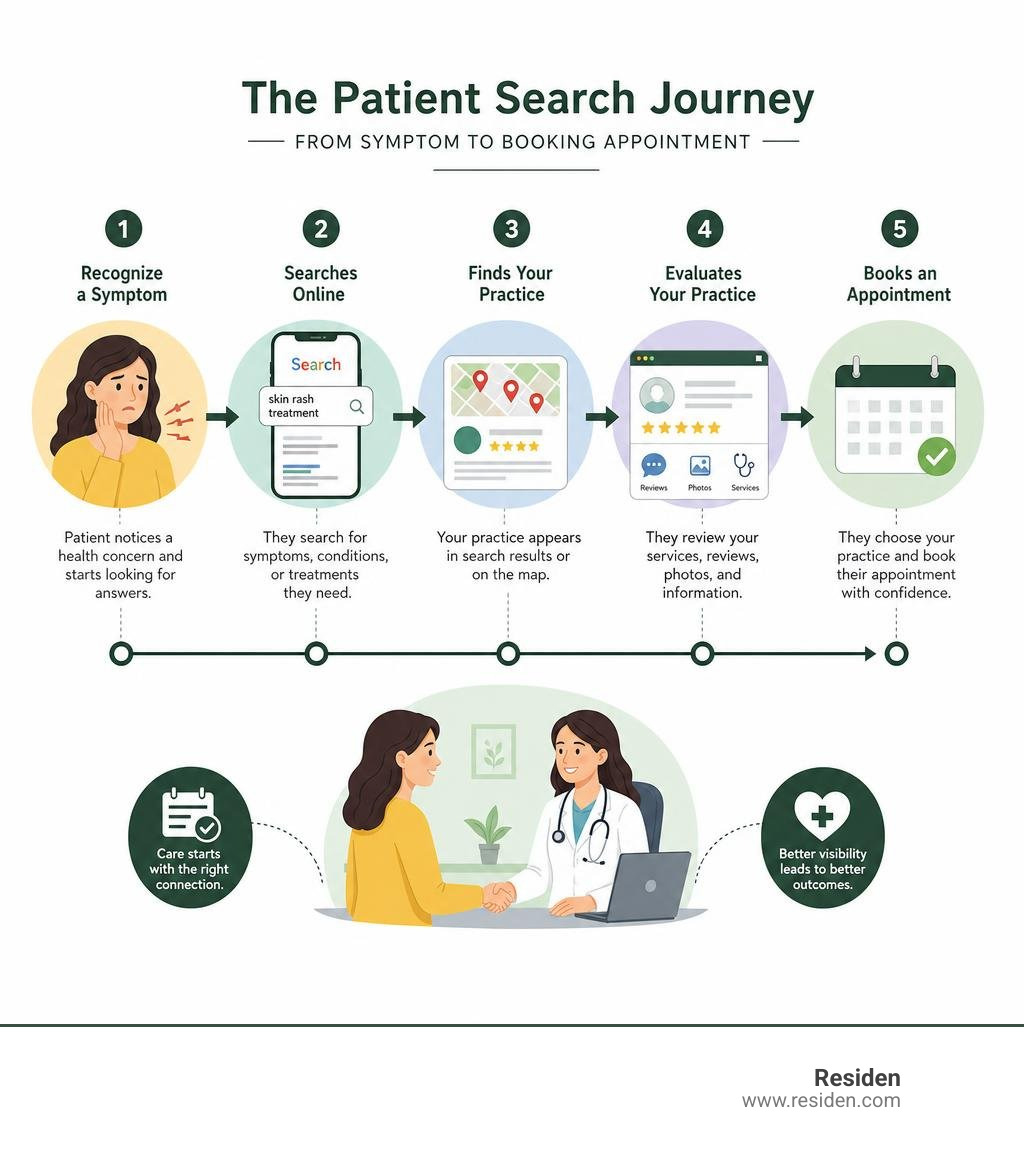
The internet has fundamentally changed how patients choose their doctors. They are not asking friends for referrals first anymore — they are opening Google, typing in a symptom or a specialty, and picking from the first few results they see. If your practice is not showing up, those patients are booking with someone else.
This is not a small problem. Google alone processes over 1 billion health-related searches every day. The gap between practices that invest in smart SEO and those that don't is growing wider every month.
I'm Dr. Jessica Wu, a Los Angeles-based dermatologist with over 20 years of private practice experience — and navigating the digital landscape to attract and retain patients has been just as critical to my practice as clinical expertise, making me deeply familiar with the real-world stakes of SEO for doctors. In this guide, I'll walk you through exactly what works, what doesn't, and how to build a steady stream of new patients through search.
Why SEO for Doctors Is the Ultimate Patient Acquisition Engine
Think of your medical website as a 24/7 digital receptionist, brand representative, and education center. If that receptionist is hiding in a dark basement where no one can see them, they aren't going to help you schedule many appointments.
When you are starting your own practice, you quickly realize that traditional marketing channels like print ads, radio, or local flyers are incredibly expensive and difficult to measure. Paid search ads (like Google Ads) can yield immediate clicks, but the second you stop paying, your patient pipeline completely dries up.
This is where search engine optimization (SEO) becomes your practice's absolute number-one growth engine. Unlike paid campaigns, organic SEO builds long-term digital equity. Once your website ranks on the first page of Google for high-intent keywords, it stays there, delivering a consistent stream of new patients month after month without a recurring cost-per-click.
The numbers tell a clear story:
- Google processes approximately 13.6 billion searches per day, translating to about 99,000 searches every second.
- Over 77% of patients use online searches to book appointments.
- The #1 organic result is 10 times more likely to get clicked than the #10 spot, capturing 27.6% of all clicks.
- Over 80% of healthcare consumers state that online visibility and scheduling options directly influence their choice of provider.
By investing in organic SEO, you position your practice exactly where patients are looking at the precise moment they need your care. This creates a compounding return on investment (ROI) that is unmatched by any other marketing channel.
The Three Pillars of Medical Search Optimization
To rank on Google, you cannot rely on a beautiful website design alone. In fact, many medical websites are built as "digital business cards" that look stunning but rank for absolutely nothing because they lack structural SEO.
To dominate search results, we must treat medical SEO as a three-dimensional framework.

Technical SEO for Doctors: Speed, Mobile, and Schema
Technical SEO ensures that search engine crawlers can easily read, index, and understand your website. If your technical foundation is broken, even the best medical content in the world will not rank.
Mobile-First Indexing and Page Speed
More than 60% of all Google searches are performed on a mobile device—and in healthcare discovery, that number climbs to nearly 85%. Google uses mobile-first indexing, meaning it evaluates the mobile version of your site to determine your rankings.
If your site takes too long to load on a smartphone, prospective patients will bounce. Data shows that pages loading in less than 4 seconds have the highest conversion rates. If your site takes 5 seconds to load, your conversion rate drops by 19%. If it takes 9 seconds or more, your conversion rate plummets by a massive 84%. A slow website is not just an inconvenience; it is a clinical failure of your user experience.

Structured Schema Markup
Schema markup is microdata added to your website's HTML that helps search engines understand the exact context of your content. For doctors, implementing medical-specific schema is crucial. This includes:
- Physician Schema: Identifies individual doctors, their specialties, board certifications, and National Provider Identifier (NPI) numbers.
- MedicalClinic Schema: Defines your physical office location, operational hours, accepted insurances, and contact details.
- MedicalCondition and MedicalProcedure Schema: Tells search engines exactly what medical conditions you treat and what procedures you perform.
Linking your Physician schema directly to authoritative third-party databases, such as NPI registries or state medical boards, acts as an immediate trust signal to Google's search algorithms.
Content Authority and the E-E-A-T Framework
Because medical websites deal directly with human health, Google categorizes them as YMYL (Your Money or Your Life). Inaccurate or misleading health information can cause real-world harm. Consequently, Google subjects healthcare websites to its strictest quality standards, known as E-E-A-T (Experience, Expertise, Authoritativeness, and Trustworthiness).
How do we build a website that satisfies these rigorous standards? We must move beyond generic, AI-generated blog posts and write with clinical depth.
1. Clinical Attribution and Bylines
Every piece of clinical content on your website should feature a clear author byline linking to a comprehensive doctor profile page. Include a "Medically Reviewed By" line if the content was drafted by a professional writer and verified by a clinician.
2. Evidence-Based Citations
Do not make medical claims without backing them up. Cite peer-reviewed journals, academic studies, and official guidelines (like the CDC or FDA) directly within your articles.
3. HIPAA-Compliant Content
Maintaining patient privacy is paramount. When publishing case studies, clinical outcomes, or patient stories, you must strictly adhere to HIPAA guidelines. Never share Protected Health Information (PHI) without explicit, documented patient consent.
Local SEO for Doctors: Dominating the Map Pack
If you are a pediatrician in Beverly Hills or an orthopedic surgeon in Brentwood, you are not trying to attract patients from New York. You need to dominate your local backyard. This is where local SEO and your Google Business Profile (GBP) come into play.
When a patient searches for a "doctor near me" or a "dermatologist in Los Angeles," Google displays the Local 3-Pack—the map and the top three local clinic listings at the very top of the page. This Local 3-Pack captures a massive 42% of all local search clicks.

To optimize your Google Business Profile and win the Local 3-Pack, you must focus on three core areas:
- NAP Consistency: Your Name, Address, and Phone number (NAP) must be identical across your website, your GBP, and all external medical directories (such as Yelp, Healthgrades, and Zocdoc). Even minor discrepancies (like writing "Suite 610" on your website but "Ste 610" on Google) can confuse search algorithms and hurt your rankings.
- Review Velocity and Recency: 9 out of 10 people check online reviews before choosing a business. Listings with 10 or more reviews generate twice as many patient inquiries. However, total volume is no longer the only ranking factor; Google now heavily prioritizes review velocity (how frequently you receive new reviews) and recency (reviews left in the last 90 days).
- Category Specificity: When setting up your GBP, choose the most specific primary category possible. If you are a cardiologist, select "Cardiologist" rather than the generic "Doctor" or "Medical Clinic."
Keyword Strategy and Content Creation for Practices
To write content that actually converts readers into scheduled appointments, you must understand search intent. Patients use search engines differently depending on where they are in their healthcare journey.
We can divide these searches into two primary categories:
- Condition-Based / Symptom-Class Queries: These are informational searches where a patient is trying to understand what is wrong (e.g., "why does my heel hurt when I wake up?").
- Service-Based / Brand Queries: These are high-intent transactional searches where a patient is looking for a specific provider or treatment (e.g., "podiatrist in Brentwood" or "plantar fasciitis treatment Los Angeles").
While service-based keywords are highly competitive, symptom-class queries represent an untapped goldmine. They have lower competition and convert at an incredibly high rate (typically 8–15%) when paired with a dedicated landing page that answers their questions and offers a seamless booking option.
| Keyword Type | Example Search Query | Search Intent | Competition Level | Conversion Rate |
|---|---|---|---|---|
| Symptom-Class | "Why is my vision blurry in one eye?" | Informational (Early Stage) | Low to Medium | 8% – 15% |
| Service-Class | "Ophthalmologist in Beverly Hills" | Transactional (Ready to Book) | High | 15% – 25% |
| Treatment-Class | "LASIK eye surgery cost Los Angeles" | Commercial Evaluation | Medium to High | 10% – 18% |
When creating content, write natural, patient-friendly answers to the exact questions your front desk receptionist hears every day. Break your articles down using an "Atomic Content" structure: start with a clear H2 or H3 question, provide a concise 40-to-60-word summary answer immediately, and then follow up with detailed clinical evidence. This format is highly favored by both search engines and patients.
By targeting these high-intent local and symptom-based keywords, you can successfully learn how to fill your schedule without insurance referrals, giving you complete independence and control over your practice's growth.
Frequently Asked Questions About Medical SEO
Navigating the nuances of digital marketing in the healthcare sector can feel overwhelming. Here are the answers to the most common questions doctors ask about SEO.
How long does it take to see results from medical SEO?
SEO is a long-term, compounding strategy rather than an overnight fix. For a newly launched website or a brand-new medical practice, you can expect the following general timeline:
- Month 1–2: Foundational technical audits, fixing site speed issues, implementing schema markup, and verifying your Google Business Profile.
- Month 3–4: Initial improvements in local Map Pack visibility and search rankings for long-tail, low-competition keywords.
- Month 5–6: Service pages and symptom-class blog posts begin to gain significant organic traction, leading to a noticeable increase in patient inquiries and online bookings.
- Month 7–12: Compounding organic growth kicks in, making your website an established authority that is highly difficult for competitors to displace.
If you are just launching your independent clinic, establishing this digital foundation early is critical. Be sure to read The Definitive Guide to Specialized Medical Practice Startup to ensure your business and digital strategies are aligned from day one.
Can I manage my practice's SEO on my own?
Yes, you can absolutely implement several highly effective DIY starter tips to kickstart your practice's SEO without hiring an expensive agency:
- Claim and Verify Your Google Business Profile: Ensure your hours, address, and phone number are 100% accurate.
- Upload Real Photos: Avoid sterile stock photos. Upload real, high-quality images of your reception desk, comfortable exam rooms, and friendly staff.
- Automate Review Collection: Set up a HIPAA-compliant text message or email system to send a review link to patients immediately after their appointment.
- Write an FAQ Page: Answer the top ten questions patients ask your staff during check-in.
While these DIY steps can yield excellent local results, managing deep technical SEO, schema chaining, and continuous clinical content creation can become highly time-consuming alongside a full clinical schedule. Many doctors choose to handle the local basics themselves and outsource complex technical optimizations.
How do AI search engines like ChatGPT affect doctor searches?
The rise of AI search engines (like ChatGPT, Gemini, Perplexity, and Google's AI Overviews) has introduced a new frontier called Answer Engine Optimization (AEO). Today, over 60% of search queries end without a single click to an external website because AI summaries answer the user's question directly on the search page.
However, AI agents do not generate recommendations out of thin air. They pull their recommendations from highly structured online data. ChatGPT and other LLMs rely heavily on:
- Your Google Business Profile details (which supply up to 50% of ChatGPT's local citation links).
- Structured schema data (like Physician and MedicalClinic markups) to verify your credentials, location, and accepted insurances.
- Verifiable clinical expertise and peer-reviewed citations on your website.
To ensure your practice is recommended by AI assistants, your website must be technically structured so these AI crawlers can easily read, verify, and cite your clinical credentials.
Conclusion
In today’s digital-first landscape, search engine optimization is no longer an optional marketing luxury for doctors—it is a fundamental business necessity. The practices that rank at the top of search results are the ones that treat SEO as a critical clinical asset rather than an afterthought.
However, we know that for many independent physicians, the biggest barrier to launching a private practice isn't just digital marketing; it is the staggering overhead cost of traditional medical real estate. Signing a multi-year commercial lease, buying expensive medical equipment, and hiring full-time administrative staff before you even have a steady patient pipeline is a massive financial risk.
That is where we can help. At Residen, we provide turnkey, shared medical office rentals in premier Southern California neighborhoods, including Los Angeles, Beverly Hills, and Brentwood (including our premier location at 433 N Camden Dr Suite 610, Beverly Hills CA).
We offer fully equipped, patient-friendly exam, procedure, and consultation rooms on a flexible hourly or daily booking basis—with absolutely no long-term leases, hidden fees, or setup costs.
Even better, we solve one of the biggest hurdles of local medical SEO: establishing a stable physical address. To verify your Google Business Profile and rank in the Beverly Hills or Los Angeles Local 3-Pack, you cannot use a P.O. Box or a standard virtual address. Google requires a physical medical office location. When you partner with us, you can secure your medical business address and mailbox with Residen, allowing you to build local search authority and verify your GBP in the most competitive medical markets in the country.
By combining a smart, patient-centric SEO strategy with our flexible, low-overhead medical spaces, you can grow your patient panel safely, scale your practice at your own pace, and focus on what you do best: delivering exceptional patient care.