
How to Use Google Ads to Grow a Practice in a Rented Medical Office

To attract patients to a rented medical office, start with Google Search ads for your specialty and location, such as "dermatologist in Beverly Hills." Send each ad to a page with your services, office location, and a clear way to book. Track calls and appointment requests, then cut search terms that bring clicks but no qualified inquiries. If you hire an agency, ask how it measures booked patients, not just leads.
This approach lets you test demand before committing to a fixed office. Residen offers premium medical coworking spaces in Brentwood, CA, and Beverly Hills, CA, with fully equipped exam, consultation, and procedure rooms available hourly, daily, or longer-term. There are no long-term leases or membership fees. Its technology supports a no-admin medical workspace; Residen does not provide shared administration.
I'm Dr. Jessica Wu, a Los Angeles dermatologist with more than 20 years in private practice. I bring that practice owner's perspective to Google ads doctor office rental planning: how to reach patients while keeping space costs flexible.
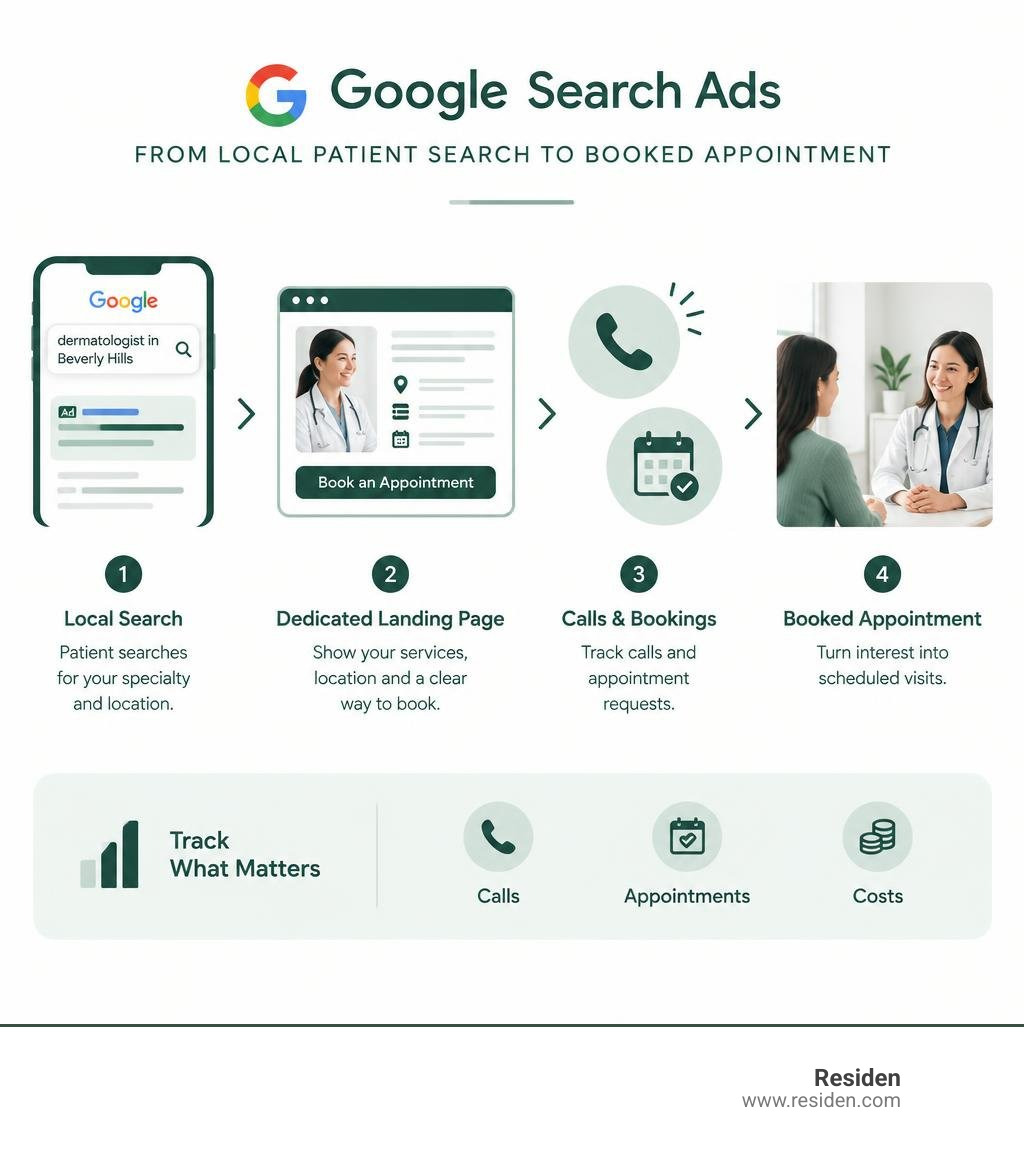
Why Specialized Google Ads Doctor Office Rental Campaigns Drive High Patient Acquisition
When launching or expanding an independent practice, building steady patient volume quickly makes all the difference. Traditional referral networks and word-of-mouth are valuable, but they take months to mature. A targeted Google Ads strategy allows you to capture active patient demand immediately.
Recent healthcare consumer data highlights why paid search remains the gold standard for clinical patient acquisition:
- High-intent search behavior: More than 77% of patients search online before scheduling a medical appointment.
- Mobile-dominant decisions: Over 60% of all healthcare searches occur on mobile devices, often with immediate booking intent.
- Superior conversion efficiency: Healthcare search campaigns achieve average conversion rates around 8.09% for appointment requests, compared to 3–4% in standard e-commerce.
- Competitive click engagement: Medical practices see click-through rates (CTR) between 3.27% and 6.11%, well above the general Google Ads average of 1.91%.

Unlike generic digital marketing channels, paid search targets users with precise intent. Someone searching for "urgent pediatric evaluation near me" or "micrographic surgeon in West LA" is not browsing casually; they are actively seeking care.
By deploying proven medical advertising strategies that reflect verified patient search behavior and intent data, clinicians operating from a flexible medical office space can direct high-intent traffic to specific clinic days. Tightly radius-targeted campaigns (typically 3 to 10 miles around your clinic location) prevent wasted ad spend on patients outside your travel shed, driving qualified appointments while optimizing your overall cost per acquisition.
What to Look for in a Healthcare Google Ads Agency
Running medical PPC campaigns requires a different skill set than standard lead generation. A generalist digital agency may understand how to generate clicks, but they frequently struggle with patient privacy regulations, clinical nuance, and specialty-specific keyword intent.
When evaluating potential agency partners, look for teams with deep experience in healthcare-specific paid media, transparent attribution modeling, and integration with local organic search visibility.
| Evaluation Metric | Specialized Healthcare PPC Agency | In-House / Generalist Agency |
|---|---|---|
| HIPAA & Privacy Compliance | Server-side tracking, BAA signed, zero PHI transmission | Standard browser pixels (high non-compliance risk) |
| Google Healthcare Certification | Direct management of LegitScript / Google certifications | Unfamiliar with certification delays and rejections |
| Negative Keyword Architecture | Comprehensive clinical exclusions (free, cheap, jobs, symptoms) | Generic negative lists that allow irrelevant traffic |
| Conversion Tracking | Direct integration with appointment intake & HIPAA-compliant call routing | Focuses solely on raw form submissions and link clicks |
| Local Search Alignment | Coordinated with integrated SEO for doctors and Google Business Profile | Siloed campaigns with disjointed landing page signals |
An agency specializing in healthcare will focus on metrics that directly impact your bottom line—such as cost per booked appointment and show-up rates—rather than vanity metrics like impressions.
Managing Google Ads Doctor Office Rental Budgets and Bidding Strategies
Effective budget management requires balancing aggressive bidding on high-intent terms while aggressively eliminating non-converting search queries. Cost-per-click (CPC) benchmarks in healthcare range widely, typically from $5 to $40 per click depending on the medical sub-specialty and geographic competitiveness.
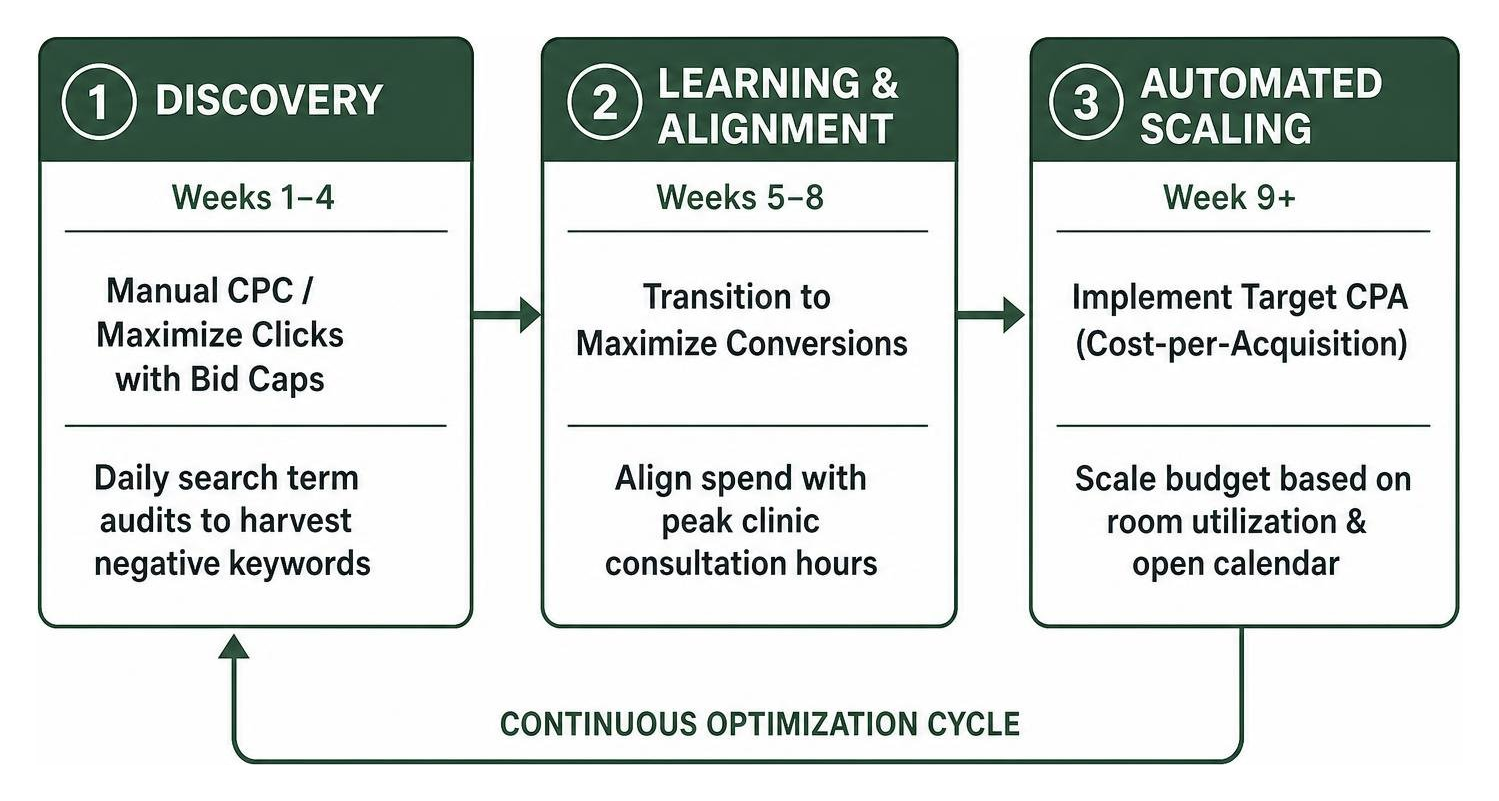
According to established Google Ads healthcare compliance benchmarks, an effective bidding strategy should aim for a target cost per qualified patient inquiry between $30 and $70 for general practices, and $75 to $150 for specialized procedure lines. Using negative keyword match types (such as excluding "home remedies", "medical school requirements", or "free clinic") prevents your budget from draining on unqualified traffic.
Ensuring Compliance with Healthcare Advertising Policies and HIPAA
Healthcare PPC operates under rigorous regulatory oversight. Google enforces strict rules regarding how medical services, pharmaceuticals, and sensitive health conditions are presented:
- Google Healthcare Certification: Certain clinical categories (such as addiction treatment or clinical trials) require specialized verification. First-time certification submissions experience an initial rejection rate near 40%, making experienced guidance invaluable.
- Personalized Advertising Restrictions: Google strictly limits retargeting for medical conditions. You cannot serve personalized display ads to users who previously visited specific treatment pages on your site.
- HIPAA-Compliant Conversion Tracking: Standard tracking scripts (like standard Meta or third-party analytics pixels) can inadvertently capture Protected Health Information (PHI) like IP addresses alongside health-seeking queries. High-performing agencies deploy server-side tracking and HIPAA-compliant call-tracking tools with signed Business Associate Agreements (BAAs).
Key Campaign Architectures That Fill Practice Schedules
To maintain high calendar density in a flexible medical office rental, your campaign architecture must reflect how patients search for care. Structuring campaigns by distinct service lines rather than a single broad ad group ensures ad copy and landing pages mirror search intent.
When establishing your independent schedule or exploring practical ways to start seeing patients this month, dividing campaigns into three core categories yields the highest return:
- Specialty + Location Campaigns: High-intent searches such as "dermatologist Brentwood Los Angeles" or "Beverly Hills sports medicine specialist".
- Procedure-Specific Campaigns: Queries focused on treatments (e.g., "joint injection clinic", "skin tag removal specialist").
- Call-Only Mobile Campaigns: Formatted exclusively for mobile devices to drive immediate intake phone calls during operational hours.
Structuring Google Ads Doctor Office Rental Ad Groups by Medical Specialty
Organizing ad groups tightly around patient symptom queries and specific procedures maximizes Quality Score, lowering your effective CPC. For example, rather than placing all aesthetic or dermatological services into one bucket, separate them into dedicated ad groups:
- Ad Group A (Condition): "adult cystic acne treatment" to Ad Copy: Focus on personalized diagnostic plans to Landing Page: Acne clearance protocols.
- Ad Group B (Procedure): "dermal filler consultation" to Ad Copy: Focus on board-certified injector credentials to Landing Page: Before-and-after gallery and procedure details.
This granular segmentation is essential when attracting your first 100 patients, as it provides the highest ad relevance and conversion rates.
Landing Page Alignment and Conversion Tracking Architecture
Your Google ad is only as effective as the page behind it. Sending paid clicks to a generic homepage dilutes conversion rates. Dedicated medical landing pages must provide immediate clarity and trust signals:
- Prominent Practice Location: Clear address details (e.g., Wilshire Blvd in Brentwood or Camden Dr in Beverly Hills) so patients confirm location convenience instantly.
- Direct Conversion Pathways: Sticky "Tap to Call" buttons for mobile users alongside streamlined online appointment request forms.
- Provider Credentials: Board certifications, professional affiliations, and clear provider headshots.
- Structured Schema Markup: Medical practice schema integrated into page code to reinforce service lines for both search crawlers and AI search tools.
Connecting landing page interactions with Google Analytics 4 (GA4) event tracking enables you to track the exact journey from search query to confirmed intake. This level of clarity is vital for filling your appointment schedule consistently.
Frequently Asked Questions About Google Ads for Medical Practices
How much should a medical practice budget for Google Ads be in 2026?
Most solo or boutique independent practices start with an ad budget between $1,500 and $4,000 per month. The exact spend depends on your medical specialty, local competition, and target patient intake volume. In major metropolitan markets like Los Angeles, competitive specialties such as aesthetics, orthopedics, or cash-pay wellness require higher starting budgets to establish reliable lead flow compared to general primary care.
How long does it take to see new patients from paid search?
Initial lead signals—such as phone calls and online booking requests—often appear within the first 7 to 14 days of campaign launch. However, a fully dialed-in campaign typically requires 60 to 90 days. This ramp-up window allows the bidding algorithm to collect conversion data, test ad copy variants, and build a robust negative keyword list that trims wasteful spend.
Can an office manager run Google Ads instead of a specialized agency?
While an experienced office manager can oversee appointment scheduling and intake logistics, managing paid search campaigns involves technical setup: conversion tracking scripting, negative keyword scrubbing, bidding algorithm management, and HIPAA compliance checks. Without dedicated PPC experience, in-house management frequently leads to misallocated budget and compliance issues. Partnering with a specialized healthcare agency or consultant ensures your advertising dollars yield maximum patient acquisition.
Conclusion
Combining an agile marketing engine with a flexible practice infrastructure allows healthcare professionals to grow their practice with complete autonomy and minimal overhead risk. By aligning targeted Google Ads campaigns with modern medical office rentals, you can expand patient volume on your own terms without committing to rigid, multi-year commercial leases.
Residen provides turnkey medical coworking spaces in Los Angeles—with locations at 11620 Wilshire Blvd in Brentwood and 433 N Camden Dr in Beverly Hills—featuring fully equipped exam rooms, consultation rooms, and procedure rooms available hourly, daily, or longer-term without leases or membership fees. To see how our flexible workspace solutions support private practice growth, partner with Residen to book turnkey medical office rentals and schedule a tour today.