
How to Fill Your Schedule Without Insurance Referrals
The Shift Toward Private Pay: Why Move Beyond Insurance Referrals?

How to Fill Your Schedule Without Relying on Insurance Referrals is something thousands of independent practitioners are doing right now — and the strategies are more straightforward than most expect.
Here are the core ways to do it:
- Build a niche-optimized website with dedicated service pages that rank in local search
- Claim and optimize directory profiles on platforms like Psychology Today and Zocdoc
- Set up a Google Business Profile to capture high-intent local searches
- Network with non-MD referral sources like physical therapists, attorneys, and accountants
- Host community events or workshops to build direct visibility with ideal clients
- Track your referral data to double down on what actually converts
- Price transparently and offer superbills so clients can seek their own reimbursement
Insurance referrals can feel like a safety net. But for many independent practitioners, they are actually a ceiling.
When your schedule depends on insurance panels, HMO gatekeepers, or a single referring physician, your growth is only as stable as those relationships. One PCP retires. One panel closes. One plan changes its network — and your inquiry flow drops overnight.
The good news? Demand for healthcare services has never been higher. The challenge is not the number of people looking for care. It is making sure they can find you when they go looking.
More practitioners are discovering that a private pay model — built on digital visibility, community presence, and smart systems — gives them more control, better margins, and a practice that grows on their terms.
I'm Dr. Jessica Wu, a Harvard-trained dermatologist who has spent over 20 years building and sustaining a thriving private practice in Los Angeles without depending on traditional referral pipelines — and the principles behind how to fill your schedule without relying on insurance referrals apply whether you're a therapist, specialist, or primary care provider. In this guide, I'll walk you through exactly what works, so you can build a practice that stays full — on your terms.
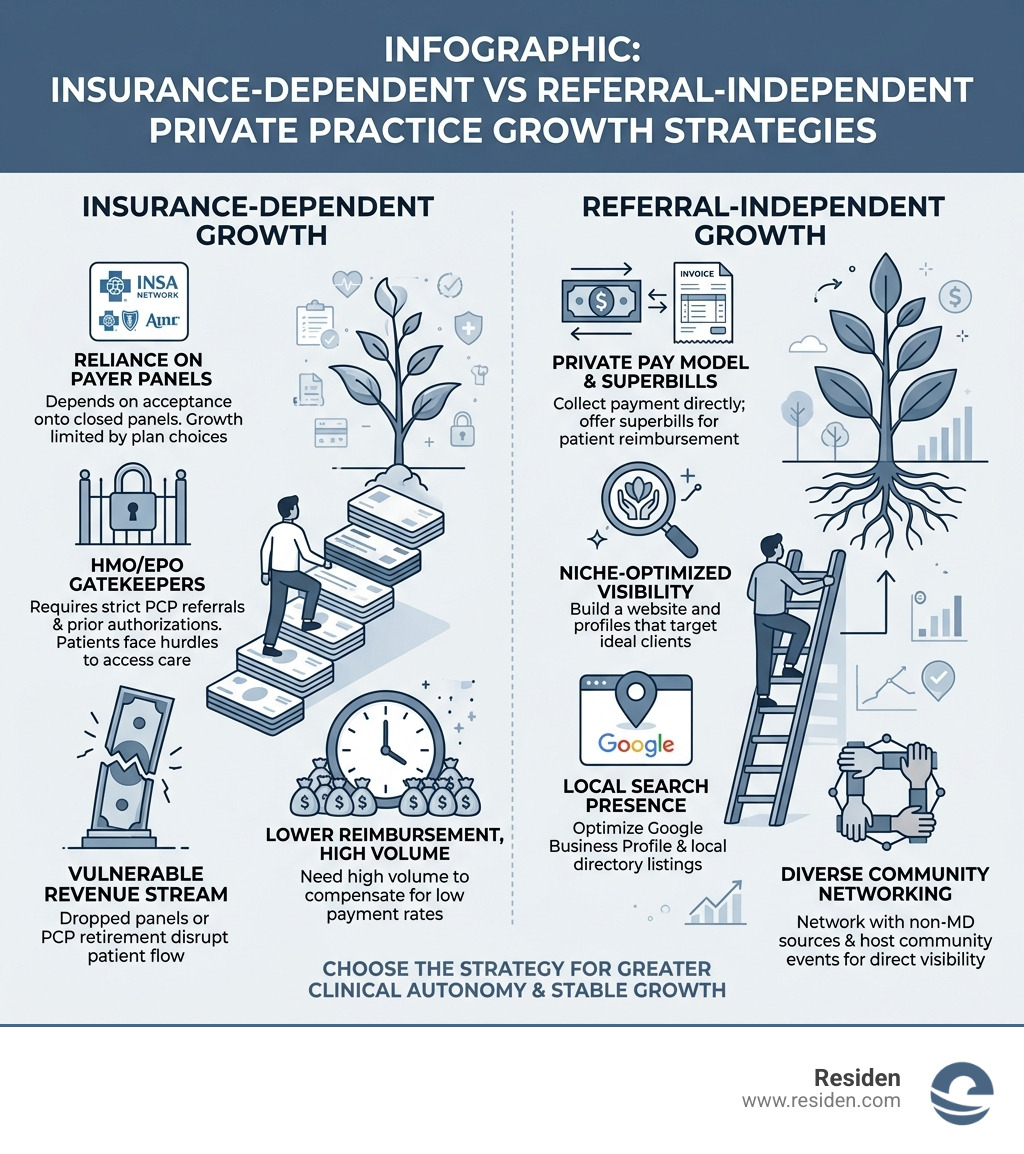
In April 2026, the healthcare landscape in Los Angeles looks different than it did a decade ago. While insurance once promised a steady stream of patients, many providers now find themselves trapped in a cycle of high volume and low reimbursement. Moving toward a private pay model isn't just about making more money; it’s about regaining The Perks of Private Practice, such as clinical autonomy and a manageable pace.
The traditional insurance model is fraught with hurdles. HMOs and EPOs have become increasingly common in the individual health insurance market as insurers look to control costs. These plans often require strict primary care provider (PCP) referrals and prior authorizations, creating friction for both the patient and the provider. If you've ever wondered How Referrals Work With Your Health Insurance, you know that a patient’s access to your care is often at the mercy of a middleman.
By stepping outside this system, we eliminate the administrative burden of chasing claims and the frustration of "invisible ceilings" where growth stops because a specific insurance panel is full. Instead, we focus on a direct-to-consumer approach that prioritizes the patient-provider relationship.
Identifying Your Ideal Client Profile
To succeed without insurance referrals, you must stop trying to be everything to everyone. Generic messaging like "I help people heal" doesn't move the needle in a competitive market like Beverly Hills or Brentwood. When Starting Your Own Practice, the first step is defining a niche.
Ask yourself:
- What specific conditions do I treat most effectively?
- What are the demographics of the patients I enjoy working with?
- What "pain points" are they searching for online at 2:00 AM?
When you specialize—for example, focusing on "postpartum anxiety for high-achieving professionals" rather than just "therapy"—you become the obvious choice for a specific group of people. This specificity doesn't narrow your practice; it deepens your connection with high-intent seekers who are willing to pay for expertise.
How to Fill Your Schedule Without Relying on Insurance Referrals Using Digital Assets
In today's market, your digital presence is your storefront. If a potential client in Los Angeles searches for your specialty and you don't appear on the first page of Google, you effectively don't exist to them. How to Grow Therapy Practice Without Referrals often comes down to building an infrastructure that attracts, filters, and converts traffic automatically.
Effective Advertising & Publicity for a private practice starts with owning your local search results.

Optimizing Your Website for High-Intent Search Without Insurance Referrals
Your website needs to do more than look "professional." It has to work. Many providers make the mistake of having a single "Services" page that lists ten different treatments. This is an SEO nightmare. Instead, create dedicated pages for each specialty. If you are a neurologist in Beverly Hills, you should have separate pages for "Migraine Treatment," "Concussion Recovery," and "Sleep Disorders."
When Starting a Medical Office: Your Complete Checklist for Success, ensure your website hits these benchmarks:
- Mobile Performance: Most health searches happen on phones. If your site takes longer than three seconds to load, you’ve lost the lead.
- Clear CTAs: Every page should have a prominent button saying "Book a Consultation" or "Schedule Your Visit."
- Local SEO: Use keywords like "Therapist in Brentwood" or "Specialist near 433 N Camden Dr" to signal your location to Google.
Leveraging Online Directories and Psychology Today Profiles
While your website is your home base, directories are the outposts that drive traffic. For mental health professionals, Psychology Today is the gold standard, but it’s crowded. To stand out, use video. Research shows that adding a video to your profile can double your visibility. It allows potential clients to hear your voice and feel your energy before they ever call.
For medical specialists, platforms like Zocdoc are essential. According to the How to Grow Your Private Practice: 2026 Guide | Zocdoc, these marketplaces turn "intent into bookings" by showing your real-time availability to patients who are ready to see someone now. Optimization is key: use high-quality photos, transparent pricing, and encourage patients to leave reviews, as online reviews are now a primary factor in how patients choose providers.
Community-Based Marketing and Networking for Private Pay Practices
Digital marketing is powerful, but in the healthcare world, human connection still reigns supreme. The Importance of Networking as a Physician cannot be overstated, especially when you are bypassing the insurance-referral loop.
Instead of waiting for a PCP to send you a patient, you must proactively build a "Center of Influence." This involves identifying 10–20 loyal partners who understand your value. Starting in Private Practice: Building Referral Networks from Scratch requires viewing yourself as a consultant who offers value to others, not a vendor begging for business.
Building Relationships with Non-MD Referral Sources
One of the most overlooked strategies for how to fill your schedule without relying on insurance referrals is looking beyond other doctors. Think about who else your ideal client interacts with:
- Physical Therapists: Often spend more time with patients than MDs and are great sources for orthopedic or neurology referrals.
- Attorneys: Family law attorneys often need therapists for their clients; personal injury attorneys need specialists.
- Accountants and Financial Advisors: High-net-worth individuals often discuss health-related stressors with their financial team.
When Doctors Know Each Other, the trust transfer to the patient is seamless. Hosting small workshops or "meet and greets" at a local gym, yoga studio, or community center in Brentwood or Beverly Hills can establish you as the local expert without ever needing an insurance company's blessing.
Essential Systems and Pricing for an Insurance-Free Practice
To run a smooth private pay practice, you need systems that replace the "work" insurance companies used to do. This includes clear billing, easy scheduling, and professional documentation. You’ll want to understand What New Physicians Need to Know About Billing Insurance even if you don't take it, because many patients will ask for "superbills"—detailed receipts they can submit to their PPO for out-of-network reimbursement.
| Feature | Insurance-Based Workflow | Private Pay Workflow |
|---|---|---|
| Payment | Delayed (30-90 days) | At time of service |
| Admin Time | High (claims, coding, appeals) | Low (automated EHR) |
| Patient Access | Requires referral/authorization | Direct booking |
| Rates | Set by insurer | Set by provider |
| Documentation | Focused on "medical necessity" | Focused on clinical care |
How to Fill Your Schedule Without Relying on Insurance Referrals by Tracking Data
You cannot improve what you do not measure. In an insurance-free model, you are the marketing director. You need to track exactly where every inquiry comes from. Use a simple spreadsheet to log:
- Source (e.g., Google Search, Zocdoc, Word of Mouth)
- Conversion (Did they book an appointment?)
- Income (Total revenue from that source)
By analyzing this data annually, you can see which channels are worth your time. If your Psychology Today profile costs $30/month but hasn't generated a lead in six months, drop it. If your website SEO is driving 80% of your full-fee patients, invest more in content. As noted in Fill Your Schedule: 10 Strategies to Get More Referrals, focusing on "lead measures"—the actions you take that predict future referrals—is the key to consistency.
Frequently Asked Questions about Filling a Caseload
How long does it take to build a full caseload without insurance?
For most New Physicians or therapists, building a full private-pay caseload takes between 6 to 18 months. The first 10–20 patients are the hardest to get; they serve as your "live audition." If they have a great experience, they become your word-of-mouth army. Consistency in your marketing efforts is more important than a one-time "big splash."
What are the most common mistakes when going insurance-free?
The biggest mistake is generic messaging. If your website sounds like every other doctor's office, patients will choose based on price or insurance. Another pitfall is failing to follow up. Many practitioners let inquiries die in their voicemail. Finally, consult our Before You Hire Checklist to ensure you aren't scaling your overhead (like expensive long-term leases) before your revenue justifies it.
Can associates or new practitioners succeed without insurance panels?
Absolutely. In fact, What Young Doctors Want is often the flexibility that insurance-free models provide. New practitioners can thrive by focusing on a hyper-niche market and using modern tools like Instagram or LinkedIn to build a personal brand. Even if you are working under supervision, you can brand your own "practice within a practice" and build a loyal following that stays with you for years.
Conclusion
Building a practice that doesn't rely on the whims of insurance companies is the ultimate path to professional freedom. By focusing on niche specialization, optimizing your digital assets, and fostering genuine community relationships, you can fill your schedule with the patients you are best equipped to help.
However, we know that the "business" side of practice—finding office space, managing overhead, and setting up equipment—can be daunting. That’s where we come in.
At Residen, we provide turnkey, shared medical office rentals in the heart of Los Angeles, Beverly Hills, and Brentwood. Whether you need a professional consultation room for an hour or a fully equipped procedure room for a day, our flexible booking system allows you to grow your practice without the burden of a long-term lease or high setup costs. Our spaces at 433 N Camden Dr are designed to be patient-friendly and ready for you to walk in and start seeing clients immediately.
Ready to take control of your schedule and your future? Get Started with Residen today and see how easy it is to practice on your own terms.