
Why Private Practice Marketing in Beverly Hills Is One of the Hardest Challenges in Healthcare

Private practice marketing in Beverly Hills: standing out in a competitive market is the defining challenge for independent providers in one of the most saturated healthcare markets in the world.
Here is what works, at a glance:
| Strategy | Why It Matters |
|---|---|
| Local SEO + Google Maps | High-value patients search by neighborhood, not city |
| Review velocity | 90% of patients read reviews before booking |
| AI search visibility | ChatGPT and Perplexity are now patient referral sources |
| Specialization | Signature procedures command premium pricing |
| Concierge patient experience | Retention beats re-acquisition every time |
| Unified marketing infrastructure | Fragmentation inflates CAC by 40-60% |
Beverly Hills is not just competitive — it is structurally expensive to compete in. The average cost to acquire a high-value patient consultation has risen from $2,400 in 2021 to over $4,100 in 2026. That's not just inflation. It's the compounding result of fragmented marketing, bidding wars between nearby practices, and a patient base that expects a luxury experience before they ever walk through your door.
As one industry observer puts it plainly: "We're spending more on marketing than ever, but CAC just keeps climbing." That sentiment is nearly universal among Beverly Hills practices today.
The good news? The practices that understand why CAC is rising — and build their marketing infrastructure accordingly — are gaining ground, not losing it.
I'm Dr. Jessica Wu, a Beverly Hills-based dermatologist who has spent over 20 years building and marketing a private practice in this exact market, and my experience navigating private practice marketing in Beverly Hills and standing out in a competitive market informs everything I share here. Let's walk through what actually moves the needle in 2026.
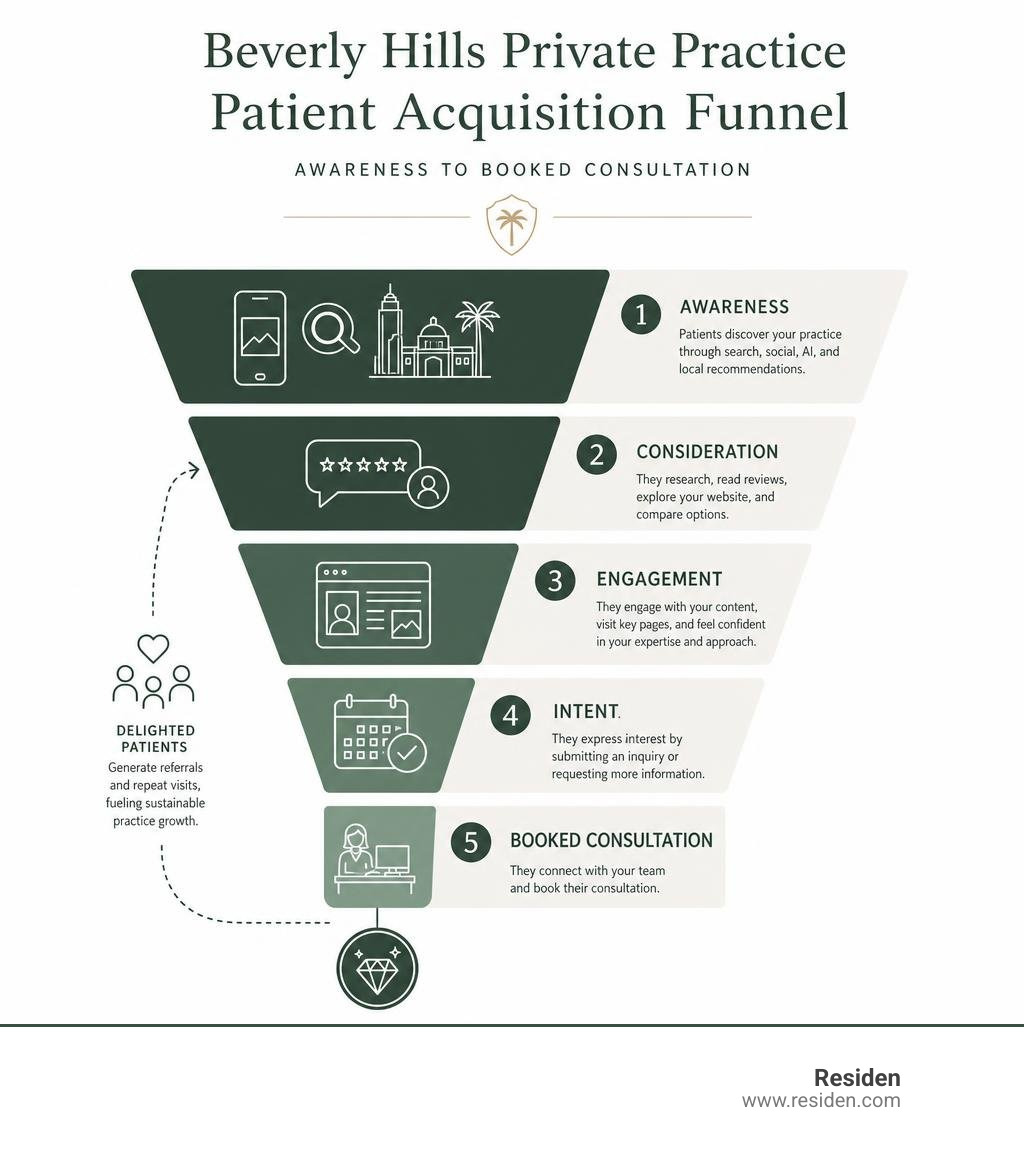
The Economics of Private Practice Marketing in Beverly Hills: Standing Out in a Competitive Market
To succeed on the Westside of Los Angeles, we must first understand the financial math driving the local healthcare landscape. In Beverly Hills, customer acquisition cost (CAC) inflation is outstripping procedure pricing growth by a staggering 23% annually. This means that while a surgeon might charge slightly more for a deep plane facelift or a non-surgical liquid rhinoplasty in 2026 than they did five years ago, the cost to get that patient through the door has grown at a much faster rate.
This economic reality is tied directly to the local real estate and marketing arms race. Beverly Hills, particularly the Wilshire and Bedford corridors, features the highest density of aesthetic, dental, and concierge medical specialists in the country. Many traditional practices are locked into expensive commercial leases and high overhead costs, leaving them with tight margins and forcing them to bid aggressively for the same local search terms.
However, choosing the independent path has incredible advantages. When we examine The Perks of Private Practice, the freedom to control your patient experience, brand positioning, and pricing structure stands out as the ultimate competitive advantage. To protect those margins, practices must transition from generic, broad-scale advertising to highly precise, localized campaigns. Trying to target the entire Los Angeles metro area is a financial money pit. Instead, successful Westside practices focus their capital strictly on high-intent, hyper-local demographics.
Overcoming High CAC with Private Practice Marketing in Beverly Hills: Standing Out in a Competitive Market
One of the most common mistakes that drives up CAC is marketing infrastructure fragmentation. Multi-provider practices or expanding clinical platforms often hire different agencies for SEO, Google Ads, and social media management across different office locations.
This siloed approach creates "marketing debt." When multiple practices or individual providers under the same parent brand bid separately on the same local keywords, they drive up their own costs through internal competition. Financial modeling indicates that consolidating your digital presence into a single, cohesive, portfolio-level marketing infrastructure can lead to a 40% to 52% reduction in CAC.
Furthermore, practices must evaluate their operational model. Choosing a Cash Pay vs Insurance model completely changes your marketing requirements. Insurance-based models rely heavily on volume and geographical convenience. In contrast, a cash-pay or hybrid model requires premium brand positioning that justifies out-of-pocket costs to a highly discerning demographic.
Strategic Positioning and Private Practice Marketing in Beverly Hills: Standing Out in a Competitive Market
In Beverly Hills, premium pricing is never a matter of luck — it is the direct result of strategic positioning. To command luxury-tier fees, a practice must position itself as a highly specialized, concierge-level service rather than a medical commodity.
This is especially true in the realm of concierge medicine marketing in Beverly Hills, where patients are not just paying for clinical expertise; they are paying for extreme discretion, 24/7 direct communication, and lifestyle-aligned care. If your website and digital presence look like a generic, insurance-driven clinic, affluent Westside patients will immediately assume your clinical technology and personalized care are similarly outdated. Your digital branding must match the aesthetic and service standards of the luxury brands your patients interact with daily.
Balancing Organic Search Dominance and Paid Media
To build a sustainable patient acquisition engine, practices must balance the immediate results of paid media with the long-term, compounding equity of organic search.

Relying solely on paid ads is a risky strategy: the moment you stop spending, your patient pipeline dries up. Conversely, relying entirely on organic search can be challenging for a new practice, as SEO can take up to six months to show significant momentum.
To find out how to balance these channels, we must look at how patients search. For comprehensive insights on structuring your digital footprint, explore our guide on SEO for Doctors. By combining immediate Google Ads campaigns with a robust organic content strategy, you can capture high-intent patients today while building an asset that reduces your acquisition costs over time. Many top-tier providers learn how practitioners in Beverly Hills get high-value patients without ads by focusing heavily on search control, map pack dominance, and organic authority.
The Power of Local SEO and Google Maps
When a local resident or an entertainment-industry executive searches for a specialist, they rarely look past the "Google Map Pack" (the top three local map listings on Google Search). Dominating this space is critical.
To win the Map Pack in Beverly Hills, practices must focus on:
- Review Velocity and Consistency: It is not just about having a high rating; Google rewards active profiles. A steady stream of fresh, positive reviews signals that your practice is active and trusted.
- Hyper-Local Relevance: Ensure your Google Business Profile is meticulously optimized with your exact Beverly Hills address, local phone number, and highly specific service categories.
- Patient Decision Factors: Understanding Choosing a Provider: What Factors Matter Most to Consumers and Patients is essential. Modern patients prioritize peer recommendations, ease of booking, and clear geographic proximity.
Precision Paid Advertising and Lead Conversion
While organic search builds long-term authority, targeted paid advertising is the fastest way to fill your schedule with high-value, elective procedures.
To maximize your return on ad spend (ROAS) in a high-cost market, your campaigns must be incredibly precise. This involves setting tight geographical parameters (e.g., a 5-mile radius around your Beverly Hills office) and targeting highly specific, long-tail search queries rather than broad, expensive terms.
To convert these high-intent leads into booked consultations, your digital infrastructure must be seamless. This means sending ad traffic to custom, high-converting landing pages rather than your homepage, offering instant text-to-schedule options, and implementing automated, HIPAA-compliant CRM follow-ups. If you want to learn more about keeping your books full without relying on traditional channels, check out our guide on How to Fill Your Schedule Without Insurance Referrals.
Optimizing for AI-Driven Search and LLM Visibility
In 2026, the search landscape has shifted dramatically. Patients are no longer just typing keywords into Google; they are asking conversational questions to Large Language Models (LLMs) like ChatGPT, Claude, and Perplexity.

If a prospective patient asks ChatGPT, "Who is the best specialist for a deep plane facelift in Beverly Hills with a natural-looking result?" your practice needs to be cited in the response. To achieve this, working with a specialized medical marketing agency in Beverly Hills can help you audit and optimize your "semantic footprint" across the web.
Schema Standardization and Semantic Authority
AI engines do not crawl the web the way traditional search engines do. They look for structured data, entities, and verified relationships to build their knowledge bases.
To ensure your practice is highly visible to AI-driven search engines, you must implement standardized schema markup across your entire website. This structured code tells AI search bots exactly who you are, what procedures you specialize in, and what credentials you hold. Building this semantic authority is a core part of modern Advertising and Publicity strategies, ensuring your practice is recognized as a trusted authority by both human patients and AI algorithms.
Structuring Multi-Surgeon Practices to Avoid Internal Competition
In multi-provider practices, internal competition can quietly destroy marketing efficiency. If three surgeons in the same practice are all trying to rank for "rhinoplasty Beverly Hills," they end up driving up their own paid search costs and diluting their organic authority.
The solution lies in clear brand architecture and procedural division. For example, one surgeon can be positioned as the primary specialist for facial rejuvenation (neck-up), while another focuses exclusively on body contouring (neck-down). This clear division preserves individual specialist reputations while building collective practice authority.
Additionally, leveraging The Importance of Networking as a Physician to build strong peer-to-peer referral pipelines is incredibly valuable. By aligning your internal brand structure with a comprehensive specialty medicine marketing strategy, you can capture a larger share of the market without competing against your own partners.
Transitioning from Personal Brands to Scalable Institutes
Many successful practices eventually face a bottleneck: the brand is entirely tied to the founding doctor's name. If the founder wants to scale, bring on junior associates, or eventually exit the business, they must transition from a personal brand to a scalable institute.
This transition involves:
- Domain Migration: Gradually transitioning your website from
DrJohnSmith.comto a generic, scalable name likeTheBeverlyHillsAestheticInstitute.com. - SEO Equity Preservation: Implementing careful, permanent 301 redirects to transfer years of accumulated search authority to the new domain.
- Transference of Credibility: Using co-branding on social media and your website to introduce junior associates under the umbrella of the institute's collective authority.
For a deeper dive into structuring your business for long-term growth, read our guide on Starting Your Own Practice.
The Patient Experience as a Critical Marketing Differentiator
In Beverly Hills, your marketing does not end when a patient books a consultation. The patient experience — from the first phone call to post-operative follow-up — is your most powerful marketing tool. High-value patients expect an absolute luxury experience, and any friction in their journey will lead them to a competitor.
To understand how high-end practices differentiate themselves, let's look at the key differences in the patient journey:
| Patient Touchpoint | Traditional Practice | Luxury Concierge Practice |
|---|---|---|
| First Contact | Automated phone tree, long hold times, generic greeting | Direct, human response within two rings; personalized greeting |
| In-Office Wait | Crowded waiting room, clinical atmosphere, delayed start | Private waiting lounge, refreshments, strict adherence to schedule |
| Consultation | Rushed 10-minute slot, clinical focus, transactional feel | Unhurried, comprehensive discussion of goals, custom treatment plan |
| Post-Care | Standard printout instructions, generic follow-up call | Personalized recovery kit, direct physician text access, proactive check-ins |
To design an exceptional patient journey, practices must view every operational touchpoint through a marketing lens. Align your operational standards with high patient expectations.
Frequently Asked Questions about Beverly Hills Medical Marketing
Why is CAC so high for Beverly Hills practices?
The high concentration of world-class specialists in the Wilshire and Bedford corridors leads to intense bidding wars for local keywords. Additionally, fragmented marketing systems and high overhead costs contribute to inflated patient acquisition costs.
How long does it take to see results from SEO in Beverly Hills?
While paid ads can generate inquiries within the first few weeks, a comprehensive local SEO and search control strategy typically takes 3 to 6 months to build strong, sustainable momentum. However, this organic authority compounds over time, significantly lowering your long-term CAC.
Can a practice succeed without running paid ads?
Yes. By dominating local SEO, maintaining a high review velocity on Google and Healthgrades, optimizing for AI search engines, and building strong professional referral networks, practices can attract a steady stream of high-value patients organically.
Conclusion
Building a successful private practice in Beverly Hills requires a sophisticated balance of strategic positioning, modern digital marketing, and an exceptional patient experience. However, even the best marketing strategy can fail if your capital is tied up in expensive commercial leases, high administrative overhead, and complex facility management.
That is where we come in. At Residen, we provide turnkey, shared medical office rentals designed specifically for modern healthcare professionals in Los Angeles. Located in the heart of the medical district at 433 N Camden Dr Suite 610, Beverly Hills CA, our premium spaces feature fully equipped exam, procedure, and consultation rooms.
Our technology-enabled, no-admin medical coworking model allows you to book clinical space on a flexible hourly or daily basis with no long-term leases, hidden fees, or setup costs. By eliminating traditional office overhead, we help you free up valuable capital to invest directly in your marketing and patient acquisition engines.
Ready to experience a smarter way to practice? Discover The Residen Difference and Book a Tour of Residen Beverly Hills today to see how we can help your practice thrive.