
The Ins and Outs of Flexible Healthcare's Future
Healthcare Is Changing Fast — Here's Why Flexibility Is at the Center of It All

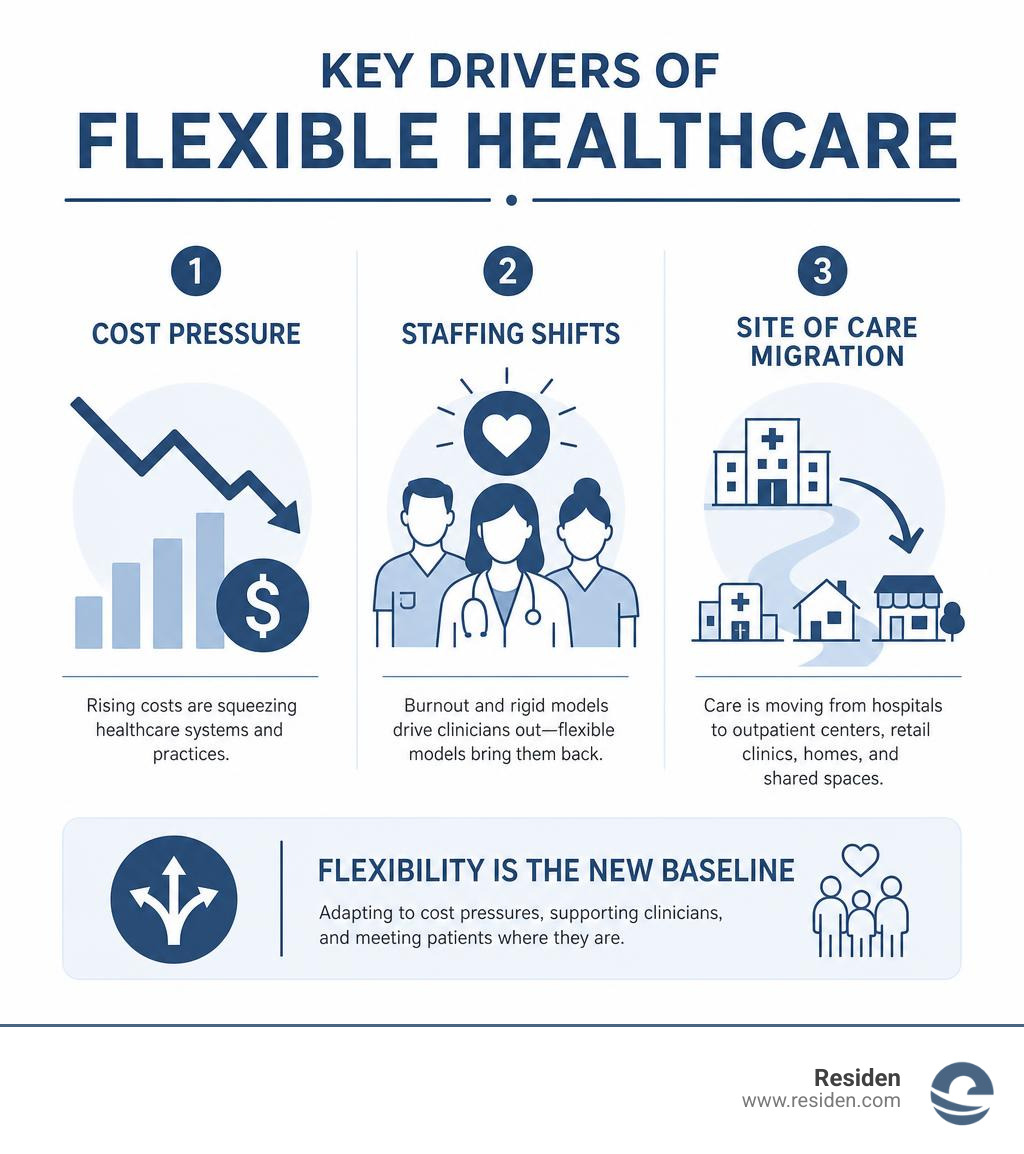
Why the future of healthcare is flexible comes down to a few unavoidable realities reshaping how, where, and by whom care is delivered:
- Rising costs — Medical cost trends are running at roughly 8% annually, squeezing both systems and independent practitioners
- Demographic pressure — About 20% of the U.S. population will be over 65 within five years, driving surging demand for care
- Staffing shortages and burnout — Rigid structures are pushing clinicians out; flexible models are bringing them back
- The site-of-care shift — Inpatient admissions dropped nearly 19% between 2000 and 2023, while outpatient visits climbed 31%
- COVID-19's lasting lesson — The pandemic proved that healthcare systems can adapt rapidly — and that the ones that do, perform better
The old model — fixed facilities, rigid schedules, long-term leases, high overhead — was already under strain before the pandemic hit. COVID-19 didn't create the pressure. It just made it impossible to ignore.
Today, care is moving out of hospitals and into outpatient centers, retail clinics, homes, and shared medical spaces. Technology is automating the administrative work that used to eat up more than a third of a physician's week. And clinicians — especially independent practitioners — are demanding more control over how and where they work.
Flexibility isn't a trend. It's the new baseline.
I'm Dr. Jessica Wu, a Harvard-trained dermatologist with over 20 years in private practice, including making house calls and working across a range of non-traditional care settings — experiences that gave me a front-row seat to why the future of healthcare is flexible and what it means for independent clinicians navigating today's landscape. In the sections ahead, we'll break down exactly what's driving this shift and what it means for your practice.
Why the Future of Healthcare Is Flexible
For decades, the hospital was the undisputed sun around which the entire healthcare universe orbited. If you needed a procedure, diagnostic imaging, or specialized treatment, you went to a centralized hospital campus. But in 2026, that gravity has weakened.
We are living through a massive structural realignment. Between 2000 and 2023, inpatient admissions dropped by nearly 19%, while outpatient visits surged by 31%. This isn't a temporary fluctuation; it is a permanent site-of-service reset.

Several forces are converging to move care away from massive hospital systems and directly into the communities where patients live and work. While hospitals captured a staggering $1.6 trillion in 2024 and drove 40% of national spending growth, that level of centralized spending is increasingly unsustainable.
In response, capital and regulations are actively steering care elsewhere:
- The Outpatient Boom: Ambulatory Surgery Centers (ASCs) are seeing unprecedented growth. Private equity poured nearly $40 billion into ASCs across 2024 and 2025 alone.
- Regulatory Tailwinds: The Centers for Medicare & Medicaid Services (CMS) has accelerated this transition by removing hundreds of procedures from the Inpatient-Only (IPO) list and adding them to the ASC-approved list.
- Hospital-at-Home Models: Reimbursed and extended through 2030, Hospital-at-Home programs have proven that high-acuity care can safely occur in a patient's living room. The results speak for themselves: a 38% lower cost of care and a 44% reduction in patient readmissions.
To understand the broader implications of these shifts, we can look at The End of Hospital Dominance? Decoding 2026 Site of Service Signals, which outlines how regulatory, statutory, commercial, and capital forces are permanently eroding traditional hospital pricing power. Care is moving to settings that patients prefer and that the system can actually afford.
Understanding Why the Future of Healthcare Is Flexible for Clinicians
The traditional, rigid clinical schedule is broken. Today, physicians spend more than a third of their time on paperwork—equating to over a day and a half each week lost to administrative burdens. Combined with inflexible 12-hour shifts or rigid five-day clinic weeks, it is no surprise that clinician burnout has reached crisis levels.
The modern workforce is demanding something different. Younger clinicians entering the field expect autonomy and schedule control from day one. To combat burnout and retain top talent, healthcare organizations are turning to workforce flexibility strategies:
- Float Pools and Cross-Training: Allowing staff to move between departments or clinics to balance the ebb and flow of patient volume.
- Per Diem and Contract Staffing: Utilizing flexible coverage models to prevent existing staff from reaching their breaking point.
- Telehealth and Hybrid Roles: Giving clinicians the ability to conduct virtual visits from home, reducing commute stress and expanding access.
Adaptable schedules have transitioned from a "hiring perk" to an essential retention strategy.
For independent practitioners, this desire for autonomy often leads straight to The Perks of Private Practice. Having the freedom to set your own hours, choose your patient volume, and design your workflow is the ultimate antidote to clinical exhaustion. However, starting a traditional private practice historically required taking on massive debt and signing long-term commercial leases. That is where physical space flexibility enters the equation.
Realizing Why the Future of Healthcare Is Flexible in Physical Spaces
If the way we practice medicine is flexible, the buildings we work in must be too. Historically, medical real estate was incredibly rigid. A specialist would sign a 10-year lease on a raw commercial space, spend hundreds of thousands of dollars on build-outs, and remain locked into that footprint regardless of how their practice evolved.
Today, forward-thinking operators are designing spaces that can easily adapt to changing needs. In a hospital setting, this looks like reconfigurable patient rooms. According to recent industry surveys:
- 36% of healthcare organizations have already implemented flexible care models where patient rooms can be reconfigured to provide different levels of care based on changes in patient acuity.
- Another 34% of organizations are actively considering doing so.
- 85% of respondents believe that hospitals with flexible care models are best positioned to manage physical resources based on the ebb and flow of daily patient capacity.
According to a leading industry perspective, flexibility and Human-Centered Design will define the next decade, designing for volatility rather than stability is the only way to future-proof medical infrastructure. High-acuity outpatient settings require modular designs that can absorb sudden operational shocks, adapt to new diagnostic technologies, and support clinician well-being.
For independent doctors, acupuncturists, physical therapists, and specialists, this physical adaptability is realized through modern coworking and shared spaces. Before committing to a physical location, it is critical to read Everything You Need to Know About Medical Office Rental Space to understand how flexible real estate can eliminate upfront capital expenditures and protect your practice from market volatility.
The Core Pillars of Flexibility in Modern Medicine
To successfully transition away from the rigid structures of the past, we must view flexibility not as a single initiative, but as a system supported by four core pillars:
- Physical Space: Real estate that scales up or down based on active patient volume.
- Workforce: Clinicians and support staff who can work across different modalities (in-person, virtual) and schedules.
- Technology: Software and digital tools that integrate seamlessly rather than operating in isolated silos.
- Financing: Capital structures that favor operational expenditure (OpEx) over massive capital expenditure (CapEx).

When these pillars align, the operational and financial differences between the old way of practicing and the new way become stark. Let's look at how traditional commercial leasing stacks up against a modern, flexible medical coworking model:
| Operational Feature | Traditional Medical Leasing | Flexible Medical Coworking (Residen) |
|---|---|---|
| Upfront Capital (CapEx) | $100k - $500k+ (build-out, permits, equipment) | $0 (fully furnished, turnkey, and ready) |
| Lease Commitment | 5 to 10 years | No lease (hourly or daily bookings) |
| Administrative Burden | High (managing utilities, cleaning, staff, OSHA) | Zero (all facility logistics handled by us) |
| Scalability | Rigid (stuck with the same square footage) | Highly flexible (scale up or down instantly) |
| Financial Risk | High (personal guarantees, fixed monthly overhead) | Extremely low (pay only for the time you use) |
Digital Infrastructure: Platforms, Plug-Ins, and Stacks
To support a highly distributed and flexible care model, our digital tools must be as adaptable as our physical rooms. Historically, healthcare IT was defined by massive, rigid Electronic Health Record (EHR) systems that did not talk to other software, creating administrative bottlenecks.
The industry is rapidly shifting toward unified digital ecosystems. As detailed in the thought leadership piece Why the Future Belongs to Platforms, Plug-Ins, and Stacks, healthcare innovation is moving away from isolated "point solutions" and toward reusable platform architectures.
Instead of buying separate, disconnected tools for remote patient monitoring, telehealth, and billing, modern practices utilize a single operational backbone. This allows a practice to easily "plug in" new capabilities—such as an AI-driven ambient listening tool for medical charting or automated prior authorization software—without having to rebuild their entire digital workflow. This platform-based approach reduces the time clinicians spend on administrative paperwork, freeing them up to focus on direct patient care.
Operational Agility: Hourly and Daily Practice Models
For independent clinicians in high-cost metropolitan areas like Los Angeles, physical real estate is often the single biggest barrier to entry. If you want to see patients in Beverly Hills or Brentwood, the cost of commercial space can be prohibitive.
This is where the hourly and daily practice model completely changes the economics of medicine. By utilizing shared medical spaces, clinicians can transition from a fixed-overhead model to a variable-cost model.
If you are a specialist who only needs to see patients in-person two days a week, why pay rent for all seven? Through flexible scheduling, you can access premium, fully managed clinical suites exactly when you need them.
To explore how this works in practice, check out Finding Your Daily Doctor Suite: A Guide to Flexible LA Healthcare Rentals. Whether you need an exam room for routine checkups or a specialized procedure room, understanding the nuances of Hourly vs Daily: Which Procedure Room Rental Fits Your Practice allows you to align your real estate expenses directly with your actual patient revenue.
Frequently Asked Questions
What does flexible healthcare mean in practice?
In practice, flexible healthcare means breaking down the rigid boundaries of traditional medicine to deliver care where, when, and how it makes the most sense. For patients, this means having access to virtual visits, home-based care, and community-integrated retail clinics. For clinicians, it means having the freedom to work part-time, utilize shared medical office spaces, and leverage digital platforms that automate administrative tasks. It shifts the entire system from a "provider-centric" model to an adaptable, "patient-centric" ecosystem.
How do flexible care models benefit patients?
Flexible care models prioritize patient convenience, outcomes, and comfort. By shifting lower-acuity procedures to outpatient settings or utilizing Hospital-at-Home programs, patients receive care in less stressful environments with a significantly lower risk of hospital-acquired infections. Additionally, flexible staffing and scheduling models reduce patient wait times, make same-day appointments more accessible, and allow for highly personalized, continuous care.
What are the financial advantages of flexible medical spaces?
The financial advantages are massive, particularly for independent practices. By utilizing shared, turnkey medical spaces, clinicians completely eliminate the upfront capital expenditures (CapEx) associated with commercial build-outs and medical equipment purchasing. It converts a massive fixed monthly overhead into a flexible operational expense (OpEx) that scales with patient volume. If your patient load drops or you go on vacation, your real estate costs drop accordingly, dramatically reducing financial risk.
Conclusion
The traditional healthcare model was built for a world of predictability and stability. But as we navigate 2026, we are living in an era of rapid technological advancement, shifting patient preferences, and economic volatility. Trying to meet these dynamic challenges with rigid, long-term infrastructure is a recipe for clinical burnout and financial strain.
Future-proofing your medical practice requires building adaptability into your business model from day one. Whether you are looking to launch a new private practice, expand your existing footprint into a new neighborhood, or transition to a part-time clinical schedule, the tools to build a flexible practice are already at your fingertips.
At Residen, we provide turnkey, shared medical office rentals—including fully equipped exam rooms, procedure rooms, and consultation spaces—designed specifically for modern healthcare professionals in Los Angeles. With our flexible daily and hourly booking options, you can see patients in premium locations like Beverly Hills and Brentwood with absolutely no long-term leases, membership fees, or upfront setup costs.
Ready to experience the future of healthcare real estate? Explore our premium, patient-friendly spaces and book your next clinical suite by visiting Residen Locations today.