
Everything you need to know about medical office rental space
What Independent Physicians Need to Know About Medical Office Space Leasing
Medical office space leasing is one of the most consequential financial decisions a healthcare professional will make — and one of the least understood.
Here's a quick overview of what it involves:
| What You Need to Know | Quick Answer |
|---|---|
| What it is | Renting a clinical space under a commercial lease agreement |
| Typical lease length | 3–10 years, often with renewal options |
| Common lease type | Triple Net (NNN) — tenant pays rent plus taxes, insurance, and maintenance |
| Typical rent range | $10–$50 per square foot per year (varies widely by market) |
| Key cost factors | Usable vs. rentable square feet, rent escalation (2–4%/year), CAM charges |
| Biggest risks | Demo clauses, relocation clauses, and hidden occupancy costs |
| Main alternative | Medical coworking or flexible shared space |
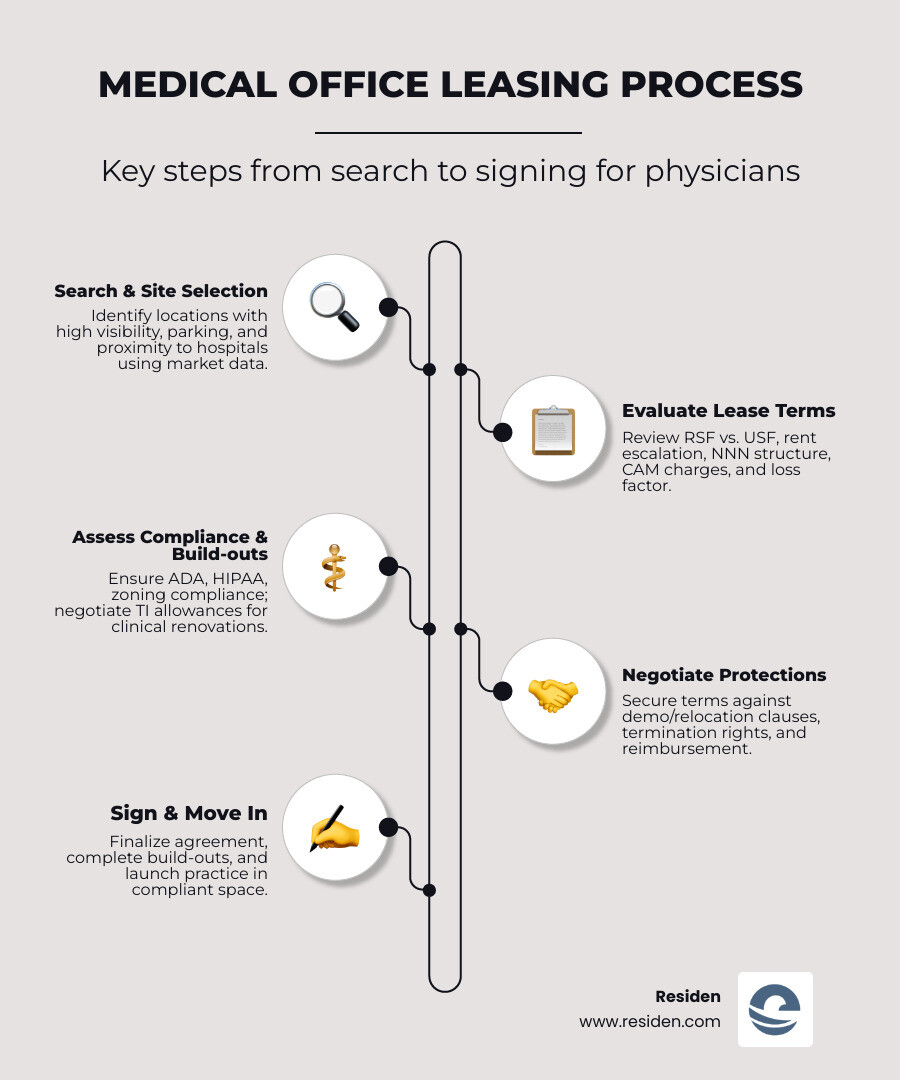
Unlike a standard office lease, a medical lease comes with layers of complexity — from understanding the difference between rentable and usable square feet, to navigating compliance requirements like ADA and HIPAA, to negotiating tenant improvement allowances for expensive clinical build-outs.
The stakes are high. Lock in the wrong terms and you could be paying for space you can't fully use, absorbing renovation costs the landlord should cover, or facing a forced relocation that disrupts your entire patient base.
More than half of medical group practices have remodeled, added square footage, or changed locations in recent years just to stay competitive. That kind of churn is expensive — and often avoidable with the right information upfront.
I'm Dr. Jessica Wu, a Los Angeles-based dermatologist with over 20 years of private practice experience navigating the realities of medical office space leasing — from evaluating lease terms to managing build-outs in one of the country's most competitive healthcare real estate markets. In this guide, I'll walk you through everything you need to know to make a confident, informed decision.
The Financial Decision: Buying vs. Medical Office Space Leasing
One of the first questions we often ask ourselves as practice owners is: "Should I keep paying a landlord, or should I own the walls I work in?" In 2026, the Los Angeles market remains incredibly tight, and the "buy vs. lease" debate is more nuanced than ever.
Buying medical real estate is often viewed as a way to build long-term wealth and secure a stable retirement. However, it isn’t a one-size-fits-all solution. Ownership requires significant up-front capital, often in the form of a 10% to 25% down payment, and ties your practice's success to the local real estate market.
On the other hand, medical office space leasing offers operational agility. It allows you to preserve your capital for medical equipment, staff, and marketing. If your practice outgrows its footprint in five years, moving is much simpler when you aren't trying to sell a specialized building.

| Factor | Buying Medical Property | Medical Office Space Leasing |
|---|---|---|
| Upfront Cost | High (Down payment + Closing) | Lower (Security deposit + First month) |
| Control | Full control over renovations | Requires landlord approval |
| Maintenance | Owner's full responsibility | Often shared or managed by landlord |
| Tax Impact | Depreciation & interest deductions | Rent is a fully deductible business expense |
| Flexibility | Low (Difficult to move quickly) | High (Relocate at lease end) |
For those just starting your own practice, leasing is almost always the preferred route to minimize initial risk.
Long-term Wealth vs. Operational Flexibility
While owning property can lead to significant appreciation, it also introduces "double risk." If your medical practice struggles, you might not be able to pay the mortgage on the building, leading to a dual financial crisis. Expert analysis suggests that for many, leasing is actually safer because it separates professional risk from real estate risk.
Furthermore, liquidity is a major concern. Real estate is an "illiquid" asset. If you need cash to upgrade to a new robotic surgical system, you can't easily pull that money out of your lobby floor. Leasing keeps your cash flow liquid and your practice nimble. We've seen at least five mistakes physicians make when leasing medical office building for their practice, and the biggest is often over-committing to a space that doesn't allow for future growth or contraction.
Impact on Practice Taxes and Retirement
The tax landscape for medical real estate has changed over the years. Currently, write-off periods for real estate are twice as long as they were in the 1980s, making the immediate tax benefits of ownership less "sexy" than they used to be. However, net income from owned real estate can sometimes avoid Social Security and Medicare taxes, which is a nice perk for high-earners.
When planning for retirement, some doctors rely on selling their building to fund their golden years. But beware: many physicians find little equity at retirement because they overpaid for the building or failed to maintain it. For most, the most predictable path to a healthy bottom line is managing overhead effectively through smart leasing. You can view our pricing models to see how flexible options compare to these heavy long-term commitments.
Essential Terms in a Medical Office Lease Agreement
When you finally receive a lease for medical office space leasing, it can feel like reading a foreign language. But those "boilerplate" terms are where the money is won or lost.
Key terms you must master include:
- Rent Escalation: Most leases include an annual increase, typically between 2% and 4%. This can be a "fixed" percentage or tied to the Consumer Price Index (CPI).
- Triple Net Lease (NNN): This is the gold standard in commercial real estate. In an NNN lease, you pay a base rent plus your "pro-rata share" of the building's property taxes, insurance, and Common Area Maintenance (CAM) charges.
- CAM Charges: These cover the "common" parts of the building—the lobby, the parking lot, the elevators, and the landscaping.
Understanding RSF, USF, and Medical Office Space Leasing Costs
This is where many doctors get tripped up. There is a difference between the space you actually stand in and the space you pay for.
- Usable Square Feet (USF): The actual space within your walls where you treat patients.
- Rentable Square Feet (RSF): The USF plus your share of the building's common areas (hallways, restrooms, lobbies).
The difference between these two is the Loss Factor. For example, if you lease 1,000 RSF but only have 800 USF of actual office space, your loss factor is 20%. In high-rise buildings in Los Angeles or Beverly Hills, these factors are often calculated using BOMA (Building Owners and Managers Association) standards. It’s vital to understand these costs to accurately compare pricing across different properties.
Protecting Your Practice from Demo and Relocation Clauses
Two of the most "draconian" clauses in a lease are the Demo Clause and the Relocation Clause.
- Demo Clause: Allows the landlord to terminate your lease if they decide to demolish or redevelop the building. For a medical practice with $200,000 in specialized plumbing and lead-lined walls, this can be a total disaster.
- Relocation Clause: Gives the landlord the right to move you to a "comparable" space in the building. "Comparable" is a subjective term. You must negotiate that the landlord pays for all moving costs, new stationery, and a build-out that is identical or better than your current one.
Always check the pricing and terms carefully to ensure you aren't signing away your practice's stability.
Evaluating Locations and Compliance Requirements
In medical office space leasing, location isn't just about a pretty view; it's about patient flow and legal survival.
When scouting Los Angeles, Beverly Hills, or Brentwood, consider:
- Parking Ratios: Standard office buildings might offer 3 spaces per 1,000 square feet. Medical offices often require 5 or more to accommodate patients, staff, and overlapping appointments.
- Visibility and Accessibility: Can your elderly patients find the entrance? Is it near major transit or hospitals like Cedars-Sinai?
- Proximity to Referrals: Being in a building with complementary specialists (e.g., an orthopedist next to a physical therapist) can naturally boost your patient volume.
Check out our Medical Office Space for Rent Los Angeles Area Guide for a deeper dive into specific neighborhoods.
Compliance Requirements for Medical Office Space Leasing
Medical spaces aren't just offices; they are regulated healthcare environments.
- ADA (Americans with Disabilities Act): Your hallways, restrooms, and exam tables must be accessible.
- HIPAA: Your layout must protect patient privacy, meaning soundproofed walls and secure filing or data areas.
- Zoning: Ensure the building is zoned for medical use. Some "professional" buildings do not allow the disposal of biohazardous waste or high-traffic clinical use.
- HCAI/Article 28: In California, certain surgical or specialized facilities must meet stringent Department of Health Care Access and Information (HCAI) standards.
The Role of Brokers and Tenant Representatives
You wouldn't perform surgery without the right instruments, so don't negotiate a lease without a tenant representative. A good broker has access to "off-market" data—they know what the doctor down the hall is paying and which landlords are desperate for a stable medical tenant. Best of all, the landlord usually pays their commission. Using a pro is a key step in starting a medical office: your complete checklist for success.
Managing Build-outs and Tenant Improvement Allowances
Medical build-outs are expensive. Between specialized plumbing for sinks in every room, reinforced floors for imaging equipment, and complex HVAC systems for air quality, costs can easily exceed $150–$200 per square foot.
This is where the Tenant Improvement (TI) Allowance comes in. This is a bucket of money the landlord gives you to renovate the space.
- Vanilla Shell: The landlord provides a basic space with four walls and a concrete floor.
- Build-to-Suit: The landlord handles the entire construction based on your blueprints.
Negotiating a high TI allowance is essential to keep your lower overhead goals on track.
Union vs. Non-union Building Impacts
In major markets like Los Angeles, some Class-A buildings are "Union Only." This means you must hire union contractors for your build-out. While union labor is often high-quality, it can be significantly more expensive and may have stricter regulations that impact your construction timeline. Always ask about the building’s labor requirements before signing.
Negotiating Effective Improvement Allowances
Don't just look at the total dollar amount of the TI allowance. Look at how it's paid. Is it a lump sum up front? Or do you have to pay the contractors yourself and wait for a reimbursement? If the landlord is "amortizing" the TI allowance, they are essentially lending you the money and charging it back to you in your monthly rent with interest.
Current Market Trends and Flexible Alternatives
As of April 2026, the medical office market remains "recession-resistant." While traditional office buildings are seeing high vacancy rates due to remote work, you can't perform a physical exam over Zoom. This has kept medical vacancy rates low—around 8% nationally—and rental rates steady.
The Rise of Medical Coworking and Shared Spaces
Because traditional medical office space leasing has become so complex and expensive, a new trend has emerged: Medical Coworking. Instead of signing a 10-year lease and spending $250k on a build-out, many physicians are opting for turnkey, shared spaces. These offer:
- No Long-Term Leases: Book by the hour or day.
- Zero Setup Costs: The exam rooms, waiting areas, and high-speed internet are already there.
- Lower Risk: Perfect for specialists who only need to see patients in a specific neighborhood once a week.
We discuss the shared medical office space pros and cons for healthcare professionals to help you decide if this "hybrid" model fits your practice.
National Demand Drivers in 2026
The aging "Baby Boomer" demographic continues to drive massive demand for healthcare services. Private equity firms and hospitals are aggressively buying up medical office buildings (MOBs), which can sometimes lead to higher rents for independent practitioners. This makes the hybrid office an attractive way to stay competitive without the massive overhead of a traditional lease.
For those in Southern California, check out our Finding Your Daily Doctor Suite: A Guide to Flexible LA Healthcare Rentals to see how these trends are playing out locally.
Frequently Asked Questions about Medical Leasing
What is a typical tenant improvement allowance for medical space?
In 2026, a standard "generous" TI allowance for a new medical space can range from $70 to $150 per square foot, depending on the length of the lease and the base rent. For specialized uses like surgery centers, it can be much higher.
How do I calculate the loss factor in a medical lease?
The formula is: 1 – (Usable Square Feet / Rentable Square Feet) = Loss Factor Percentage. If you have 800 usable square feet in a 1,000 rentable square foot lease, your loss factor is 20%.
Why are triple net (NNN) leases common in healthcare?
Landlords prefer NNN leases because they shift the risk of rising taxes and insurance costs onto the tenant. For medical tenants, it provides transparency into exactly what building operating costs are being paid.
Conclusion
Navigating medical office space leasing doesn't have to be a headache. Whether you are looking for a traditional long-term home in Beverly Hills or a flexible, part-time suite in Brentwood, understanding the math and the "fine print" is your best defense.
At Residen, we believe the future of medicine is flexible. We provide turnkey, shared medical office rentals—including fully equipped exam, procedure, and consultation rooms—right here in Los Angeles. With our model, there are no long-term leases, no hidden fees, and absolutely no setup costs. You get to focus on your patients in a professional, high-end environment while we handle the real estate.
Ready to see a better way to practice? Visit our locations in Beverly Hills and across Los Angeles today.