
The Best Daily Medical Procedure Rooms for Modern Practices
What Are Daily Medical Procedure Rooms — and Where Can You Find One?

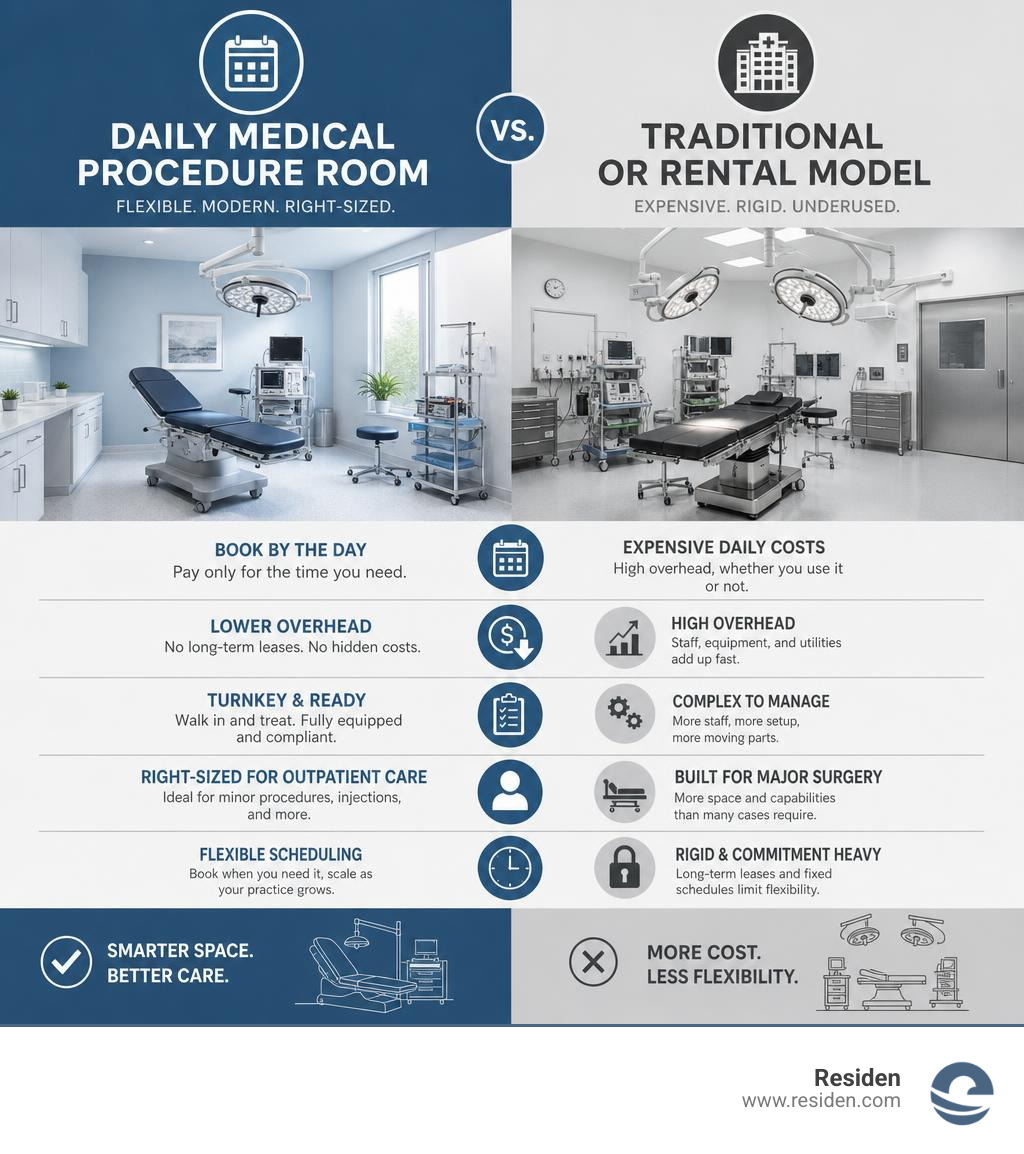
Daily medical procedure rooms are fully equipped, turnkey clinical spaces that healthcare professionals can book by the day — without long-term leases, high overhead, or the cost of owning a full operating room.
Here's a quick breakdown of what they are and how they work:
- What they are: Sterile, outpatient-grade rooms designed for minor surgeries, injections, wound care, endoscopy, and other procedures that don't require a traditional hospital OR
- Who uses them: Independent physicians, dermatologists, plastic surgeons, and other specialists who need a professional clinical space on a flexible schedule
- How booking works: Reserve by the day (or sometimes by the hour) through a medical space rental platform — no lease required
- What's typically included: Surgical tables, mobile lighting, medical gases, infection-control flooring, and Body Protected electrical systems
- Why it matters: Traditional operating rooms cost upwards of $6,000–$8,000 per day to run, and a significant portion of that time often goes unused
If you're an independent practitioner looking for a turnkey procedure space you can book on your terms, this guide covers the best options and what to look for.
Running a private practice means juggling clinical excellence with the very real pressure of overhead costs. For many independent providers, paying for a dedicated procedure room that sits empty half the week simply doesn't make financial sense. That's where daily medical procedure rooms come in — offering a smarter, more flexible alternative to traditional setups.
I'm Dr. Jessica Wu, a Los Angeles-based dermatologist with over 20 years of private practice experience performing procedures in a range of clinical settings, including daily medical procedure rooms that allow me to serve patients without the burden of maintaining a full surgical suite. In my practice, flexibility and sterility are non-negotiable — and the right space makes all the difference.
Why Modern Practices are Turning to Daily Medical Procedure Rooms
If you have ever looked at your monthly commercial rent statement and winced, you are not alone. Traditional medical real estate forces providers into rigid, multi-year leases for space they might only use a few days a week. This is especially true for specialized clinical spaces.
When we look at the financial realities of running a dedicated surgical space, the numbers are eye-opening. Classic healthcare economic data shows that running a traditional suite of operating rooms (ORs) is incredibly resource-intensive. For instance, in established hospital systems, the daily cost of running operating suites has historically risen from $6,242 to $8,873 per day, with total annual costs for a 4-OR setup climbing well over $3.2 million.
Worse yet is the cost of unutilized time. When a specialized room sits empty because you are seeing consultation patients at another clinic or catching up on charting, it still drains your budget. Unutilized OR time can easily cost an organization between $198,315 and $298,342 annually. For an independent practice, that kind of waste is a major financial burden.
By transitioning to daily medical procedure rooms, modern practices can bypass these extreme capital expenditures entirely. Instead of sinking 70% of your budget into capital expenses and facility setup, you can access premium, fully compliant clinical environments only on the days you actually have procedures scheduled.
To help you decide which setup aligns with your workflow, it is highly beneficial to review our guide on Hourly vs Daily: Which Procedure Room Rental Fits Your Practice.
| Cost Component | Traditional Operating Room (OR) | Turnkey Daily Procedure Room |
|---|---|---|
| Upfront Capital Exp. | Extremely high (construction, HVAC, specialized plumbing) | $0 (fully built and equipped by provider) |
| Lease Commitment | 5 to 10 years | No lease (booked daily or hourly) |
| Unutilized Time Cost | High (you pay for the room even when empty) | $0 (you only book and pay for the days you use) |
| Staffing & Overhead | Fixed salaries, high maintenance fees | Included in booking or scaled to your active days |
| Main Cost Driver | 70% capital expenditure, 15% consumables | Simple, predictable daily usage fee |
With a daily rental model, you pay a flat, transparent rate. This drastically lowers your overhead, frees up cash flow, and allows you to scale your practice naturally. If you want to see how this fits into your overall clinical budget, take a look at our transparent Pricing structure.
Key Differences Between Procedure Rooms and Traditional Operating Rooms
It is common to confuse a standard procedure room with a traditional operating room, but they serve very different clinical purposes and carry distinct regulatory definitions.
The primary differentiator is the level of anesthesia administered and the invasiveness of the surgery:
- Traditional Operating Rooms (ORs): Designed for major, invasive surgeries. They require full general anesthesia capabilities, positive air pressure systems, extensive sterile corridors, and a massive footprint to accommodate complex surgical teams.
- Daily Medical Procedure Rooms: Tailored for minor surgeries, minimally invasive interventions, and outpatient care. These rooms are designed for procedures performed under local anesthesia, regional blocks, or conscious sedation.
According to the International Health Facility Guidelines for Day Surgery, a standard procedure room does not accommodate general anesthesia. This distinction simplifies the physical and regulatory requirements of the space, making it far more cost-effective to operate while maintaining immaculate safety standards.
For providers looking to maximize their clinical footprint without the headache of managing a massive facility, exploring shared spaces is a natural next step. You can read more about how these spaces operate in our article on The Ins and Outs of Shared Medical Procedure Space.
Essential Equipment in Daily Medical Procedure Rooms
To safely and efficiently perform outpatient treatments, a daily procedure room must be outfitted with specialized, medical-grade equipment. It is not simply an exam room with a fancy chair; it requires a layout optimized for minor surgical interventions.
According to precise architectural standards, such as those found in the Procedure Room CAD Block | Minor Surgery Layout - PinCad, a functional procedure room must accommodate:
- Surgical Tables: Fully adjustable, multi-segment tables that allow for precise patient positioning.
- Mobile Surgical Lighting: High-intensity, shadow-free overhead lighting that can be adjusted dynamically during a procedure.
- Anesthesia Carts & Monitoring Equipment: For local or conscious sedation monitoring.
- Medical Gases: Integrated oxygen, nitrous oxide, or suction lines (either wall-piped or securely mobile).
- Body Protected Electrical Areas: Enhanced electrical safety systems designed to protect patients from micro-shocks during electrosurgery.
Every square inch must be accounted for to ensure a sterile perimeter around the surgical table, allowing staff to move freely without contaminating the field.
Designing Daily Medical Procedure Rooms for Patient Comfort
While clinical safety is paramount, the patient's psychological comfort matters just as much. A cold, sterile, dungeon-like room can spike a patient's blood pressure before you even pick up a syringe.
When we design and select our Medical Procedure Rooms, we balance clinical rigidity with a warm, welcoming aesthetic. Key design features outlined in the Details - International Health Facility Guidelines for a standard 20m² procedure room include:
- Acoustic Privacy: High-quality wall construction providing medium sound attenuation to ensure conversations between the patient and physician remain completely confidential.
- Seamless Coved Vinyl Flooring: Essential for infection control, as it prevents fluids and bacteria from pooling in cracks, while remaining easy to sanitize rapidly between cases.
- Optimized Patient Flow: A layout that allows patients to transition seamlessly from a calming waiting area, into the procedure room, and directly into a comfortable recovery zone without crossing paths with public traffic.
- Warm Aesthetic Design: Utilizing soothing colors, dimmable ambient lighting, and natural wood finishes to reduce patient anxiety.
Safety, Sterility, and Regulatory Standards for Outpatient Spaces
Operating an outpatient clinical space requires strict adherence to local, state, and federal healthcare guidelines. In California, and specifically within Los Angeles and Beverly Hills, the regulatory landscape is highly detailed.
To maintain a safe environment, facilities must implement robust clinical protocols. For example, the Royal Cornwall Hospital Trust Medical Day Unit SOPs highlight the importance of controlled access, clear escalation pathways, and strict patient eligibility criteria to ensure safety in outpatient settings.
Key regulatory and safety areas include:
- Infection Control: Seamless, non-porous surfaces that can withstand medical-grade chemical disinfectants. Hand hygiene stations must be readily accessible within the room.
- HVAC and Climate Control: Precise control over temperature and relative humidity to prevent bacterial growth and ensure comfort. Air filtration systems must meet strict air-change-per-hour (ACH) requirements.
- Electrical Safety: Classifying rooms as Body Protected or Cardiac Protected areas depending on the types of cardiac devices or electrosurgical tools being utilized.
Navigating these regulations on your own can be incredibly overwhelming. That is why turnkey rentals are so valuable—the hosting platform handles the regulatory compliance, facility maintenance, and safety certifications for you. For a deeper dive into how this works, read our comprehensive Guide to medical office rental spaces.
Frequently Asked Questions about Outpatient Procedure Rooms
What types of procedures can be performed in a daily procedure room?
Because these rooms are built to outpatient surgical standards but do not utilize general anesthesia, they are incredibly versatile. They are ideal for:
- Dermatology & Plastic Surgery: Excisions, biopsies, Mohs surgery, cyst removals, and cosmetic injections.
- Gastroenterology: Endoscopies and colonoscopies under conscious sedation, similar to the high-standard setups found at premier facilities like the Valley Medical Group | Ambulatory Surgery and Procedures Center.
- Orthopedics & Pain Management: Joint injections, nerve blocks, and minor wound debridement.
- General Medicine: Wound suturing, dressing changes, and minor vascular access procedures.
How do hybrid procedure rooms improve patient outcomes?
A hybrid procedure room combines advanced medical imaging equipment (like real-time fluoroscopy, ultrasound, or CT scanners) directly within a clean surgical suite.
Evidence suggests that the use of hybrid operating rooms can result in improved patient outcomes and decreased procedure times. By allowing the physician to perform minimally invasive diagnostic imaging and therapeutic surgical interventions in the exact same room, the patient does not need to be transferred mid-procedure. This reduces infection risks, minimizes anesthesia time, and vastly improves clinical precision.
What are the benefits of shared medical office spaces?
Choosing a shared, turnkey medical office model offers immense advantages for modern, agile practices. To weigh the options, you can read our detailed breakdown of the Pros and cons of shared medical office space.
The primary benefits include:
- Massive Overhead Reduction: No more paying for space when you are not using it. You only pay for the time you book.
- Zero Administrative Headaches: The facility takes care of utilities, high-speed internet, clinical waste disposal, and general cleaning.
- Flexible Scheduling: Scale your practice up or down dynamically depending on your patient volume.
- Community Networking: Work alongside other independent specialists, creating opportunities for collaborative patient care and direct referrals.
Conclusion
The landscape of healthcare real estate is shifting rapidly. Paying thousands of dollars a month for a dedicated surgical space that sits empty most of the week is a relic of the past. For independent practitioners in Los Angeles, daily medical procedure rooms offer the ultimate blend of clinical excellence, financial freedom, and operational flexibility.
At Residen, we provide premium, turnkey, shared medical office rentals—including fully equipped exam, consultation, and procedure rooms—designed specifically for modern healthcare professionals. Located in the heart of Beverly Hills (at 433 N Camden Dr Suite 610, Beverly Hills CA) and Brentwood, our spaces are fully compliant, beautifully designed, and completely patient-friendly.
Best of all, we offer flexible hourly and daily bookings with absolutely no long-term leases, membership fees, or setup costs.
Ready to elevate your practice and leave the burdens of traditional leasing behind?
- Read our guide on how to Book a daily doctor suite in LA.
- Explore Residen Locations to find your next clinical home.
- Ready to take the next step? Get Started with us today!