
You're Not Just a Doctor Anymore—Business 101
Mastering the CEO Mindset: You’re Not Just a Doctor Anymore—you’re a Business Owner: Now What?

When we transition from a hospital residency or a corporate medical group into our own practice, we often experience a quiet realization. There is no ceremony for this shift; no new white coat is handed out. Yet, suddenly, we are responsible for more than just a differential diagnosis. We are responsible for a lease, a payroll, and a brand.
As noted in Tips for Physicians Transitioning to the Business Side of Health Care, this transition is often driven by burnout or a desire for autonomy, but the shift in professional identity is profound. We are building what some call The Second Career Most Physicians Don’t Realize They’re Building. In this "second career," our clinical skills are the product, but our executive skills are the engine.
To succeed, we must view health care through a triad: medicine as a science, doctoring as an art, and health care as a business. If any one of these legs is missing, the stool topples. Mastering the business side isn't about abandoning our patients; it’s about creating a stable environment where we can actually care for them on our own terms.
Transitioning from Clinician to CEO: You’re Not Just a Doctor Anymore—you’re a Business Owner: Now What?
The mindset shift from clinician to CEO requires moving from "doing" to "leading." In the exam room, we are the primary actors. In the business office, we are the strategists. This means learning to speak the language of finance—understanding overhead, payer mix, and EBITDA—just as fluently as we understand pathophysiology.
The The Perks of Private Practice are immense—chief among them being the ability to design a patient experience that aligns with our personal values. However, as a CEO, we must make hard decisions. We have to decide which insurance contracts to keep and which to drop. We have to manage staff conflicts and navigate the "invisible handcuffs" of traditional employment that we’ve finally traded for the weight of the crown.
Choosing Your Practice Model and Managing Startup Costs

Before we sign a lease or buy a single stethoscope, we must decide what kind of business we are running. The "standard" private practice model is no longer the only path. In 2026, we see a massive surge in alternative models:
- Direct Primary Care (DPC): A subscription-based model that cuts out the middleman (insurance). This can slash overhead by 30–40%.
- Concierge Medicine: Patients pay a premium monthly fee (often $100–$300) for enhanced access. A viable practice can be maintained with just 300–600 patients.
- Hybrid Models: Mixing insurance-based billing with cash-pay services. These models often see 25% fewer denied claims and 18% higher collections.
- Micro-Practices: Ultra-lean operations, often solo, with minimal staffing and high automation.
When Starting Your Own Practice, one of the most critical hurdles is the physical space. We’ve seen many colleagues fall into the Five Mistakes Physicians Make When Leasing Medical Office Building for Their Practice, such as signing long-term, 10-year leases before they’ve even seen their first ten patients. In Los Angeles, where real estate is at a premium, flexibility is your best friend.
Financial Planning and Cash Flow Forecasts
The reality of startup costs can be a wake-up call. For a primary care practice, the average first-year cost ranges from $70,000 to $100,000—and that’s a lean estimate that doesn't include your own take-home pay. If you’re building a "deluxe" specialty suite, those costs can skyrocket to $500,000.
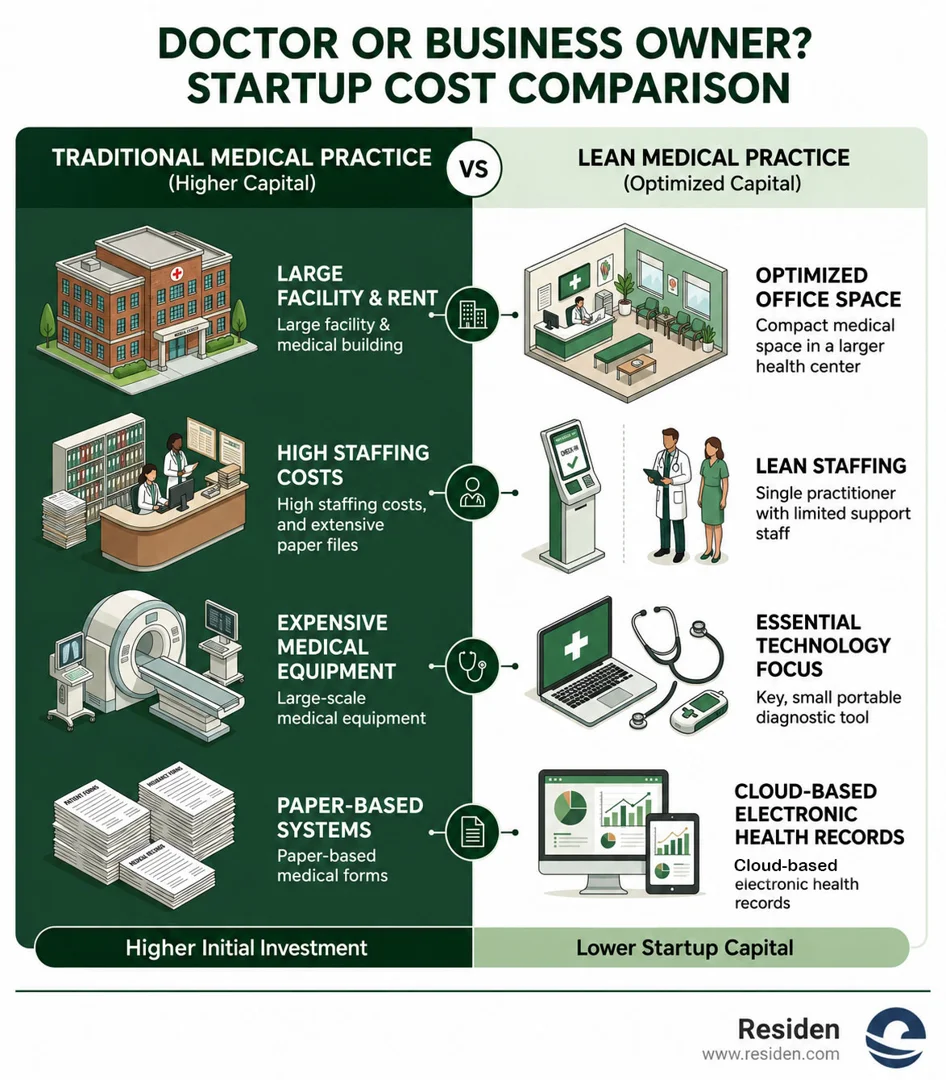
The biggest threat to a new practice isn't a lack of patients; it's a lack of cash. Since 82% of business failures are due to poor cash flow management, we must plan for a "runway." This means having enough capital to cover 6–12 months of expenses while you wait for insurance reimbursements to trickle in.
At Residen, our Pricing model is designed to eliminate the "sunk cost" of traditional leases. By paying only for the time you use, you can keep your overhead low while you build your patient base, effectively bypassing the massive debt-trap of traditional build-outs.
The Operational Foundation: Compliance, Credentialing, and Staffing
Once the model is chosen, we have to build the "boring" but essential backbone of the practice. Compliance is not optional. A single OSHA violation can cost up to $15,625, and HIPAA penalties in 2023 alone exceeded $34 million across the industry.
Your foundation must include:
- OSHA: Safety protocols and annual staff training.
- HIPAA: Secure EHR systems and patient privacy standards.
- CLIA: Required if you plan to do any in-office lab testing (even simple strep tests).
- OIG: Compliance plans to avoid fraud and abuse allegations.
Using a Starting a Medical Office: Your Complete Checklist for Success ensures that you don't miss a critical filing date that could shut down your revenue stream before it starts.
Payer Enrollment and HR Systems
Credentialing is the "silent killer" of new practices. It takes an average of 90–120 days per payer. If you don’t start this process four months before your doors open, you will be seeing patients for free. We cannot stress enough What New Physicians Need to Know About Billing Insurance: if the paperwork isn't perfect, the check won't come.
Then there is the human element. The Struggles of Staffing are real in a tight labor market like Los Angeles. Employee turnover costs a practice 25–30% of that employee’s annual salary. Before you post a job ad, consult a Before You Hire Checklist. You need a practice manual, clear job descriptions, and a culture that makes people want to stay.
Revenue Optimization and Marketing Strategies
Efficiency is the difference between a practice that survives and one that thrives. Practices with optimized workflows collect 20% more revenue per provider. This means designing a "patient journey" that has zero friction—from the first Google search to the final bill payment.
In Run Your Medical Practice Like a Business, the advice is clear: use your EHR as a diagnostic tool for your business. Run reports on claim denials, track how long patients spend in the waiting room, and identify which services are your "loss leaders" versus your profit drivers. By focusing on Lower Overhead, you can protect your margins even during the slow months.
Marketing is no longer "optional" for doctors. A 2023 survey found that 84% of patients research physicians online before booking. If you don't have a digital presence, you don't exist to the modern patient.
Scaling Your Vision: You’re Not Just a Doctor Anymore—you’re a Business Owner: Now What?
Growth requires a strategy, not just luck. Master the 5 business skills every physician needs before starting practice, starting with niche identification. Are you the "Beverly Hills Dermatologist for Professionals" or the "Brentwood Family Doc for Young Parents"?
Building referral networks is also key. In private practice, your fellow independent physicians are your greatest allies. Don't just wait for the phone to ring; get out into the Los Angeles medical community and build relationships.
Avoiding Pitfalls with Professional Advisory Support
One of the most dangerous phrases in business is "I'll just do it myself." While we are smart and capable, we are not trained tax strategists or healthcare attorneys. For instance, choosing to be an S-Corp instead of a Sole Proprietorship can save a physician tens of thousands of dollars in self-employment taxes—but only if the timing is right.
Moving from scrubs to CEO, while the journey is rewarding, is "not for the faint of heart." The statistics back this up: 84% of practices that use an external advisor, launch on time and on budget, compared to just 42% of those who go it alone.
When you leverage Built-in Expertise, you aren't just paying for advice; you are buying back your time. Your time is best spent with patients, not trying to figure out the intricacies of Los Angeles commercial zoning laws or complex payer contracts.
Frequently Asked Questions about Physician Entrepreneurship
What are the most common business mistakes new practice owners make?
The most common mistake is over-leveraging early on—specifically, signing a long-term lease and hiring too many staff members before the patient volume exists. Other common pitfalls include neglecting the credentialing timeline and failing to set up a robust billing follow-up system, leading to a "leaky" revenue cycle.
How long does it take for a new medical practice to become profitable?
Most practices take 6 to 12 months to reach a break-even point. However, this varies wildly by model. A Direct Primary Care practice with low overhead may become profitable in 3-4 months, while a traditional multi-provider specialty group with heavy equipment costs may take closer to two years.
Do I need an MBA to run a successful private practice?
No. While an MBA provides a great foundation, it is not a requirement. Many successful physician entrepreneurs learn through targeted business education, mentorship, and by surrounding themselves with professional advisors (CPAs, attorneys, and consultants) who specialize in healthcare.
Conclusion
The transition to being a practice owner is the most intellectually demanding and creatively satisfying chapter of a medical career. It is the path to reclaiming your time, your autonomy, and your passion for patient care.
At Residen, we believe that the "business" of medicine shouldn't be a barrier to the "practice" of medicine. We provide turnkey, shared medical office rentals in prime Los Angeles locations like Beverly Hills and Brentwood. Our model allows you to book exam and procedure rooms by the hour or day, with no long-term leases, no setup costs, and no hidden fees.
Whether you are launching a solo micro-practice or testing a new hybrid model, we provide the infrastructure so you can focus on being the CEO and the clinician. The future of medicine is independent, and it starts with taking that first step toward ownership.