
A Practical Guide to Scaling from One Medical Location to Multiple
Why Most Medical Practices Fail to Scale — and What Actually Works

How to scale from one medical location to multiple locations is one of the most searched questions among independent healthcare professionals — and for good reason. Most clinic owners who try to expand hit a wall fast.
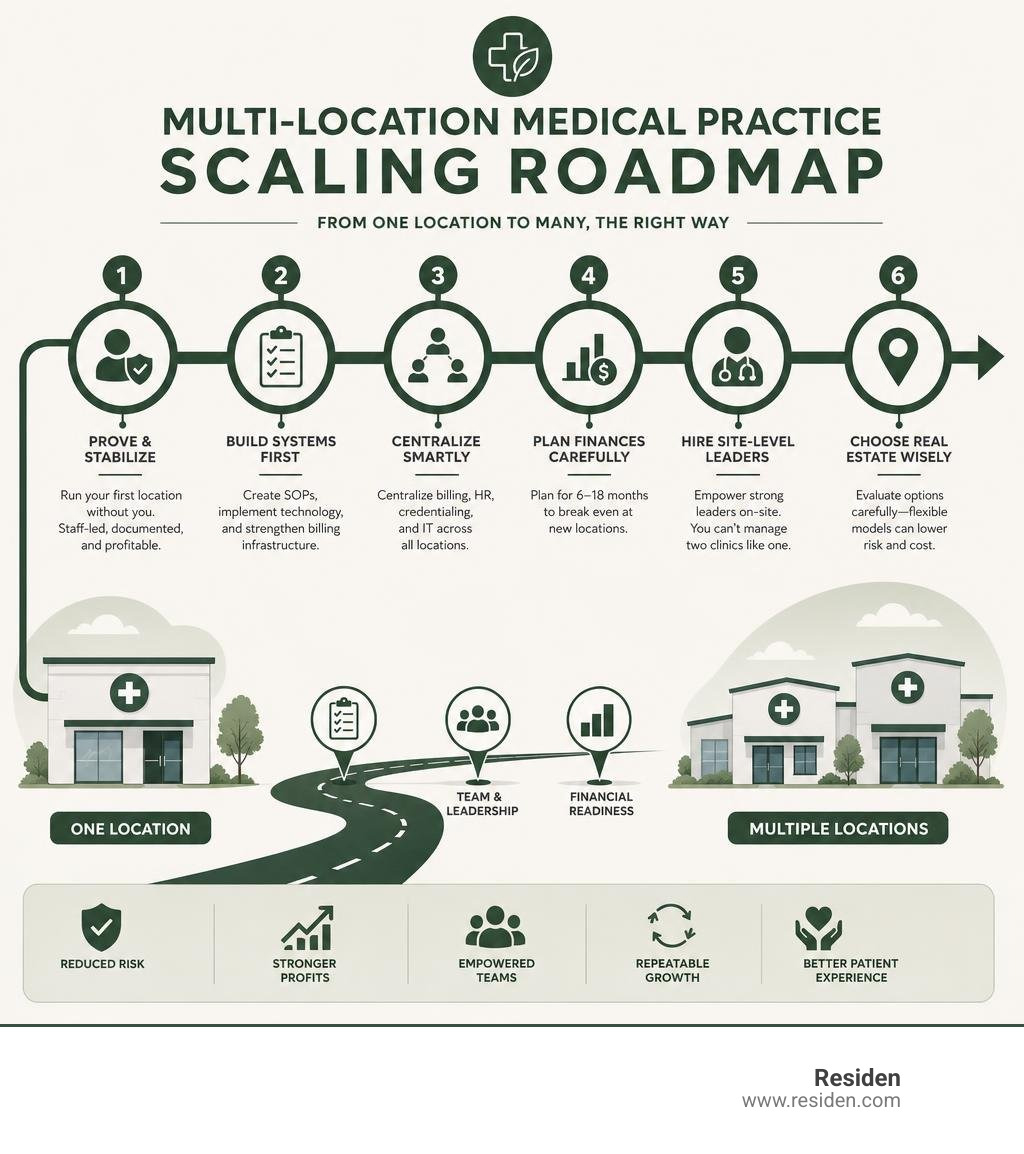
Here's a quick overview of what successful scaling actually requires:
- Prove your first location runs without you — staff-led, documented, and profitable
- Build systems before you build locations — SOPs, technology, and billing infrastructure first
- Centralize the right functions — billing, HR, credentialing, and IT across all sites
- Plan your finances before you sign a lease — new locations typically take 6 to 18 months to break even
- Hire site-level leadership early — you cannot manage two clinics the way you managed one
- Choose your real estate model wisely — traditional leases carry high risk; flexible shared spaces lower the barrier
The reality? Only 18% of multi-site medical practices report that their second location was profitable within 12 months. That number isn't meant to scare you — it's meant to redirect your energy. The practices that scale successfully don't just open more doors. They build a repeatable system first, then multiply it.
The most common mistake is treating expansion like a real estate decision when it's really an operational one. If your first clinic depends on your daily presence to function, opening a second location won't create freedom — it will double the chaos.
I'm Dr. Jessica Wu, a Harvard-trained dermatologist with over 20 years in private practice — and I've navigated the operational and strategic complexity of growing beyond a single location. In this guide, I'll share what the research and real-world experience reveal about how to scale from one medical location to multiple locations in a way that's sustainable, financially sound, and built to last.
Defining Your "Why" and Assessing Readiness to Replicate
Before we sign commercial leases or buy more exam tables, we have to ask ourselves: Why are we growing, and is our current clinic actually ready for it?
In our experience, medical practice growth strategies generally fall into two camps: tactical and strategic. Tactical growth is reactive. You have a long waitlist, your front desk is constantly overwhelmed, and you think, "We just need more space!" Strategic growth, on the other hand, is proactive. It is about building a business platform that can expand without increasing your personal stress or diluting patient care.
If your primary motivation is simply to handle patient overflow, opening a traditional second brick-and-mortar office might actually be the most expensive and risky way to do it. True scalability means your business can expand without a corresponding, linear increase in operational complexity. If your current practice depends entirely on your personal presence, clinical oversight, or daily troubleshooting to function, you do not have a scalable business yet — you have a highly demanding job.
To scale successfully, we must shift our mindset. We have to treat our first clinic as a "prototype." Every workflow, from how the phone is answered to how clinical notes are finalized, must be refined and documented so that it can be handed to a new team in a different ZIP code. For a deep dive into laying this groundwork, explore our Scaling Medical Practices: Operations Growth Guide (2026).
Evaluating If Your First Location Is Ready for Replication
How do we know if our prototype is actually ready to be replicated? We look for operational maturity, not just high revenues.
A clinic is ready to scale when it is staff-led and system-driven. Ask yourself this simple diagnostic question: Could you leave your practice for a month without checking your email, and return to find it just as profitable, compliant, and organized as when you left? If the answer is a nervous laugh, it is time to build better systems first.
Before expanding, we must transition from informal "habits" to written Standard Operating Procedures (SOPs). We need clear playbooks for:
- Front desk check-in and checkout flows
- Patient intake and insurance verification
- Clinical room turnover and supply management
- Billing, coding, and denial management
- Patient cancellations and no-show follow-ups
By documenting these processes, we eliminate "key-person risk" and ensure that our brand's standards are maintained, even when we aren't physically there to enforce them. To learn how to streamline your current workflows and keep overhead low before taking the leap, check out our guide on Simple Ways to Run the Lean Medical Practice.
Milestones and Timelines: How to Scale from One Medical Location to Multiple Locations Safely
Once the prototype is stable, we must plan the expansion timeline. Rushing this phase is where many ambitious clinic owners stumble.
Historically, new medical locations take anywhere from 12 to 18 months to reach steady-state patient volume and consistent profitability. This ramp-up timeline depends heavily on whether you are opening a cold-start clinic in a new neighborhood or expanding with established patient relationships. Because of this lag, opening a second site too quickly can drain the cash reserves of your primary location, putting the entire enterprise at risk.
A safe, strategic approach involves geographic clustering. For example, in a sprawling area like Los Angeles, keeping your locations within 15 to 25 minutes of each other (such as Beverly Hills and Brentwood) allows for operational flexibility. You can rotate trusted staff members, share specialized medical equipment, and direct patient overflow to sister clinics without requiring patients or providers to travel long distances.
To prevent operational chaos, we recommend waiting until your current locations are fully profitable, stable, and staff-led before launching the next one. For more on structuring this timeline, refer to Multi-Location Practice Management: Scaling Healthcare Operations.
Centralized vs. Localized Operations: Structuring for Efficiency
One of the most critical decisions in learning how to scale from one medical location to multiple locations is determining what to manage from a central hub versus what to keep local. If you try to run every location as an independent island, you will duplicate your overhead and lose the economies of scale that make expansion profitable.
The table below outlines how to divide these operational responsibilities:
| Operational Function | Centralized Hub | Localized (At the Clinic) |
|---|---|---|
| Billing & RCM | Aggressive centralization (claims, collections, denials) | Basic copay collection & intake scanning |
| Scheduling & Phones | Unified phone tree, central call center, or text portal | Local overrides for urgent, same-day walk-ins |
| HR & Recruitment | Standardized hiring policies, payroll, credentialing | On-site daily management & team-building |
| Marketing & Brand | Main website, local SEO, unified ad campaigns | Community outreach, local relationship building |
| Purchasing & Inventory | Bulk vendor contracts, standardized supplies | Local stock monitoring & receipt verification |
For a comprehensive breakdown of these operational structures, see Structuring a Multi‑Site Practice: Centralized vs Localized Operations.
Deciding Which Functions to Centralize
As a rule of thumb, any back-office task that does not require face-to-face patient contact should be centralized.
Billing and Revenue Cycle Management (RCM) are the prime candidates for centralization. Local billing is where revenue quietly leaks for years. When a single front desk receptionist is responsible for answering phones, greeting patients, checking clinical charts, and submitting insurance claims, mistakes happen.
In contrast, a centralized, dedicated billing team achieves a much higher Net Collection Rate — typically 94% to 98% compared to the 88% to 92% averages seen with fully localized, multitasking front desks. Centralizing HR recruitment and provider credentialing is equally vital. It ensures that every new hire goes through the same rigorous screening, and prevents administrative delays from keeping your new providers from seeing patients on day one.
Managing Patient Communication and Scheduling Across Sites
Patient communication can quickly become a bottleneck when you expand. If patients have to call different phone numbers for different locations, or if your staff is constantly playing phone tag to coordinate appointments, patient satisfaction will plummet.
To keep operations lean and efficient, we recommend centralizing your communication infrastructure. Moving to a unified phone tree and adopting digital-first communication tools can transform your front desk.
Switching to two-way texting can reduce inbound phone call volume by up to 50%, freeing up your on-site staff to focus entirely on the patients standing in front of them. Furthermore, implementing automated appointment reminders across all sites can reduce no-show rates by up to 75% — directly protecting your revenue at every location.
Building the Technology and Compliance Infrastructure
To run a multi-site medical group smoothly, your technology must serve as the digital backbone of your business. Fragmented systems — such as using different Electronic Medical Records (EMRs) or separate scheduling softwares for different clinics — will make it impossible to track performance and will inevitably lead to administrative errors. For a technical guide on aligning these systems, read Multi-Location Urgent Care Efficiency: A Scaling Guide.
Essential Tech Stack for Multi-Site Management
Your multi-location technology stack should be built on three core pillars:
- Unified, Cloud-Based EMR & PM: A single, cloud-based practice management and EMR platform ensures that patient records, scheduling, and billing are accessible in real-time across all locations. It also prevents duplicate charts and allows providers to seamlessly view patient histories, regardless of which clinic the patient visits.
- Real-Time Performance Dashboards: Rather than waiting for end-of-month financial reports, scale-ready practices use centralized dashboards to track key performance indicators (KPIs) daily. This allows leadership to monitor patient volume, billing velocity, and staff productivity across all sites simultaneously.
- Role-Based Access Control (RBAC): As your team grows, protecting patient data becomes more complex. Implementing RBAC within your software ensures that staff members only have access to the specific patient records and financial data required for their roles, keeping your practice compliant with HIPAA regulations.
Maintaining Brand Consistency and ADA Compliance
A consistent patient experience is what turns a growing practice into a trusted brand. Whether a patient walks into your office in Beverly Hills or Brentwood, the environment, customer service, and clinical quality should feel identical.
But consistency isn't just about matching paint colors and logo designs; it is also about meeting strict regulatory standards. Under the ADA and HHS guidelines, private practices that accept federal funding (including Medicare or Medicaid) must comply with strict Medical Diagnostic Equipment (MDE) accessibility standards.
By the mid-2026 compliance deadlines, practices must ensure that a designated percentage of their equipment (typically 10% for standard practices, and 20% for specialty clinics focusing on mobility) is fully accessible. This means investing in height-adjustable exam tables (with a low position of 17 to 19 inches and a high position of at least 25 inches) and wheelchair-accessible weight scales. When scaling, these compliance costs must be built into the budget for every new location from day one.
Financial Modeling and Avoiding Common Scaling Bottlenecks
Growth without financial planning is just stress in a nicer building. Many clinic owners assume that doubling their locations will automatically double their profits, only to find that the increased overhead eats away at their margins.
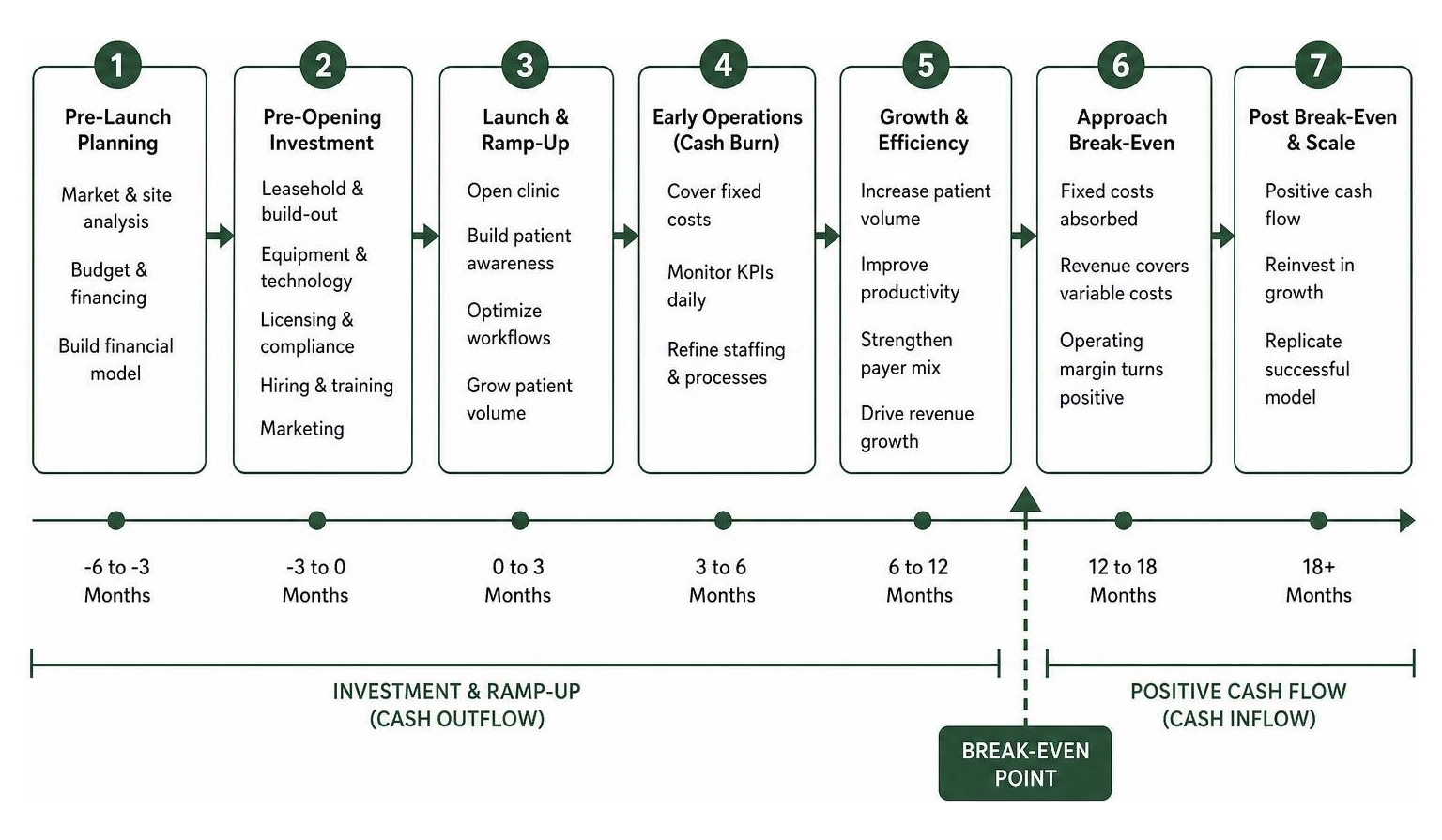
To prove scalability and attract potential partners or investors down the road, you must show that your business model can absorb expansion costs without eroding profitability. For a deeper look at this process, see the Healthcare CEO Guide to Proving Scalability.
Key Financial Metrics and Cash Flow Projections
When modeling your expansion, you must track and project several key financial metrics:
- Site-Level EBITDA: Track the profitability of each location independently, excluding corporate overhead, to ensure every clinic is pulling its own weight.
- Exact Break-Even Point: Calculate the precise number of patient visits and revenue required per month to cover each site's local operating costs.
- Staffing Ratios: Maintain strict clinician-to-administrative staff ratios to prevent labor costs from spiraling out of control.
- 3-to-6-Month Operating Contingency Fund: Never open a new site without a cash reserve to cover at least three to six months of operating costs, protecting your business during the initial ramp-up phase.
To learn more about budgeting and setting up a solid financial foundation for a new office, review our guide on Starting a Medical Office: Your Complete Checklist for Success.
How to Scale from One Medical Location to Multiple Locations Without Operational Bottlenecks
The biggest bottleneck in any expanding practice is almost always the founder. If every clinical question, operational dispute, and financial decision has to go through you, your growth will cap quickly.
To avoid this, we must consciously remove ourselves as the operational bottleneck. This requires building a second line of leadership early on. By empowering clinic managers and lead clinicians to handle daily operations within clearly defined boundaries, you can step back from working in the business and focus entirely on working on the business.
Leadership, Culture, and Staffing Across Multiple Sites
The clinical side of a medical practice is relatively easy to scale; the people and culture side is where things get tricky. When you are no longer physically present at a location every day, clinic culture can quickly drift, and staff morale can suffer.
Hiring and Developing Site Leads and Clinic Managers
Your first key hire when expanding is not another doctor — it is a dedicated clinic manager or site lead. This individual is responsible for daily operations, staff scheduling, patient relations, and policy enforcement at their specific location.
When onboarding a new site manager, we recommend embedding them at your most successful, established location for at least two weeks before they take over their new site. This intensive, hands-on training allows them to absorb your team's workflows and "tribal knowledge" in a real-world setting, ensuring they can replicate that success at their own clinic.
Preserving Clinic Culture and Morale
To keep your team aligned across different geographic locations, you must establish structured communication channels.
We recommend holding short, cross-clinic operational huddles weekly. These meetings should focus on transparent communication, sharing wins, and addressing bottlenecks collectively. Additionally, hosting a centralized orientation program for all new hires ensures that every team member, regardless of their location, is introduced to your practice’s core values, mission, and patient-care standards from their very first day.
How to Scale from One Medical Location to Multiple Locations: Strategic Real Estate Options
Historically, scaling a medical practice meant signing long-term, multi-year commercial leases, spending hundreds of thousands of dollars on custom build-outs, and waiting months for construction and permits to clear.
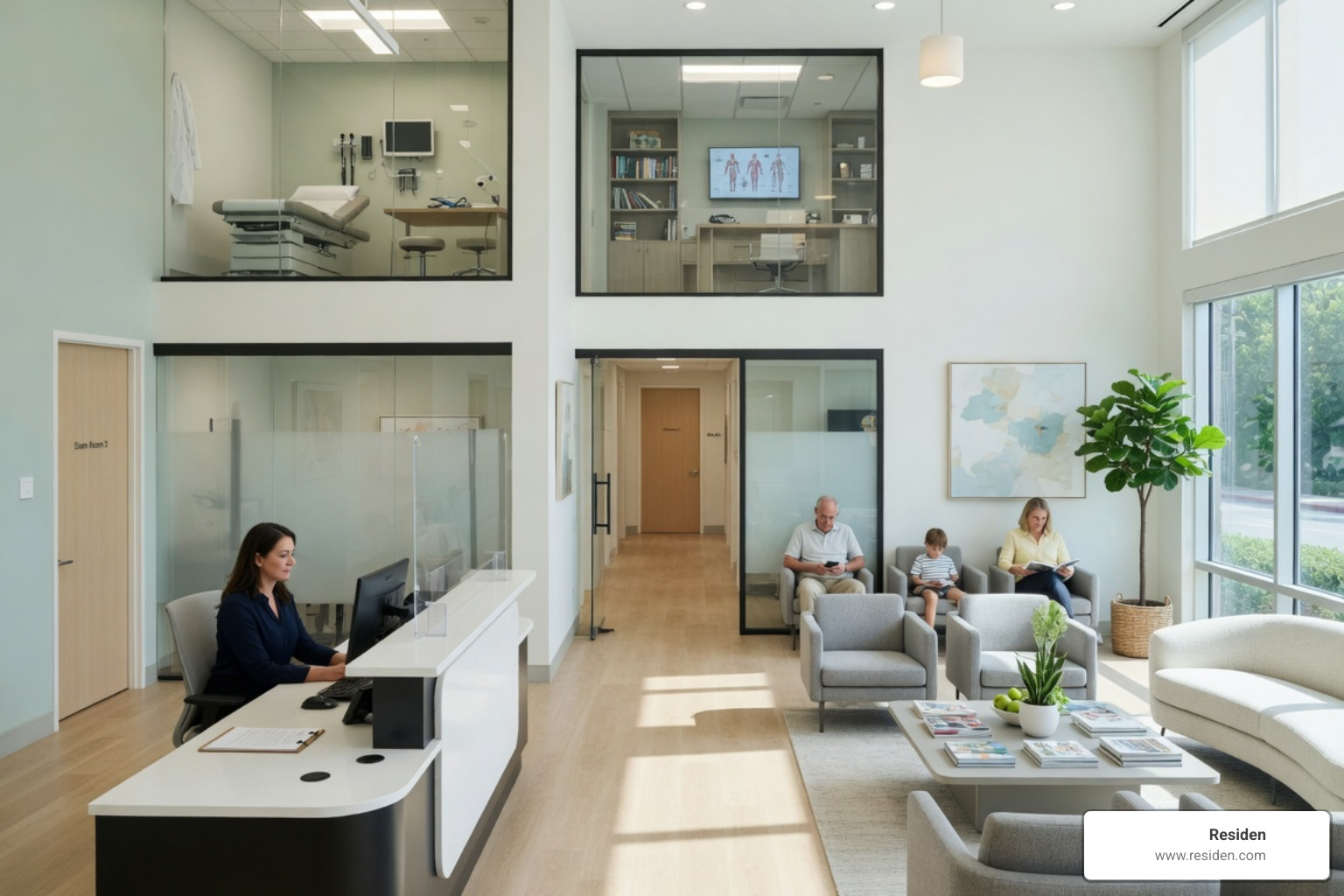
This traditional approach carries massive upfront capital requirements and significant financial risk, especially if a new market takes longer to ramp up than expected. To understand the full scope of medical real estate commitments, read Everything You Need to Know About Medical Office Rental Space.
Traditional Leases vs. Flexible Shared Medical Spaces
For many modern practices, the traditional lease model is no longer the most efficient way to scale. Flexible, turnkey medical coworking spaces offer a low-risk, highly scalable alternative.
Consider the differences between these two models:
- Traditional Commercial Leases: High upfront capital expenditures (CapEx) for construction and equipment, 5-to-10-year lease commitments, personal guarantees, and months of administrative delays before seeing your first patient.
- Turnkey Medical Coworking: Zero upfront setup costs, fully equipped and compliant exam and procedure rooms, and the ability to book space only when you need it. This allows you to test new markets and establish a patient base without any long-term financial risk.
For an honest look at the pros and cons of sharing space as a medical professional, check out our analysis of Shared Medical Office Space Pros and Cons for Healthcare Professionals.
Leveraging Residen for Low-Overhead Expansion
At Residen, we provide turnkey, shared medical office rentals designed specifically for healthcare professionals looking to scale their practices with minimal overhead.
We offer fully equipped, compliant, and patient-friendly exam, procedure, and consultation rooms in prime Southern California locations, including Beverly Hills and Brentwood (with our flagship suite located at 433 N Camden Dr Suite 610, Beverly Hills CA).
Our model features:
- Flexible Hourly/Daily Bookings: Book space only for the hours or days you need, allowing you to scale up or down as your patient volume grows.
- No Long-Term Leases or Setup Costs: Avoid the heavy financial burden of traditional commercial real estate.
- Fully Managed Facilities: Focus entirely on clinical care while we handle utilities, cleaning, front-desk greeting, and basic facility compliance.
By leveraging our turnkey spaces, you can easily establish a presence in Los Angeles's most desirable medical districts with virtually no risk. To learn how we help practices maintain a lean operational footprint, explore our page on Lower Overhead, and view our available spaces on our Locations page.
Frequently Asked Questions about Multi-Site Scaling
What is the biggest mistake clinic owners make when scaling?
The biggest mistake is premature expansion — opening a second location before the first one is operationally stable and able to run without the owner's daily presence. If your current clinic relies on informal workflows and your personal oversight to function, expanding will only replicate and amplify that operational chaos across multiple sites.
How long does it typically take for a new medical location to break even?
Most new medical locations take between 6 to 18 months to reach steady-state volume and break even. This timeline depends on your specialty, your local marketing efforts, and whether you are starting fresh or expanding with an existing patient base. Having a 3-to-6-month operating cash reserve is essential to support the clinic during this initial ramp-up phase.
Do I need a separate manager for each clinic?
Eventually, yes. While you might share a single practice administrator across two close locations during the early stages, each site will ultimately require dedicated, on-site leadership to maintain quality of care, handle daily operations, and preserve team morale as you scale.
Conclusion
Learning how to scale from one medical location to multiple locations is a journey of operational discipline, strategic planning, and learning to let go. By treating your first clinic as a repeatable prototype, centralizing your back-office systems, and building a strong second line of leadership, you can expand your practice's reach without burning out or compromising patient care.
You don't have to take on massive debt or sign risky, long-term leases to start your expansion journey. With our flexible, fully equipped medical spaces in Beverly Hills and Brentwood, we make it simple to grow your footprint on your own terms. Ready to take the next step? Get Started with Residen today and discover a smarter, lower-overhead way to scale.