
The Ultimate Guide to Reducing Patient No-Shows Without Annoyance
The True Cost and Behavioral Drivers of Missed Appointments
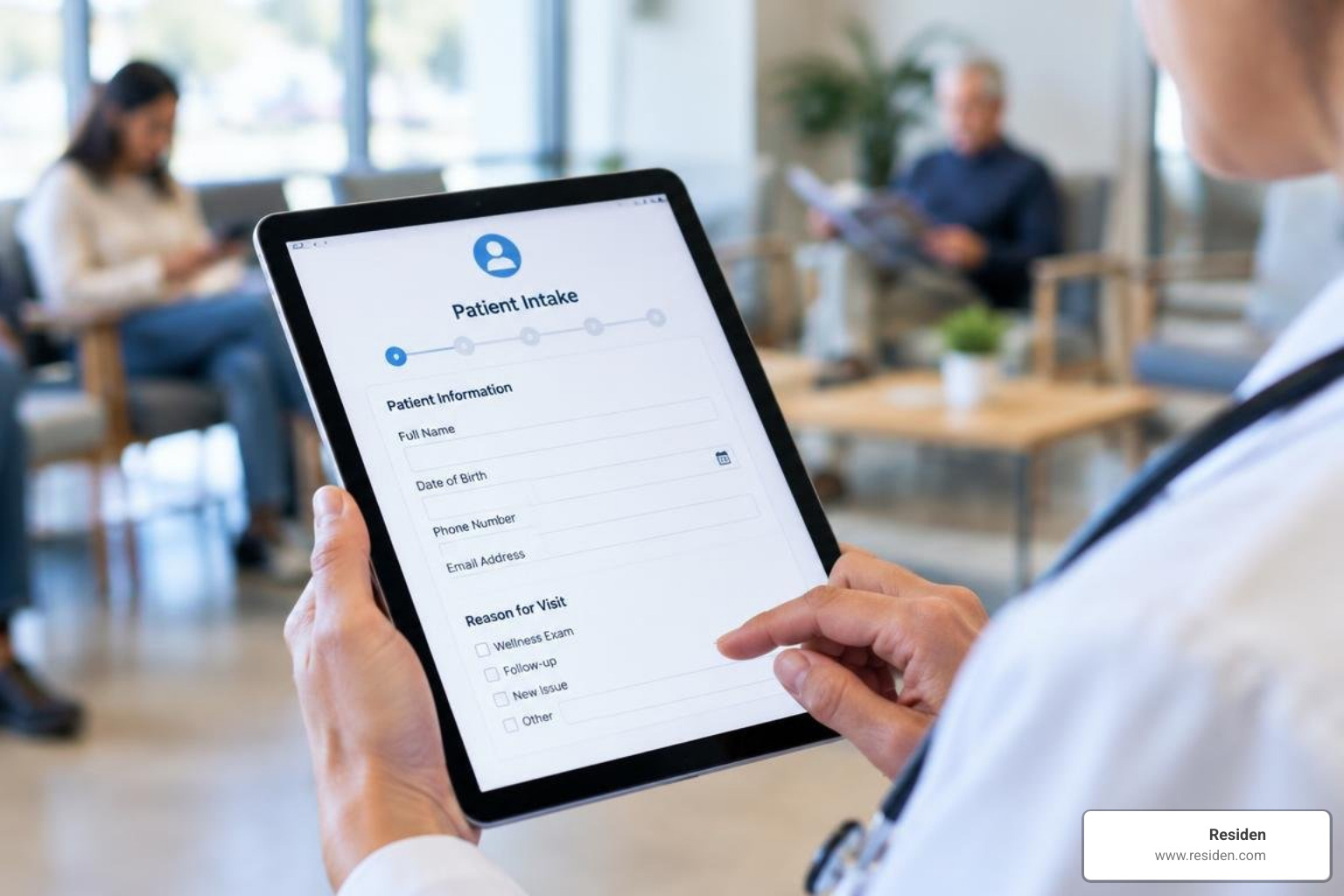
Reducing patient no-shows without annoying your patients requires shortening booking lead times, using automated multi-channel reminders with frictionless one-tap self-rescheduling, and establishing transparent financial policies. These strategies address the root causes of missed appointments while respecting patient autonomy and convenience.
Missed appointments cost the US healthcare system an estimated $150 billion annually, with the average missed clinical slot representing a direct financial loss of roughly $200. Across outpatient care, typical no-show rates hover between 15% and 30%, with the national average sitting around 18%. In certain high-friction specialties, non-attendance can surge even higher.
Beyond lost top-line revenue, chronic attendance gaps trigger provider burnout. Clinical staff expend energy preparing charts and sterilizing rooms for visits that never happen, disrupting daily clinic rhythms. A comprehensive review on methods to reduce outpatient non-attendance illustrates that missed care stems from complex behavioral and structural friction rather than simple patient negligence.
The single largest operational predictor of a missed visit is appointment lead time. Same-day appointments account for just 2% of no-shows. In contrast, appointments booked 15 or more days in advance generate nearly a third of all no-shows. As weeks pass between scheduling and the visit, patient motivation wanes, acute symptoms resolve or shift, and calendar conflicts multiply.
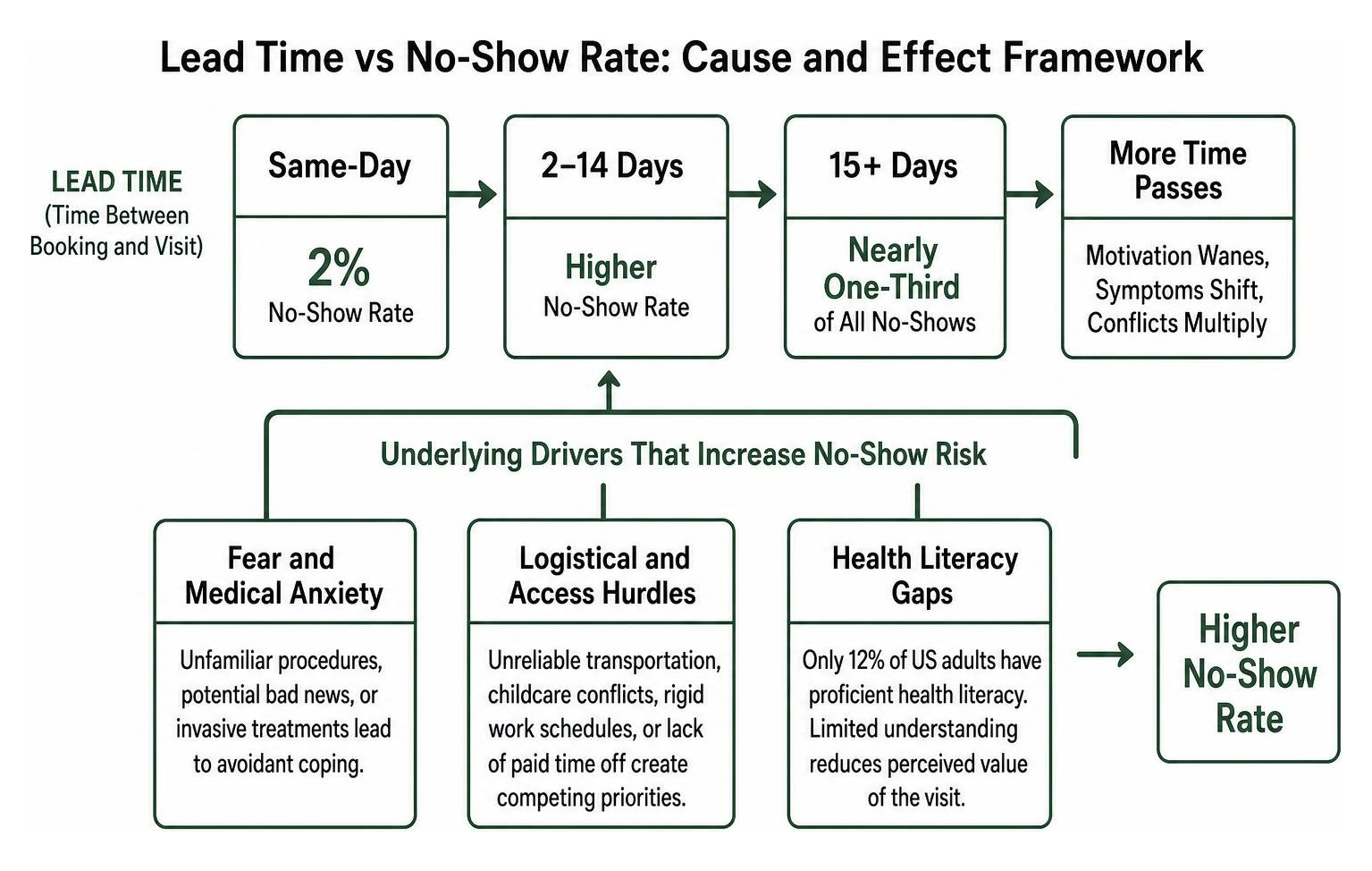
Underlying psychological and logistical barriers also influence attendance:
- Fear and Medical Anxiety: Patients facing unfamiliar diagnostic procedures, potential bad news, or invasive treatments frequently practice avoidant coping by skipping visits.
- Logistical and Access Hurdles: Unreliable transportation, sudden childcare conflicts, rigid hourly work schedules, or lack of paid time off force patients to triage daily emergencies over routine care.
- Health Literacy Gaps: Only 12% of US adults have proficient health literacy. When patients do not fully comprehend why a follow-up or screening matters, the perceived value of the visit drops.
- Financial Ambiguity: Unclear out-of-pocket costs or surprise co-pays cause patients to silently skip visits rather than negotiate billing at the front desk.
| Driver Category | Core Root Cause | Patient-First Operational Solution |
|---|---|---|
| Forgetfulness | Long scheduling lead times (15+ days) | Timed multi-channel SMS cadence with digital calendar invites |
| Logistical Barriers | Lack of transit, childcare, or rigid work hours | Telehealth fallback options, evening slots, and ride-coordination support |
| Medical Avoidance | Anxiety regarding procedures or test results | Pre-visit empathetic educational messaging outlining what to expect |
| Financial Uncertainty | Confusion over co-pays and out-of-pocket fees | Upfront price transparency and standardized financial intake protocols |
Why Traditional Reminder Tactics Annoy Modern Patients
When clinics experience elevated no-show rates, the common reaction is to amplify outreach: sending more robocalls, generic blast emails, and repetitive SMS alerts. This approach often fails. A recent 2026 meta-analysis revealed that automated reminders alone produce only an approximate 11% relative lift in attendance. Bombarding patients without addressing underlying friction creates diminishing returns.
Traditional reminder systems fail modern patients for several clear reasons:
- Intrusive Robocalls: Unsolicited phone calls from unknown automated numbers interrupt workdays, trigger spam filters, and alienate patients.
- One-Way Confirmation Walls: Messages that demand "Reply Y to confirm" but offer no pathway to change the appointment trap patients. If a conflict arises, an inability to reschedule easily forces a silent no-show.
- Clunky Patient Portals: Requiring a patient to recall forgotten login credentials, navigate two-factor authentication, and click through layered portal menus just to move an appointment creates unnecessary friction.
- Disregard for Autonomy: Treating patients as passive recipients of clinic demands rather than active partners in their schedule damages the patient-provider relationship.
Operational Framework: How to Reduce Patient No-Shows Without Annoying Your Patients
Solving attendance problems requires redesigning your operational workflows so that keeping or adjusting an appointment is effortless. Multi-channel strategies that combine targeted text messaging, email, and clear digital options have demonstrated the ability to cut clinic no-show rates by 40% across hundreds of medical practices.
To achieve these gains without frustrating your schedule, start by minimizing the interval between booking and the actual consultation. Implementing modified open-access scheduling—reserving set blocks of time daily or weekly for short-notice bookings—dramatically lowers non-attendance because same-day slots average a minimal 2% no-show rate.
Focusing on creating a five-star patient experience means honoring your patients' time inside the clinic as well. When clinics routinely run 45 minutes behind schedule, patients begin devaluing appointment punctuality. Streamlining clinic flow and offering flexible early-morning, evening, or weekend options ensures busy professionals can fit medical appointments into their routines.
Communication Tactics: How to Reduce Patient No-Shows Without Annoying Your Patients
Effective communication is conversational, respectful, and brief. Text messaging serves as the most effective medium, with studies showing 95% of text messages are opened and read within three minutes.
To balance thorough communication with patient convenience, structure reminders into a predictable sequence:
- 72 Hours Prior (The Planning Touchpoint): Send an SMS and email notification confirming the date, provider, office address, and anticipated visit duration. Include a direct, single-tap link allowing the patient to either confirm or reschedule instantly.
- 24 Hours Prior (The Action Touchpoint): Send a concise text alert highlighting essential arrival instructions, such as parking details or check-in instructions.
- 2 Hours Prior (The Day-Of Nudge): For procedures or detailed evaluations, a brief same-day text keeps the visit top-of-mind during busy transit windows.
Personalizing message copy with the provider's name and visit purpose improves engagement. Modern urban patients expect high levels of communication efficiency; understanding why West LA patients value convenience more than ever highlights that reducing friction directly protects your retention metrics.
Technology Solutions: How to Reduce Patient No-Shows Without Annoying Your Patients
Modern digital tools enable independent practices to maintain high schedule density without burdening front-desk staff. Deploying online self-scheduling allows patients to select dates and times that match their personal calendars. Studies show online self-scheduling can lower no-show rates from 5.9% down to 1.8% compared to traditional phone booking.
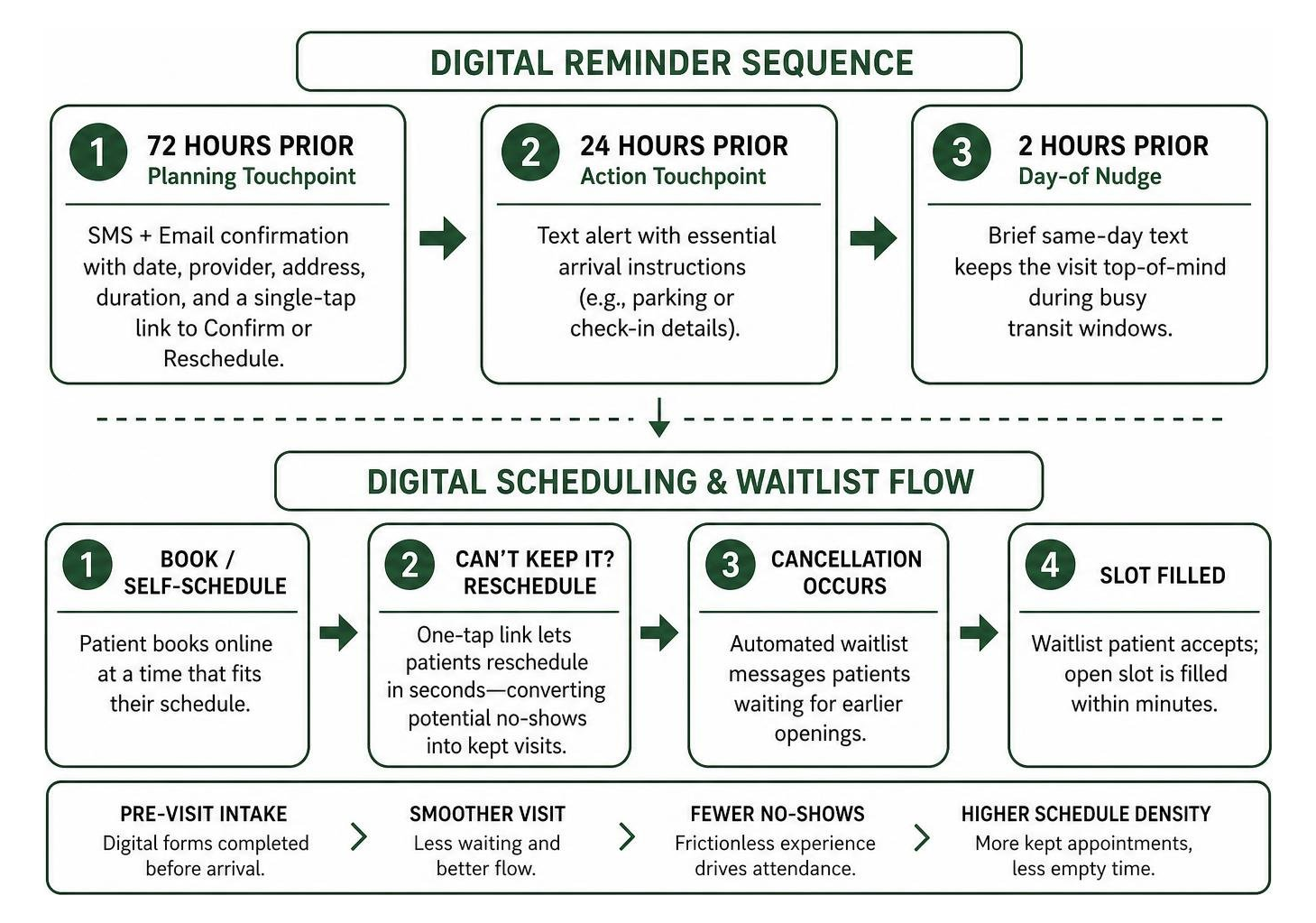
Key technological automations include:
- Frictionless One-Tap Rescheduling: Providing a secure, tokenized web link within reminder texts lets patients move their slot in seconds without downloading apps or remembering passwords. Research indicates self-rescheduling tools successfully convert 35% to 55% of potential no-shows into completed visits.
- Automated Waitlist Fill: When a cancellation occurs, an automated waitlist engine messages patients waiting for earlier openings. Digital waitlists reliably recover 50% to 70% of open slots within minutes.
- Pre-Visit Digital Intake: Delivering electronic medical history and consent forms directly to the patient's phone prior to arrival increases commitment. Completing intake ahead of time reduces waiting room delays.
- Direct Calendar Sync: Including standard calendar invites (.ics links for Google, Apple, and Outlook calendars) ensures the appointment populates the patient's personal calendar with automated travel alerts.
Adopting these streamlined tools helps independent clinicians discover simple ways to run the lean medical practice without inflating administrative overhead.
Policy, Deposits, and Accountability Without Damaging Trust
Clear financial policies protect schedule integrity while maintaining patient trust when communicated transparently.
A survey by MGMA revealed that over 40% of medical groups utilize a formal no-show or late-cancellation fee policy. Practices implementing clear policies report higher attendance rates (25% improvement versus 16% for practices without them). However, policies must be framed around shared accountability rather than punishment:
- Transparent Windows: Establish a standard 24- to 48-hour cancellation policy. Display this policy visibly during online booking, on intake forms, and in confirmation messages.
- Card-on-File Capture: Securely saving a payment method during initial digital registration creates psychological commitment. Capturing payment details at intake has been shown to reduce unnotified absences by roughly 14%.
- Refundable First-Time Deposits: For elective, aesthetic, or high-overhead procedure slots, a modest refundable deposit (e.g., $25 to $50 applied directly to the visit balance) lowers new-patient drop-off rates by up to 50%.
- First-Offense Grace Protocol: Life happens. Waiving the fee for a patient's first accidental missed appointment—while gently reminding them of the clinic policy—preserves goodwill and prevents negative reviews.
Standardizing these administrative boundaries is an effective way for clinicians to learn how to reduce administrative burnout in a medical office and eliminate awkward billing disputes at the front desk.
High-Risk Patient Triage and Empathy-First Interventions
Not all appointments carry the same attendance risk. Predictive segmentation allows practices to allocate administrative outreach where it matters most:
- Targeted Personal Outreach: Machine-learning triage and manual historical reviews can identify appointments with higher missed-visit likelihoods (e.g., long lead times, past missed visits, or complex logistics). In clinical trials, placing a warm, live telephone call to a flagged patient reduced no-show rates to 3%, compared to a 24% no-show rate when leaving voicemails and 39% when unreached.
- Addressing Structural Barriers: A safety-net family health center successfully lowered its no-show rate from 18.6% to 12.3% (a 33.8% relative drop across 62,000 appointments) by introducing multilingual staff coordination, transportation support, and standardized assistance.
- Telehealth Fallback: If a patient encounters last-minute transport or schedule issues, offering an instant conversion to a virtual consultation preserves clinical continuity and recovers provider time.
- Continuity of Care: Patients scheduled with their primary, consistent provider demonstrate significantly lower attrition and missed-visit rates than those assigned to rotating clinical staff.
Frequently Asked Questions About Patient No-Shows
What is an acceptable benchmark for patient no-show rates in 2026?
While national outpatient averages range between 15% and 30%, top-performing independent practices aim for a combined cancellation and no-show rate under 5% to 8%. Primary care typically sustains rates around 10% to 15%, whereas procedural specialties can achieve lower rates through automated reminders, pre-visit deposits, and short booking windows.
Does charging a no-show fee drive patients away?
When communicated clearly in advance and paired with a first-offense grace policy, modest fees do not negatively affect patient acquisition. Patients appreciate that clinical time is valuable. Transparent fees primarily deter unnotified absences while encouraging patients to use digital rescheduling links ahead of time.
How can independent practitioners streamline scheduling without dedicated reception staff?
Independent providers can deploy automated digital platforms featuring integrated online self-scheduling, two-way SMS reminders, digital intake forms, and automated waitlist backfilling. These systems handle routine administrative coordination in the background, allowing clinicians to manage full patient schedules efficiently without relying on traditional front-desk staffing.
Conclusion
Reducing patient no-shows does not require relentless phone calls or rigid policies that alienate the people you care for. By shortening scheduling lead times, enabling frictionless self-rescheduling, adopting warm multi-channel reminders, and approaching patient attendance with empathy, independent practices can maintain high schedule utilization while delivering an elevated patient experience.
For healthcare professionals seeking to grow an independent practice on their own terms, controlling practice overhead is just as critical as protecting your schedule. Residen provides premium medical coworking spaces in Los Angeles—with locations in Brentwood (11620 Wilshire Blvd) and Beverly Hills (433 N Camden Dr Ste 610). Our flexible medical office solutions feature fully equipped, patient-ready exam rooms, consultation rooms, and procedure rooms available hourly, daily, or longer-term without long-term leases or membership fees. Residen's innovative technology enables a seamless no-admin medical workspace, allowing you to focus entirely on patient outcomes and clinical independence.
Explore our medical coworking spaces and discover how practicing in a modern, turnkey medical office can elevate your private practice.