
The Definitive Guide to Why West LA Patients Value Convenience Now
Why West LA Patients Value Convenience More Than Ever

Why West LA patients value convenience more than ever comes down to a few key forces colliding at once: brutal traffic, packed schedules, and a post-pandemic shift in what people expect from their doctors.
Here is a quick summary:
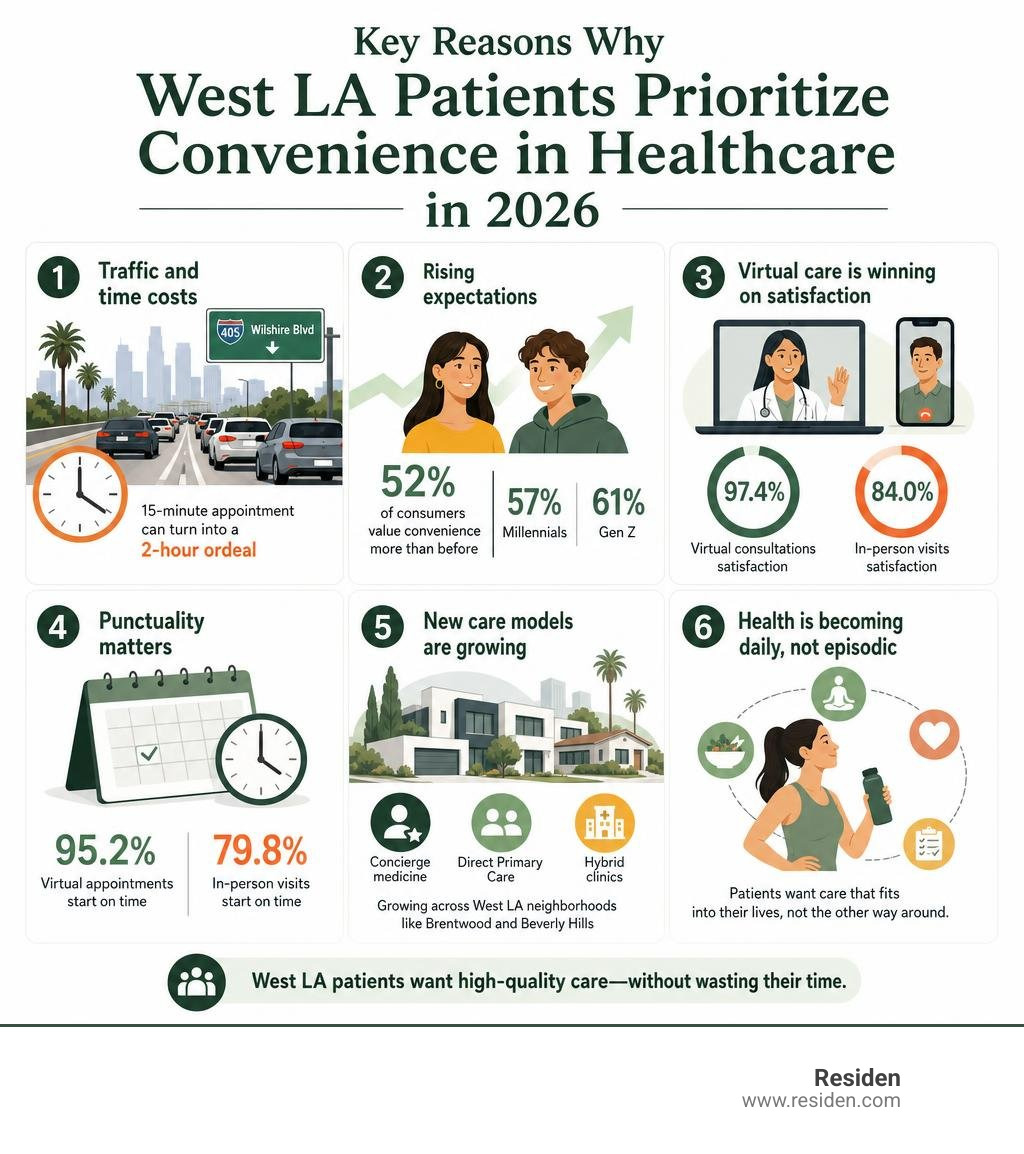
- Traffic and time costs — Commuting on the 405 or Wilshire Boulevard can turn a 15-minute appointment into a 2-hour ordeal
- Rising expectations — 52% of consumers now value convenience more than they did before, with Millennials (57%) and Gen Z (61%) leading the shift
- Virtual care is winning on satisfaction — 97.4% of virtual consultation patients report overall satisfaction, vs. 84.0% for in-person visits
- Punctuality matters — 95.2% of virtual appointments start on time, compared to only 79.8% of in-person visits
- New care models — Concierge medicine, Direct Primary Care, and hybrid clinics are growing fast across West LA neighborhoods like Brentwood and Beverly Hills
- Health is becoming daily, not episodic — Patients want care that fits into their lives, not the other way around
West LA patients are not asking for less quality. They are asking to stop wasting their time.
Imagine spending 45 minutes battling traffic on Wilshire Boulevard, only to sit in a waiting room for another 30 minutes past your scheduled appointment time. For today's patients, that is not just frustrating — it is a dealbreaker.
Healthcare providers who ignore this shift are already losing patients to faster, more accessible alternatives.
I'm Dr. Jessica Wu, a Los Angeles-based dermatologist with over 20 years of private practice experience — including making house calls to Hollywood sets — and I have watched as patient expectations around access and convenience have fundamentally changed. Understanding why West LA patients value convenience more than ever is something I navigate daily, and in this guide I will walk you through exactly what is driving this shift and what it means for healthcare providers operating in this market.
The post-pandemic era has completely rewritten the playbook for how people interact with services. We live in a world where groceries appear on our doorsteps in under an hour, streaming services serve up instant entertainment, and work happens from our living rooms. It was only a matter of time before these frictionless expectations disrupted the traditional, slow-moving medical system.
In West Los Angeles, this disruption is happening faster and more frequently than almost anywhere else in the country. The modern West LA patient is no longer willing to tolerate the administrative friction that has defined American healthcare for decades. If a medical practice requires a patient to call multiple times just to book an appointment, wait three weeks for an open slot, and then spend half a day traveling to a physical office, that patient will simply find another provider.
To remain competitive in 2026, healthcare providers must understand that convenience is no longer an optional perk—it is the very foundation of patient acquisition and retention. Let’s dive deep into the specific geographic, demographic, and cultural forces driving this transformation.
Demographics and Traffic: Why West LA Patients Value Convenience More Than Ever
To truly understand why West LA patients value convenience more than ever, you have to look at a map of Los Angeles—and then look at the red lines on Google Maps during rush hour.
In West LA, distance is never measured in miles; it is measured in minutes. Traveling from Santa Monica to Beverly Hills can easily take 45 minutes to an hour on a weekday afternoon, even though the physical distance is barely six miles. The notorious gridlock on the 405 freeway, Santa Monica Boulevard, and Wilshire Boulevard acts as a massive physical barrier to healthcare access. For a busy professional, a parent juggling school runs, or an active senior, a routine doctor’s appointment doesn’t just take 30 minutes—it consumes half a day of lost productivity and intense transit stress.
This geographic reality is colliding with a massive generational shift. Over half of all consumers surveyed (52%) report that they value convenience today far more than they did in the past. This demand is even more pronounced among younger demographics, with 57% of Millennials and 61% of Gen Z expressing a growing insistence on frictionless experiences. These generations have grown up with on-demand digital services. They do not understand why scheduling a medical check-up should be more difficult than booking a ride-share or ordering dinner.
Furthermore, West LA is home to a highly concentrated population of high-income professionals, creative executives, and tech entrepreneurs who view time as their most valuable currency. In affluent enclaves like our locations in Location: Brentwood and Location: Beverly Hills, patients are very willing to pay a premium for services that protect their time and eliminate administrative hassle. They expect their healthcare experiences to match the seamless, high-touch services they receive in every other aspect of their lives.
When faced with rigid scheduling, long wait times, and difficult parking, many residents are bypassing traditional primary care offices entirely. Instead, they are turning to alternative care models that prioritize their lifestyle. This is why we are seeing such a dramatic rise in local urgent care utilization for routine needs; patients are actively seeking out providers that offer walk-in access and extended hours. To understand this shift in patient behavior, we can look at Why West Hollywood Residents Prefer Urgent Care Over Traditional Clinics, which highlights how modern patients are increasingly choosing immediate, localized care over the rigid, weeks-in-advance booking structures of legacy medical groups.
The Shift to Concierge and DPC: Why West LA Patients Value Convenience More Than Ever
The traditional, insurance-based primary care model in the United States is fundamentally volume-driven. Because reimbursement rates have steadily declined, traditional practices are forced to manage massive patient panels—often exceeding 2,000 patients per physician. This volume-first approach results in standard appointment slots that average a mere 7 to 12 minutes, leaving patients feeling rushed, ignored, and deeply unsatisfied.
In response to this systemic failure, West LA patients are taking control of their health by migrating in droves toward membership-based healthcare models. Concierge medicine and Direct Primary Care (DPC) have transitioned from exclusive luxury services for the ultra-wealthy into mainstream solutions for busy families and professionals who refuse to compromise on access.
To understand this dramatic shift, consider how these models completely restructure the patient-provider relationship:
- Drastically Smaller Patient Panels: While a conventional doctor manages thousands of patients, a DPC or concierge physician typically caps their entire panel between 300 and 600 patients.
- Unhurried, Comprehensive Visits: Instead of a rushed 10-minute slot, appointments in a concierge practice run between 30 and 60 minutes, allowing for deep-dive discussions, preventive planning, and holistic wellness evaluations.
- True 24/7 Access: Members enjoy direct communication channels with their personal doctor via phone, email, or text, bypassing receptionist gatekeepers and automated phone trees.
- Same-Day or Next-Day Scheduling: Because the patient load is controlled, patients can easily secure immediate appointments when they are actually sick, rather than waiting weeks for an opening.
For a detailed breakdown of how these models are reshaping the local landscape, explore What Is Concierge Medicine and Why Los Angeles Patients Are Making the Switch in 2026. This shift represents a fundamental rejection of reactive "sick-care" in favor of a proactive, relationship-driven health partnership.
By eliminating insurance middlemen, Direct Primary Care allows doctors to focus entirely on clinical care and patient experience. Patients pay a flat, transparent monthly or annual fee directly to the clinic, unlocking unprecedented convenience and peace of mind. This model empowers patients to bypass traditional administrative headaches and build a direct, continuous relationship with a trusted medical professional who is actually available when needed.
Virtual vs. In-Person Care: The Battle for Patient Satisfaction
The rapid expansion of telehealth was born out of pandemic necessity, but its sustained popularity in 2026 is driven entirely by its superior convenience. When we compare virtual healthcare consultations to traditional in-person visits, the data reveals a stark contrast in patient satisfaction and operational efficiency.
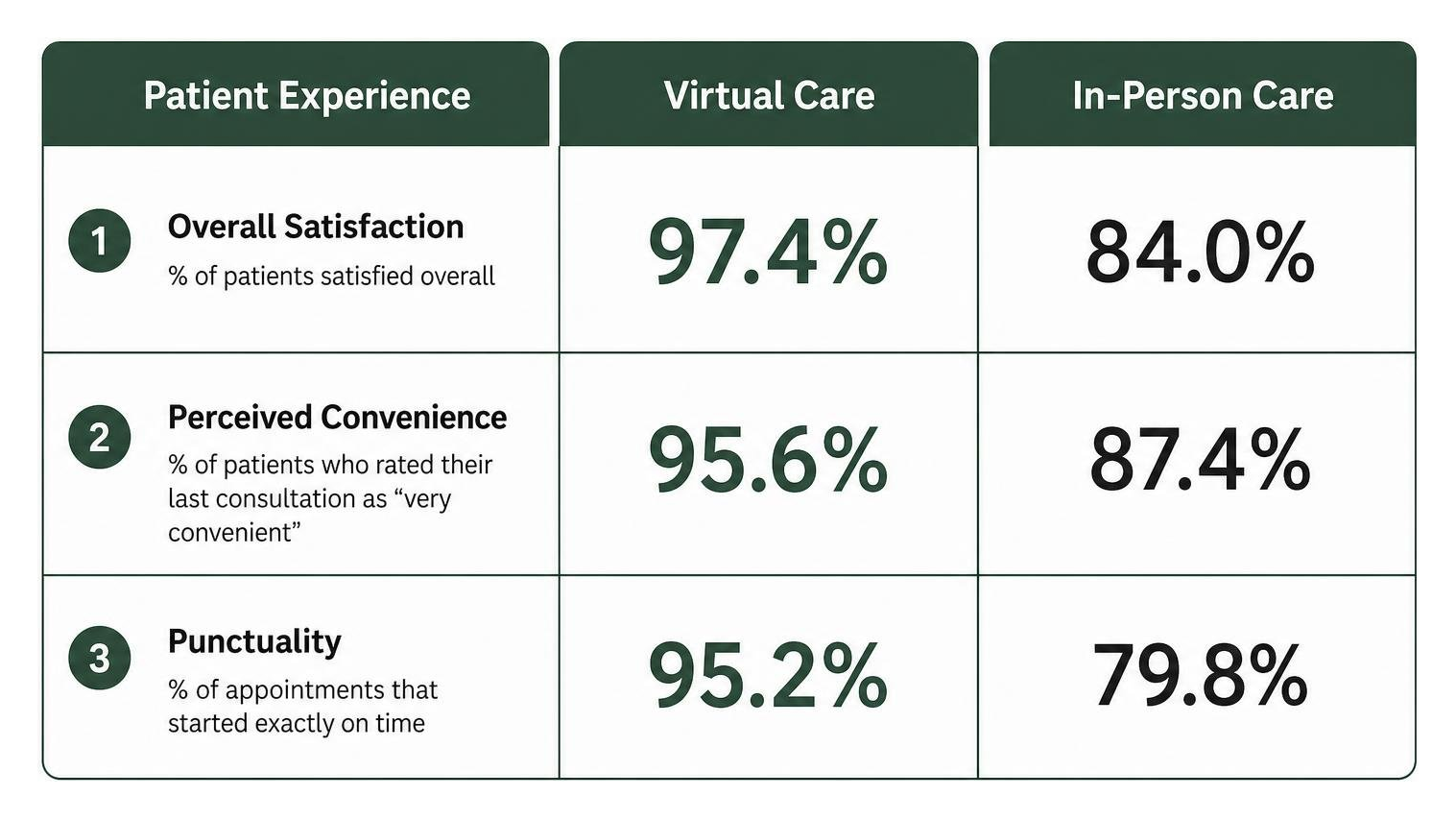
According to recent clinical studies evaluating patient experiences, virtual consultations consistently outperform traditional in-person visits across several critical metrics:
- Overall Satisfaction: 97.4% of patients attending virtual consultations reported being satisfied overall, compared to only 84.0% of patients who attended traditional in-person visits.
- Perceived Convenience: An overwhelming 95.6% of virtual care patients rated their last consultation as "very convenient," while only 87.4% of in-person patients said the same.
- Punctuality: One of the single biggest pain points in healthcare is waiting. The data shows that 95.2% of virtual consultations started exactly on time, compared to a disappointing 79.8% for traditional in-person appointments.
- Communication Comfort: Interestingly, 96.5% of virtual patients felt comfortable communicating with their clinician, compared to 87.9% of in-person patients. This suggests that being in the comfort of one's own home reduces clinical anxiety and fosters more open, honest dialogue.
- Privacy and Respect: 96.5% of virtual patients felt their privacy was fully respected during their visit, compared to 91.2% of those visiting physical clinics.
To make these differences clear, let’s look at a direct comparison of the key performance indicators:
| Patient Experience Metric | Virtual Consultations | In-Person Consultations |
|---|---|---|
| Overall Patient Satisfaction | 97.4% | 84.0% |
| Rated as "Very Convenient" | 95.6% | 87.4% |
| Appointments Starting On-Time | 95.2% | 79.8% |
| Comfortable Communicating with Doctor | 96.5% | 87.9% |
| Felt Privacy Was Fully Respected | 96.5% | 91.2% |
While virtual care is an incredibly powerful tool for triaging, reviewing lab results, managing prescriptions, and conducting mental health therapy, it cannot completely replace the physical exam. Certain diagnostics, procedures, and hands-on therapies will always require a face-to-face visit. The challenge for modern healthcare providers is not choosing one over the other, but rather building a seamless hybrid model that captures the efficiency of digital access while maintaining the high-touch quality of a physical clinic.
The Role of Technology in Frictionless Scheduling
To bridge the gap between the digital and physical worlds, healthcare providers must leverage modern technology to eliminate friction before the patient ever steps foot in an exam room. In 2026, the patient journey begins on a smartphone screen, not in a waiting room.
Implementing user-friendly telehealth apps, secure patient portals, and automated scheduling systems is essential for meeting the convenience demands of West LA patients. However, technology should be used to simplify the patient experience, not complicate it. Research indicates that while patients appreciate background technology that makes operations smoother—such as instant text reminders or automated insurance verification—they are highly resistant to overly complex, hyped tech solutions. For instance, only 27% of consumers express a desire to use generative AI-powered shopping or booking assistants, preferring intuitive, straightforward interfaces where they can quickly select an appointment slot and move on with their day.
By utilizing clean, digital health platforms, practices can offer:
- On-Demand Self-Scheduling: Allowing patients to view real-time availability and book, reschedule, or cancel appointments 24/7 without having to make a phone call.
- Digital Intake Forms: Eliminating the dreaded clipboard by allowing patients to complete medical histories and upload insurance cards securely from home prior to their visit.
- Direct Messaging Channels: Giving patients a secure, direct line to ask quick follow-up questions, request prescription refills, or view lab results.
To explore how these digital tools are being integrated with highly customized, relationship-driven care models, read our deep dive on Blog: The Rise of Personalized Healthcare. When technology is used thoughtfully to remove administrative barriers, it frees up valuable time for both the doctor and the patient, allowing the actual medical interaction to be more focused, relaxed, and personalized.
Lessons from Retail: Integrating 'Fresh Convenience' into Healthcare
To truly innovate, the healthcare industry must look outside of its own silo and learn from other consumer-facing sectors that have successfully mastered the convenience revolution. The grocery retail industry, in particular, offers brilliant insights into how businesses can deliver ultra-premium, high-quality products without sacrificing speed or ease of access.
Consider the phenomenon of Erewhon, often called America's most expensive supermarket, which has a highly popular location right in the heart of Beverly Hills.
Why are West LA residents willing to pay astronomical prices for items at Erewhon? It is because the brand has successfully pioneered the concept of "fresh convenience." They have combined two traditionally opposing strengths: uncompromising, organic, health-conscious quality and frictionless, grab-and-go convenience.
In the retail sector, convenience is one of the very few purchasing drivers that has sustained its high value even under intense inflationary pressures. Consumers are actively looking to outsource their daily stressors. For example, 53% of all consumers—rising to 66% for Gen Z—report that simply figuring out "what's for dinner" is a major daily pain point. Retailers solve this "planning fatigue" by offering pre-packaged, high-quality, ready-to-eat meals. More than two-thirds of consumers (67%) admit that on busy days, they will buy more convenient food items even if they know they are less healthy, simply because their time is limited.
This reveals a profound truth about human behavior: when forced to choose, modern consumers will frequently prioritize convenience over quality.
In fact, national healthcare surveys have mirrored this retail reality, finding that a staggering number of patients now value convenience more than the perceived quality of clinical care itself.
For medical providers, the lesson is clear: you can be the most brilliant, highly trained specialist in Beverly Hills, but if your practice is highly inconvenient to access, patients will choose a more accessible competitor. The goal must be to eliminate the tradeoff entirely—delivering world-class clinical care wrapped in a seamless, convenient experience.
Overcoming the Quality vs. Speed Tradeoff
Balancing the demand for rapid, convenient service with the absolute necessity of maintaining safe, high-quality, and deeply personalized clinical care is the primary challenge facing modern practitioners. Patients want speed, but they also want to trust that their doctor is fully invested in their long-term well-being.
The solution lies in adopting a hybrid, highly localized care model. By establishing smaller, community-focused clinics directly in the neighborhoods where patients live and work, healthcare systems can bypass the geographic and transit barriers that make centralized medical centers so inconvenient.
A perfect example of this hyper-local approach is UCLA Health's recent expansion. By opening a dedicated, family-focused primary care clinic in West Adams, they brought world-class medical services directly to a growing, historic neighborhood, eliminating the need for local families to travel long distances across town for routine care. To learn more about this community-oriented facility, read New clinic brings world-class care to the West Adams community | UCLA Health.
When primary care is deeply embedded within a local neighborhood, it fosters a unique sense of trust and community connection. This model allows providers to:
- Act as the central "quarterback" of a patient's healthcare team, helping them easily navigate complex specialist referrals.
- Offer flexible, same-day appointments for acute illnesses, reducing unnecessary, expensive trips to the emergency room.
- Integrate multi-generational care under one roof, simplifying healthcare logistics for busy families.
Modernizing West LA Healthcare Infrastructure
To support this massive shift toward localized, convenient, and outpatient-focused care, the physical infrastructure of healthcare in West LA is undergoing a major modernization. Historically, medical offices were confined to massive, sterile hospital campuses or outdated commercial towers that lacked the technological capabilities and aesthetic appeal demanded by modern patients.
Today, we are seeing a rapid rise in the development of independent outpatient clinics, specialized wellness centers, and ambulatory surgery centers (ASCs). These modern facilities allow patients to receive advanced diagnostic and surgical procedures in a comfortable, boutique setting closer to home, completely bypassing the administrative delays, parking hassles, and high costs associated with major hospital networks.
However, building new medical facilities in highly dense, fully developed urban corridors like Beverly Hills and Brentwood is incredibly difficult due to strict zoning laws, parking requirements, and limited real estate. As a result, the industry is relying heavily on the adaptive reuse of existing commercial assets.
A prime example of this trend is the recent transformation of 640 S San Vicente Boulevard, a boutique commercial building located less than a mile from Cedars-Sinai Medical Center. Through a highly strategic entitlement process, developers secured unanimous city approval to convert this legacy office building into a state-of-the-art medical clinic and outpatient ambulatory surgery center.
While these large-scale redevelopments are vital for the healthcare ecosystem, they require millions of dollars in capital and years of construction, making them completely inaccessible for independent practitioners who want to establish a local presence. This is where modern real estate solutions are stepping in to democratize medical space.
At Residen, we provide a flexible, low-overhead alternative through our turnkey, shared medical office rentals. Instead of signing a restrictive, multi-year commercial lease, paying massive build-out fees, and managing complex facility operations, independent doctors can simply book fully equipped, patient-friendly exam and procedure rooms by the hour or by the day. To learn how this flexible model is helping doctors establish highly convenient, local practices without the traditional real estate headaches, read our comprehensive guide, Blog: Finding Your Daily Doctor Suite: A Guide to Flexible LA Healthcare Rentals.
Bringing Care Directly to the Neighborhood
Expanding physical healthcare access into local neighborhoods is not just a commercial trend; it is a vital public health necessity. In a sprawling metropolis like Los Angeles, transportation barriers and transit deserts directly prevent patients from seeking preventive screenings and adhering to chronic disease management plans.
When patients have to travel long distances, they are far more likely to delay care until a minor issue escalates into a medical emergency. By decentralizing clinical spaces and positioning them directly within local communities, we can dramatically improve patient compliance, build long-term trust, and elevate overall community health outcomes.
This community-first philosophy is driving major healthcare initiatives across the city. Localized primary care is bridging geographic gaps and overcoming urban transit challenges. By creating a welcoming "medical home" directly in the neighborhood, providers are making it easier than ever for families to prioritize their health without having to battle the West LA traffic.
Frequently Asked Questions about West LA Healthcare Convenience
Why is healthcare convenience so critical for West LA residents?
West LA residents face unique geographic and lifestyle challenges, most notably severe traffic congestion on major corridors like the 405 freeway and Wilshire Boulevard. In this environment, time is a highly valuable currency. Patients are no longer willing to lose half a day of productivity to travel a few miles for a rushed doctor's appointment. They demand frictionless, localized healthcare options that respect their schedules and fit seamlessly into their busy lives.
How does virtual care compare to in-person visits in terms of satisfaction?
Clinical data reveals that virtual care actually outperforms traditional in-person visits in several key areas. Virtual consultations boast a 97.4% overall satisfaction rate compared to 84.0% for in-person visits, largely driven by superior punctuality and reduced travel friction. Additionally, patients report feeling highly comfortable communicating and feel their privacy is better respected in a virtual format. However, for physical diagnostics and procedures, a hybrid care model combining virtual triage with highly convenient, local physical offices is the ideal solution.
What is the difference between concierge medicine and traditional primary care?
Traditional primary care practices rely on high patient volumes, managing panels of over 2,000 patients, which results in rushed 10-minute visits and weeks-long booking delays. Concierge medicine and Direct Primary Care (DPC) are membership-based models where patients pay a flat fee directly to their physician. In exchange, doctors cap their patient panels between 300 and 600 patients, allowing them to offer same-day or next-day scheduling, unhurried 30-to-60-minute appointments, direct 24/7 digital access, and a strong focus on proactive, personalized wellness.
Conclusion
The evidence is clear: West LA Patients Value Convenience More Than Ever and it is not a passing post-pandemic fad, but a permanent structural shift in consumer behavior. The modern patient expects their healthcare journey to be as frictionless, transparent, and accessible as every other service they utilize daily. Providers who fail to adapt to this demand will inevitably see their patient panels shrink as tech-savvy, convenience-first alternatives continue to grow.
Fortunately, adapting to this new landscape does not require independent practitioners to take on massive financial risks or sign restrictive, long-term commercial leases.
At Residen, we have built the ultimate real estate solution for the modern healthcare era. We provide fully equipped, beautifully designed, and compliant shared medical office rentals in West LA's most desirable neighborhoods, including Beverly Hills and Brentwood. With our turnkey spaces, you can book professional exam, procedure, or consultation rooms by the hour or day—with absolutely no long-term leases, setup costs, or hidden membership fees.
Whether you want to establish a local satellite clinic, transition your practice to a Direct Primary Care model, or simply offer your patients a highly convenient, premium physical location closer to where they live, we are here to support you.
Ready to elevate your patient experience and grow your practice on your own terms? Explore our flexible medical workspaces and check out our premier Southern California Locations today to find your perfect suite.