
How to Reduce Administrative Burnout in a Medical Office Effectively
Administrative burden in modern medical offices has reached an all-time high, pulling clinicians away from patient care and contributing significantly to workplace exhaustion. Addressing this systemic challenge requires targeted operational strategies, workflow mapping, and technology optimization.
Understanding Administrative Burnout vs. Clinical Exhaustion

To address administrative burden effectively, practice leaders must distinguish between pure clinical exhaustion and systemic administrative burnout. Clinical exhaustion typically stems from the intense cognitive and emotional weight of treating illness. Administrative burnout, however, is driven by structural friction—endless clicks, repetitive data entry, complex billing requirements, and constant phone interruptions.
When administrative tasks consume nearly two out of every five working hours of a provider's day, healthcare professionals experience depersonalization and cynicism. They feel less like healers and more like data entry clerks with medical degrees. Task fragmentation occurs when staff are repeatedly pulled away from their primary responsibilities to handle phone calls, prior authorization queries, or missing paperwork.
Key Indicators of Administrative Burden
- Excessive time spent on non-clinical paperwork: Spending more time filling out forms and managing insurance verifications than interacting directly with patients.
- Inefficient patient communication channels: High inbound call volumes that force front-desk staff to field dozens of phone inquiries while simultaneously trying to greet walk-in patients.
- EMR documentation overload and pajama time: Clinicians logging into electronic medical record (EMR) systems late at night or on weekends to catch up on charting after clinic hours end.
Differentiating Clinician Burnout from Administrative Friction
While clinician burnout is often treated as a personal resilience issue, research proves it is fundamentally a systems failure. Trying to solve heavy documentation burdens with wellness apps or yoga stipends ignores the root cause. Reframing the issue around Ten Commandments Of Physician Wellness allows practices to focus on operational fixes that protect cognitive bandwidth. Cognitive overload occurs when clinicians must process disjointed electronic health record (EHR) inbox messages, track down outside test results, and navigate complex billing codes while conducting rapid-fire patient visits.
Identifying Primary Tasks and Mapping Workflow Bottlenecks
Reducing friction requires pinpointing the exact tasks that consume the most time and energy. Across most medical practices, four administrative culprits create the heaviest drain:
- Prior Authorizations: Insurance requests that demand hours of manual follow-up, medical record faxing, and phone calls.
- EHR Documentation & Pajama Time: Unoptimized templates that require dozens of extra clicks per encounter, extending the workday into off-hours.
- Phone Interruptions: Front-desk phones ringing constantly, breaking staff concentration and slowing patient check-ins.
- Insurance Verification & Billing: Manual eligibility checks that lead to unexpected claim denials and billing rework.
To eliminate these stressors, independent practices can adopt strategies for running a lean medical practice that targets waste and redundant effort.
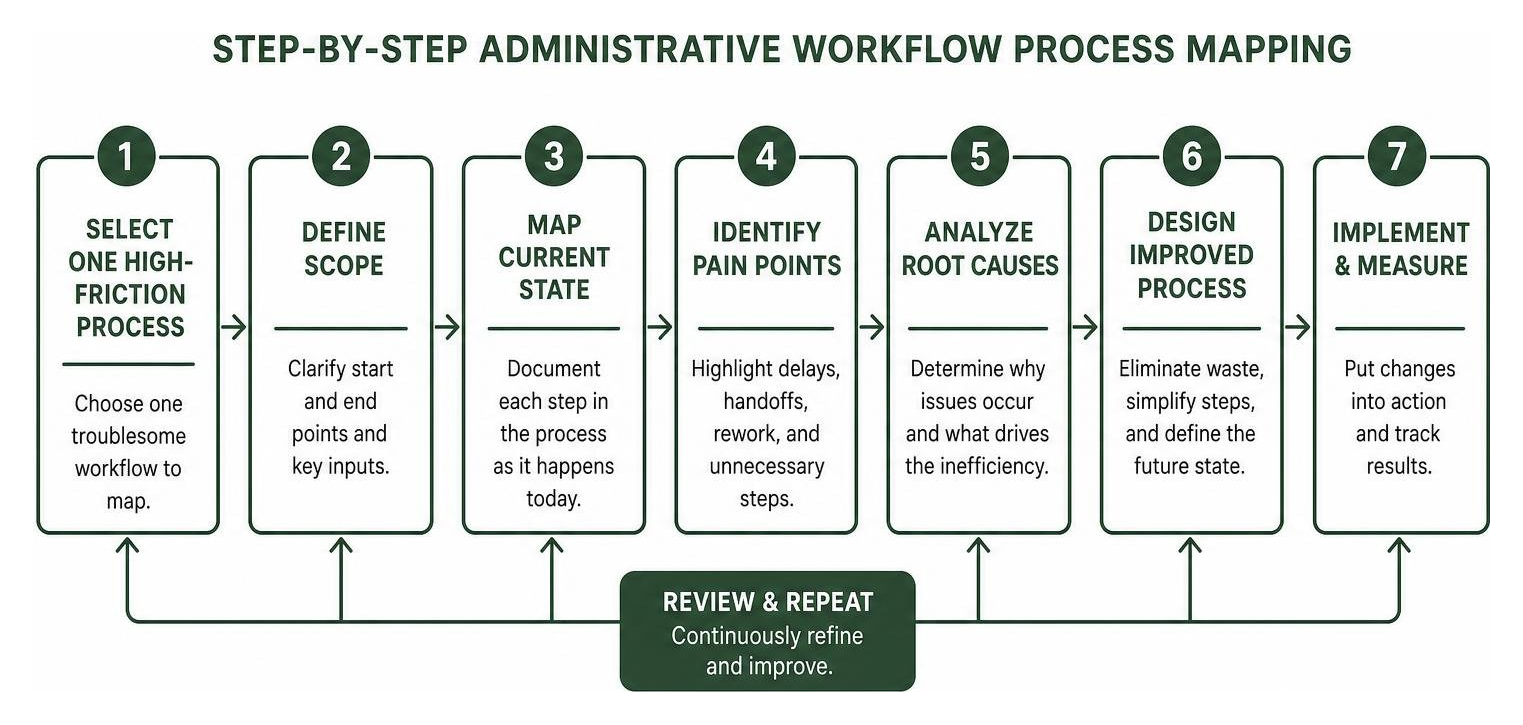
Step-by-Step Workflow Process Mapping
Practices should map high-friction workflows alongside front-line staff who perform the daily tasks.
- Select One High-Friction Process: Focus on a single troublesome workflow, such as prescription refills or prior authorizations.
- Conduct Front-Line Staff Interviews: Ask medical assistants, receptionists, and billing specialists where tasks get delayed or stuck.
- Run a Time-Tracking Audit: Track the exact minutes spent on manual phone calls, status checks, and repeated data entry over a two-week period.
- Identify Bottlenecks and Redundancies: Pinpoint tasks where staff act as "human bridges"—manually typing information from paper intake forms or separate software platforms into the primary EHR.
Operational Strategies: How to Reduce Administrative Burnout in a Medical Office

Addressing administrative burden requires leadership commitment to systemic workflow redesign rather than temporary fixes. When leadership prioritizes top-of-license care, every team member performs tasks that match their exact skill level and credentials. Medical assistants handle pre-visit documentation and medication history updates, leaving physicians free to focus entirely on diagnosis and clinical strategy. Discovering joy in medicine is far easier when operational friction no longer stands between providers and their patients.
Measuring the Financial and Well-Being Impact
Streamlining operations produces measurable improvements across practice health and clinical well-being:
- Turnover Reduction: Replacing a burned-out provider or experienced staff member can cost tens of thousands of dollars in recruitment, hiring, and lost productivity. Reducing daily administrative strain keeps valuable team members in place.
- Claim Denial Rates: Automating insurance verification and prior authorization preparation significantly lowers initial claim rejections, stabilizing practice cash flow.
- Patient Experience Scores: Patients notice when front-desk teams are calm and clinicians are focused on them rather than a computer screen.
- Provider Satisfaction: A landmark pilot study on reducing administrative burden demonstrated that offloading medication history tasks resulted in a statistically significant drop in reported clinician burnout and emotional exhaustion.
Fostering a Culture of Operational Efficiency
Building a resilient practice culture relies on psychological safety. Staff members must feel safe raising operational concerns or pointing out broken processes without fear of reprimand. Participatory scheduling grants providers and support staff greater input over their weekly clinic hours and patient appointment pacing.
Empowering staff to suggest workflow fixes creates an environment of continuous improvement. When practices build clear operational systems, they create setups that let the practice run smoothly without constant firefighting.
Technology Solutions and EHR Optimization

Technology should simplify work, not add extra clicks. Because most practices use less than half of their EHR system's features, targeted technology optimizations can yield immediate time savings.
Leveraging Automation Tools
Deploying narrow, targeted automation tools eliminates daily manual chores:
- Ambient AI Scribes: AI documentation tools listen naturally to patient-doctor conversations and draft clinical notes in real time, dramatically reducing off-hours charting.
- Digital Intake Forms: Patients complete registration and history forms online prior to their appointment, auto-populating patient records and eliminating paper processing at check-in.
- Automated Prior Authorization: Dedicated software platforms trigger prior authorization requests automatically during order entry, reducing manual phone calls and faxes.
- Billing Auto-Scrubber Tools: Automated software checks claims for coding errors or missing insurance data before submission, lowering initial denial rates.
Smart EHR Tweaks
- Dot-Phrases and Macros: Create custom text shortcuts for common physical exam findings, patient instructions, and standard treatment plans to speed up charting.
- Template Customization: Tailor documentation templates to specific patient complaints so clinicians complete notes in fewer clicks.
- System Interoperability: Ensure external lab, imaging, and communication tools integrate directly into the main EHR to eliminate duplicate data entry.
- Inbox Delegation Protocols: Train medical assistants and triage staff to filter routine prescription refill requests and minor messages using standardized protocols, protecting provider inboxes.
Strategic Delegation and Offloading

Effective delegation relies on absolute role clarity. Tasks should be assigned to the lowest-cost, properly credentialed team member capable of executing them safely under established protocols.
When staff operate below their level of training—such as doctors spending hours hunting down lab results or scheduling appointments—the practice loses both time and money. Addressing staffing struggles involves reallocating tasks so every staff member works efficiently.
Virtual Assistants and Strategic Outsourcing
For small or growing practices, hiring full-time, in-office staff for every administrative task can be cost-prohibitive. Virtual support and specialized third-party services provide flexible alternatives:
- Revenue Cycle Management (RCM): Outsourcing complex medical billing, coding, and claim appeals to specialized external vendors converts fixed overhead costs into manageable variable expenses while raising collection rates.
- Virtual Receptionists: Dedicated virtual team members field inbound telephone calls, process patient appointment requests, and track down patient referrals off-site, leaving in-office front-desk staff free to greet walk-in patients without distraction.
- HIPAA Compliance Assurance: When deploying remote staff or outsourced billing, ensure all partner organizations execute Business Associate Agreements (BAAs) and maintain strict, end-to-end data security protocols.
Frequently Asked Questions About Medical Office Burnout
What is the main difference between physician burnout and administrative burnout?
Physician burnout stems from chronic workplace stress, emotional exhaustion, and the demands of clinical patient care. Administrative burnout is caused specifically by operational friction—such as redundant EHR documentation, insurance verifications, prior authorizations, and constant phone interruptions—that distracts from direct patient care.
Which administrative tasks contribute most heavily to practice exhaustion?
The primary tasks contributing to office exhaustion are manual prior authorization requests, unoptimized EHR documentation (which causes late-night charting or "pajama time"), high inbound phone call volume, duplicate data entry, and managing cluttered EHR communication inboxes.
How quickly can a practice expect measurable results after streamlining workflows?
Practices that implement targeted operational changes—such as setting up custom dot-phrases, deploying ambient AI scribes, or setting up automated appointment reminders—often see noticeable reductions in documentation time and phone volume within 30 to 60 days. Broader cultural and leadership changes typically show sustained results within 6 to 12 months.
Summary
Reducing administrative friction requires an operational commitment to modernizing how a practice handles day-to-day work:
- Automate repetitive administrative workflows: Streamline routine tasks like patient intake, appointment scheduling, and prior authorizations through integrated software tools.
- Optimize EHR usage: Maximize charting speed using custom macros, ambient AI scribes, template shortcuts, and delegated inbox triage protocols.
- Partner with flexible medical office solutions: Reduce facility management friction, fixed commercial real estate leases, and workspace setup hassles by leveraging modern healthcare workspace solutions.
Conclusion
Reducing administrative burnout is essential for running a sustainable, efficient private practice. By identifying operational bottlenecks, automating manual tasks, optimizing EHR documentation, and delegating non-clinical responsibilities, practice leaders can restore focus to direct patient care and improve overall job satisfaction.
Physical office operations also play a major role in administrative burden. Managing long-term commercial leases, setting up exam rooms, and maintaining building facilities require significant time and capital. Choosing a flexible medical office solution removes these real estate headaches entirely.
As a turnkey medical office provider, Residen offers fully equipped exam, procedure, and consultation rooms in premier locations like Brentwood, CA, and Beverly Hills, CA. Providers can book healthcare workspaces on an hourly, daily, or long-term basis with no complex leases or upfront setup costs. Utilizing a flexible medical coworking space allows providers to keep administrative overhead low, streamline practice operations, and focus their time where it matters most: delivering exceptional patient care.
Explore our medical coworking spaces to learn how Residen can support your practice.