
How to Work 3 Days a Week as a Doctor in 5 Simple Steps
Why More Doctors Are Choosing to Work 3 Days a Week (Without Earning Less)

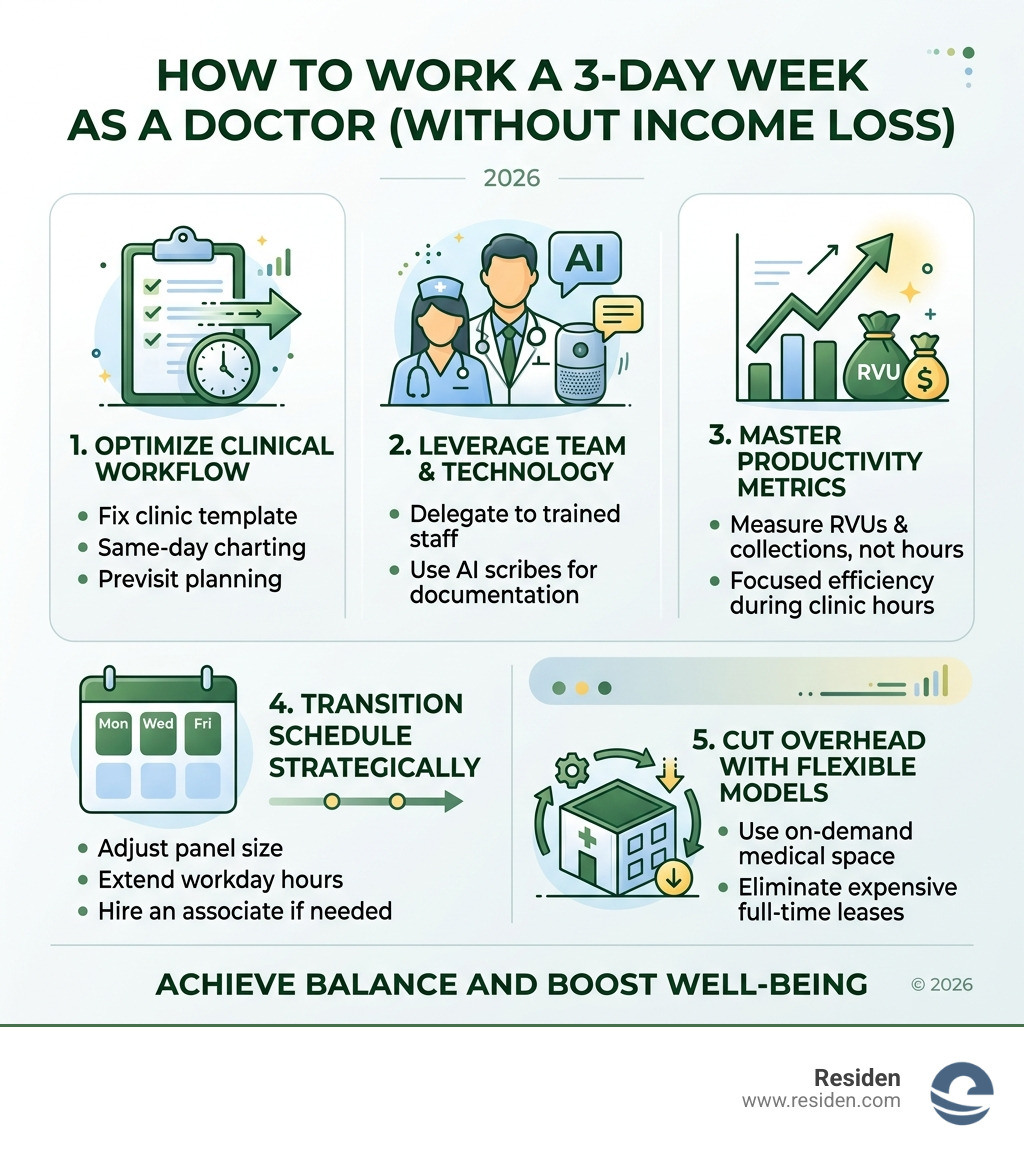
How to Work 3 Days a Week as a Doctor (Without Cutting Income) is absolutely possible — and more physicians are doing it in 2026 than ever before. Here's the short version:
- Optimize your clinical workflow — fix your clinic template, do same-day charting, and use previsit planning
- Leverage team-based care and AI — delegate to trained staff and use AI scribes to eliminate after-hours documentation
- Master your productivity metrics — measure output by RVUs and collections, not hours clocked
- Transition your schedule strategically — adjust panel size, extend hours on workdays, or hire an associate
- Cut overhead with flexible practice models — use on-demand medical office space instead of expensive full-time leases
The average physician works 59 hours a week — with nearly 28% of that time spent on documentation and administrative tasks outside normal clinic hours. Family physicians alone spend close to 30 hours per month charting after hours, often on weekends. Physicians call it "pajama time." And it's a major reason why nearly half of all doctors reported burnout symptoms as recently as 2023.
The good news? That exhaustion isn't inevitable. It's largely a systems problem — not a medicine problem.
Part-time physicians now make up 21% of the workforce, up from just 13% in 2005. Many maintain their income by working smarter, not longer — optimizing every clinical hour instead of simply adding more of them.
I'm Dr. Jessica Wu, a Los Angeles dermatologist with over 20 years in private practice, where I've built a career around efficiency and intentional scheduling. Figuring out how to work 3 days a week as a doctor without cutting income is something I've navigated — and the strategies I'll share below are grounded in real-world practice, not theory.
The Reality of Physician Burnout and the 3-Day Solution
In 2026, the term "pajama time" has become a bitter staple of the medical lexicon. It refers to that window between 9:00 PM and midnight—or perhaps 10:00 AM on a Sunday—where doctors are hunched over laptops finishing charts. Statistics show that over 20% of physicians spend more than eight hours a week on the EHR outside of normal work hours. This persistent administrative burden is a primary driver of the 48.2% burnout rate reported by physicians.
When we look at The Rise of the Part-Time Doctor, we see it isn't just about laziness; it’s about survival. Working a 3-day week isn't "quitting"; it's a strategic recalibration to ensure Ten Commandments of Physician Wellness are actually met. By condensing clinical hours, we can eliminate the "drag" of a five-day grind that often bleeds into seven days of mental load.
There are immense Benefits of Doing Part-Time Work as a Doctor, ranging from improved mental clarity to better patient outcomes. When you aren't rushing through your 30th patient of the day on a Friday afternoon, your diagnostic accuracy and empathy levels naturally rise.
How to Work 3 Days a Week as a Doctor (Without Cutting Income)
The biggest myth in medicine is that income is strictly linear to hours spent in the building. In reality, your income is a product of Efficiency × Value. To figure out How to Work 3 Days a Week as a Doctor (Without Cutting Income), you must shift your focus from "busyness" to productivity metrics like Relative Value Units (RVUs) and collections.
Many doctors have successfully reclaimed 10+ hours per week simply by cutting low-value work—tasks that don't require an MD/DO degree—and optimizing their billing. If you can increase your revenue per hour by 40%, you can work 40% fewer hours and take home the same paycheck.
As noted in the White Coat Investor’s guide on part-time doctors, the marginal utility of wealth often decreases as you earn more, especially when considering progressive taxation. However, by utilizing The Perks of Private Practice, you gain the autonomy to adjust your fees, choose high-reimbursement procedures, and control your overhead, making the 3-day week financially viable.
Productivity Comparison: Traditional vs. Optimized
| Metric | Traditional 5-Day Week | Optimized 3-Day Week |
|---|---|---|
| Clinical Hours | 40 hours | 30 hours (3 x 10hr) |
| Admin/Pajama Time | 15+ hours | < 2 hours |
| Patient Volume | 100/week (rushed) | 75/week (focused) |
| Revenue Focus | Volume-based | High-value/RVU-optimized |
| Overhead | High (Fixed lease) | Low (Flexible rental) |
| Take-Home Pay | $X | $X (or higher) |
Step 1: Optimize Your Clinical Workflow and Documentation
The first step to a 3-day week is killing the "charting debt." If you leave the office on Wednesday with 15 open charts, you haven't actually finished your workweek.
Fix Your Clinic Template: Most templates are outdated. Ensure your schedule accounts for the complexity of the patient. Grouping similar procedures or visit types can reduce the mental "switching cost."
Previsit Planning: This is a game-changer. Ensure labs are ordered and results are in the chart before the patient arrives. Use "prep sheets" so your Medical Assistant (MA) can gather the necessary data, allowing you to walk into the room fully informed.
Same-Day Charting: The goal should be "zero open charts" by the time you pull out of the parking lot. This requires a commitment to documenting during or immediately after the encounter.
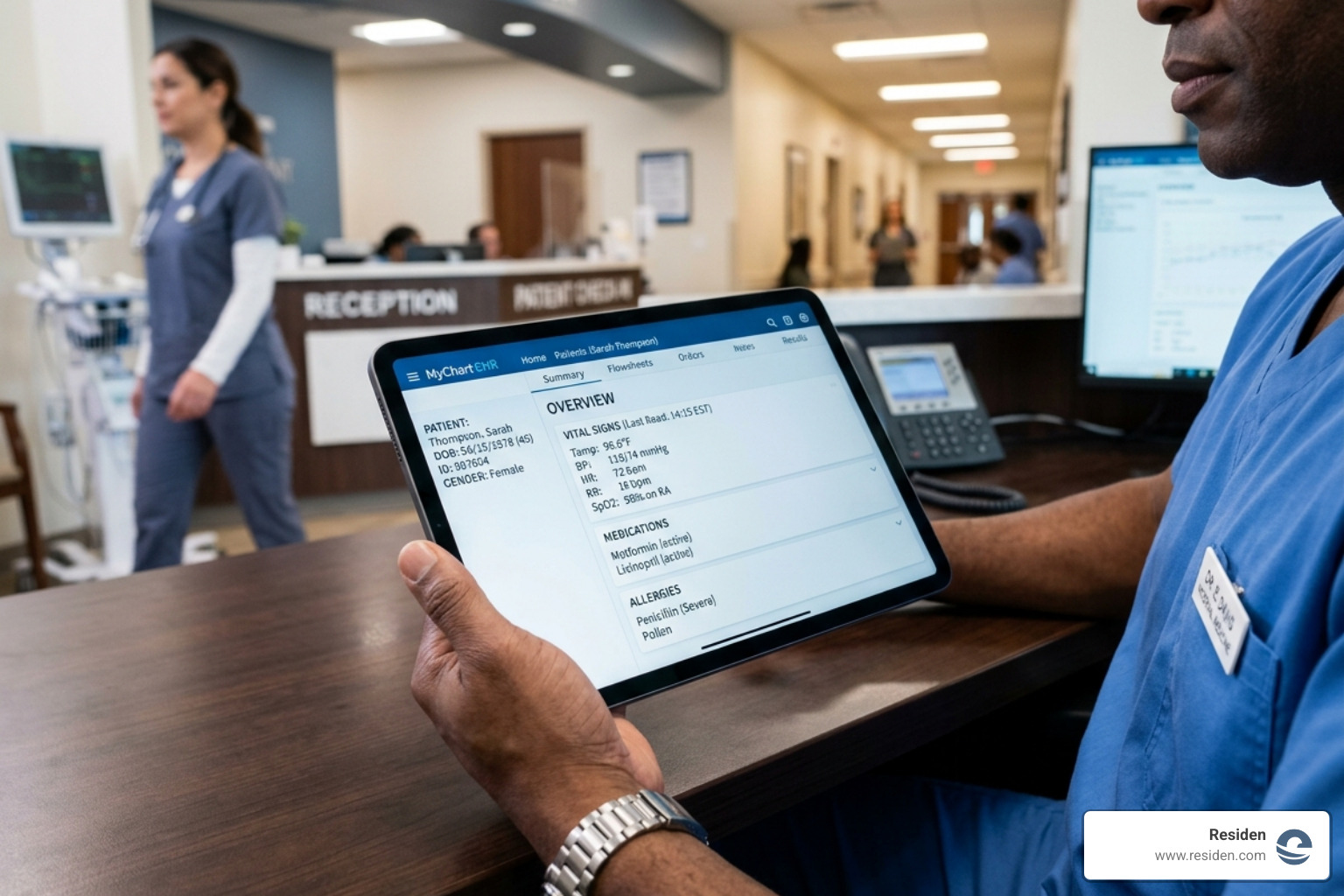
When we find What is Joy in Medicine? It's About More Than Beating Burnout, it almost always involves regaining control over our time. Documentation shouldn't be a second job you do for free at night.
Step 2: Leverage Team-Based Care and AI Technology
You cannot do it all alone. To work three days a week, you need a team that functions at the "top of their license."
- Documentation Specialists & Scribes: Whether human or AI-based, having someone (or something) draft your notes in real-time can reduce EHR time by 14% or more. Some practices in 2026 have successfully integrated AI tools to draft patient portal responses and visit summaries.
- Standing Orders: Empower your MAs to perform screenings, vaccinations, and diabetic foot exams based on standing orders. This moves the "work" off your plate while maintaining high-quality care.
- Team Inbox Management: Your staff should triage your inbox. You should only see messages that require a physician’s decision. Everything else—pharmacy refills, normal lab notifications, and scheduling requests—should be handled by the team.
As discussed in Medscape's look at the four-day workweek, these efficiencies are what allow for condensed schedules. When Starting Your Own Practice, you have the unique opportunity to build these tech-forward systems from day one.
Step 3: Master Your Productivity Metrics and Billing
If you want to earn a full-time salary in three days, you must become an expert in coding and billing.
Time-Based Billing: Since the 2021/2023 E/M coding changes, you can often bill based on the total time spent on the date of the encounter. This includes review of records and documentation, not just face-to-face time. This is a massive win for doctors who spend significant time on complex cases.
Reduce "Note Bloat": More words do not equal more money. Focus on documenting what is medically necessary. This speeds up your workflow and makes your notes more readable for other clinicians.
Focus on High-Value Work: Identify which procedures or visit types have the highest RVU-to-time ratio. If you are a specialist, this might mean blocking specific days for procedures while utilizing Lower Overhead solutions for your consultation days.
Before making the jump, it’s vital to run the numbers to see exactly how your billable output translates to your desired income.
Step 4: Transitioning to a 3-Day Schedule Without Income Loss
How do you actually make the move? It requires a strategic shift in your practice structure.
- Extended Hours: Many 3-day-a-week doctors work "long" days (e.g., 7:00 AM to 6:00 PM). This allows you to maintain a larger panel size and provides patients with early or late appointment options they often prefer.
- Right-Sizing Your Panel: The average family physician panel is nearly 2,000 patients. If you transition to three days, you may need to focus your panel on higher-acuity patients or transition to a Direct Primary Care (DPC) model where membership fees provide a stable income floor with fewer patients.
- Hiring an Associate or Job-Sharing: If you own a practice, you can hire an associate to cover the other two or three days. This keeps your office productive 5-6 days a week, covering the fixed costs of the space while you are only there for three.
For many, this is An Alternative to Early Retirement. Instead of leaving medicine entirely, becoming a Three-Day-a-Week Practice Owner allows you to enjoy the clinical work without the burnout.
Step 5: Reduce Overhead with Flexible Practice Models
The "hidden killer" of physician income is the 10-year commercial lease. Traditional medical office space in Los Angeles or Beverly Hills is incredibly expensive. If you only work three days a week but pay for seven days of rent, utilities, and staffing, your margins disappear.
This is where Medical Coworking changes the game. By using turnkey, shared medical office rentals, you only pay for the time you actually use.
- No Long-Term Leases: Avoid the trap of 5-10 year commitments.
- Fully Equipped: Walk into a room that already has the exam table, stool, and sink ready to go.
- Scalability: Start with one day a week and move to three as your patient base grows.
The Benefits of Medical Coworking are particularly clear for those looking to maximize their hourly take-home pay. When you eliminate the "empty room tax," your profitability per patient skyrockets. This is The Residen Difference—providing the infrastructure of a world-class medical office without the financial "ball and chain" of traditional real estate.
Frequently Asked Questions about How to Work 3 Days a Week as a Doctor (Without Cutting Income)
Is it realistic to maintain my current salary on a 3-day schedule?
Yes, but it requires a shift from a "time-spent" mindset to a "value-delivered" mindset. By optimizing your billing (using time-based billing where appropriate), eliminating administrative waste through AI and delegation, and reducing fixed overhead, many doctors find their net income remains stable or even increases. As explored in So You Want to be a Part-Time Physician?, the key is planning and choosing the right practice model, such as DPC or high-efficiency specialty care.
Which specialties are best suited for a 3-day workweek?
Primary care (Family Medicine, Internal Medicine, Pediatrics) is very well-suited because of the high demand and the ability to utilize DPC or shift-based models. Psychiatry and Neurology are also excellent candidates due to the high volume of work that can be done via telehealth or in focused clinical blocks.
Emergency Medicine is naturally shift-based, though "full-time" EM often feels like more due to the intensity and "DOMA" (Day Off My Arse) recovery time from nights. Surgical specialties can be trickier due to call requirements and malpractice premiums that don't always scale down, but many surgeons are now moving to a "3 days clinical/OR, 4 days off" model to improve longevity. Check out our Physician Happiness Survey to see how different specialties rank their satisfaction with reduced hours.
How do I manage patient continuity when working fewer days?
Continuity is managed through team-based care and clear communication. Educate your patients on your schedule—most are happy to wait a day or two to see "their" doctor if they know your availability is consistent. For urgent issues on your off-days, a "job-share" partner or a well-trained mid-level provider can bridge the gap. Modern EHRs and team-based messaging ensure that even when you aren't in the building, the patient's care plan is followed. As noted in The Work Week… Reinvented, some of the most successful practices treat the job-share as a single unit to ensure nothing falls through the cracks.
Conclusion
The dream of a 3-day workweek isn't just a fantasy—it's a calculated business decision. By mastering your workflow, leveraging the latest AI technology, and choosing a flexible office model, you can reclaim your life without sacrificing your hard-earned income.
At Residen, we are proud to support the next generation of physicians in Los Angeles, Beverly Hills, and Brentwood. Whether you are looking for a suite at 433 N Camden Dr in Beverly Hills or a flexible space in Brentwood, we provide the turnkey, patient-friendly environments you need to thrive on your own terms.
Stop paying for space you don't use and start building the practice you actually want.