
How to Get More Google Reviews for Your Medical Practice: 5 Ethical Steps
How to Get More Google Reviews Without Risking Patient Trust

To get more Google reviews ethically, make it easy for patients to share feedback without pressure or a loss of privacy:
- Create a direct review link from your Google Business Profile.
- Invite all eligible patients to review you, not just those who seem pleased.
- Offer the link at checkout or send a short, general follow-up by text or email through an approved workflow.
- Never offer rewards or ask patients to mention a diagnosis or treatment.
- Reply without confirming that a reviewer is a patient. Take concerns to a private channel.
Reviews can help people find your practice and decide whether they trust it. But in healthcare, a public reply can reveal more than you intend.
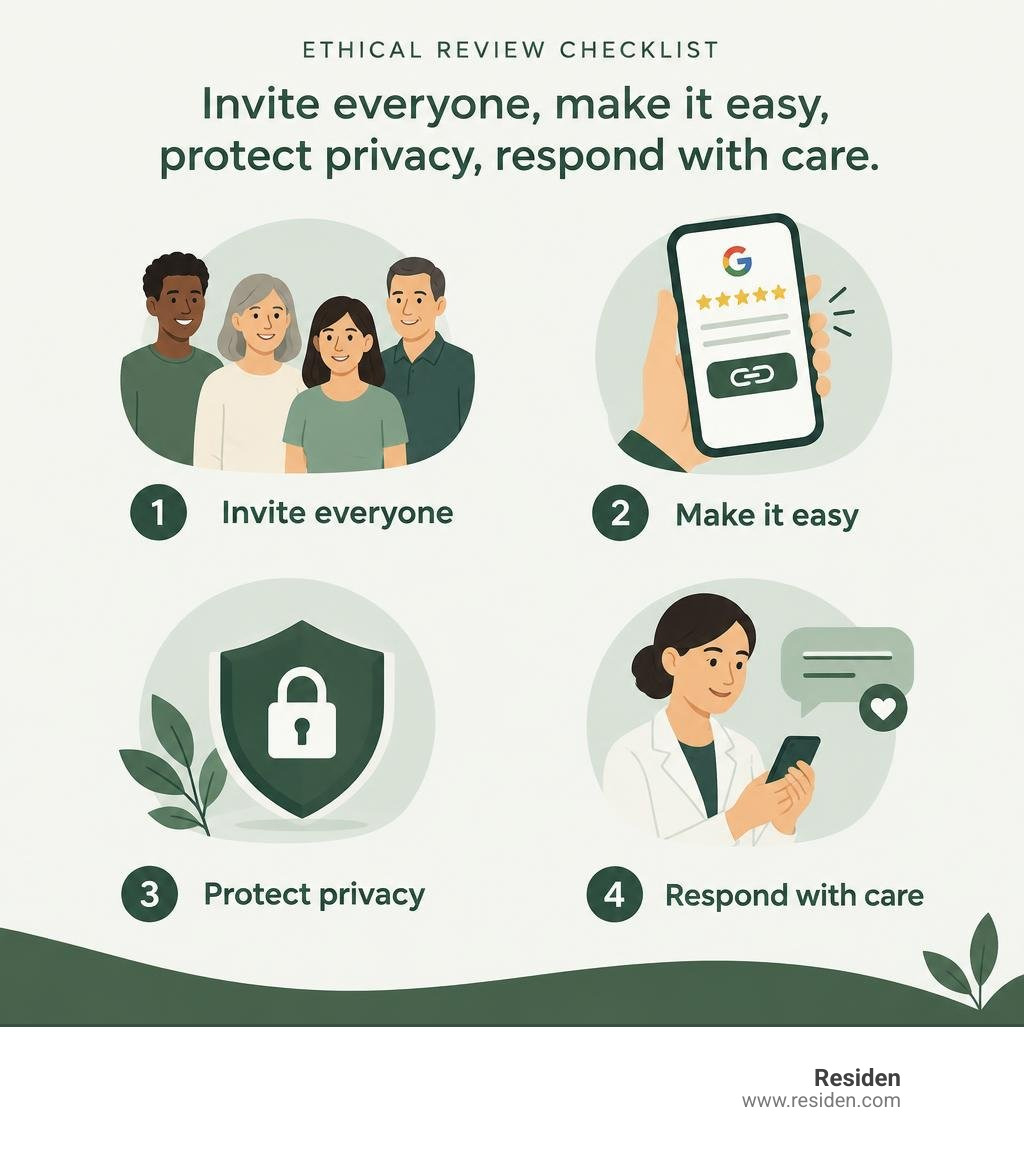
I'm Dr. Jessica Wu, a Los Angeles dermatologist with more than 20 years in private practice. In How to Get More Google Reviews for Your Medical Practice — Ethically, I bring that patient-facing experience to a simple goal: earn trust while protecting privacy, as the checklist below shows.
Why Google Reviews Dictate Healthcare Growth and Local SEO
For any independent medical practice, patient acquisition no longer begins with the phone book or a traditional directory. Nearly 84% of patients check online reviews before booking with a new healthcare provider, and over 60% trust digital feedback as much as personal referrals. Online reputation serves as the primary gateway to your clinic.
When prospective patients evaluate a physician, they look for authentic social proof. Research into factors that matter most when patients choose a provider shows that star ratings and authentic testimonials directly impact whether an individual schedules an appointment or scrolls past. In fact, roughly 75% of prospective patients will not book an appointment with a clinic rated below 4.0 stars, and a significant majority expect to see at least 5 to 10 recent reviews before making a decision.
Beyond patient psychology, Google reviews heavily influence your search visibility. In local healthcare search, Google's algorithm prioritizes three core components: relevance, distance, and prominence. Reviews are a cornerstone of prominence. They contribute roughly 19% of the ranking weight in local map pack results.
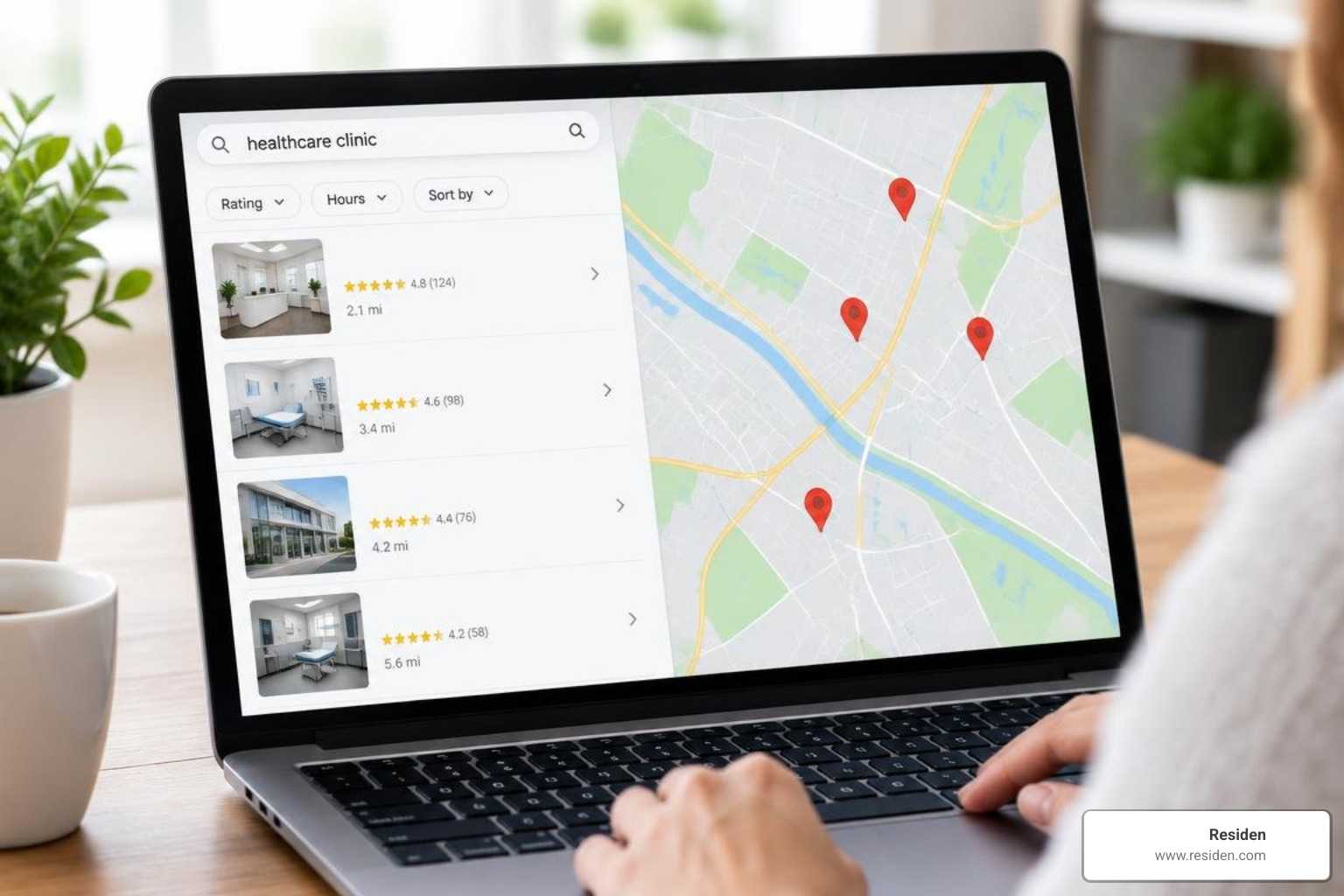
Google evaluates multiple dimensions of your review profile:
- Review Volume: The total number of reviews relative to competitors in your geographic area.
- Review Velocity: A steady, organic trickle of feedback over time rather than sporadic, unnatural surges.
- Review Recency: Recent commentary carries far more algorithmic weight; 73% of consumers focus primarily on feedback posted within the last 30 days.
- Review Sentiment & Detail: Thorough commentary containing natural keywords (such as treatment descriptions or bedside manner notes) helps Google understand your clinical expertise.
- Owner Engagement: Consistently replying to patient feedback signals active management and reliability.
Integrating genuine social proof into your practice marketing is one of the most proven strategies to promote your medical practice. When combined with robust local SEO for doctors, a reliable review-generation system creates compounding organic growth for private practices.
The Regulatory Landscape: HIPAA, FTC, and Google Policies
Managing an online reputation in healthcare differs fundamentally from retail or hospitality. While a restaurant owner can freely comment on a patron's meal or offer a coupon for a review, healthcare providers must navigate strict federal privacy mandates and fair-trade regulations.
A single misstep can lead to substantial civil monetary penalties, state licensing sanctions, or permanent profile suspensions. Mastering online medical reputation management requires navigating three distinct regulatory layers:
- HIPAA (Health Insurance Portability and Accountability Act): The Privacy Rule strictly prohibits disclosing any Protected Health Information (PHI) without express written patient authorization. PHI encompasses 18 distinct identifiers, including patient names, contact details, appointment dates, and treatment data. A healthcare practice cannot publicly confirm or deny that a reviewer is a patient—even if the individual voluntarily outlines their entire clinical history online. Furthermore, any software vendor transmitting patient identifiers to request reviews must sign a valid Business Associate Agreement (BAA).
- FTC (Federal Trade Commission) Regulations: The FTC’s Consumer Review Rule prohibits unfair and deceptive marketing practices. Offering financial incentives, discounts, gift cards, or complimentary services in exchange for positive reviews is illegal. The FTC also prohibits selective solicitation (cherry-picking only happy clients), which can trigger severe civil fines.
- Google Business Profile Policies: Google strictly prohibits review gating (diverting unhappy customers away from public platforms while routing satisfied ones to Google), posting reviews on behalf of clients, incentivization, and deploying on-premise review kiosks.
| Regulatory Focus | Compliant Review Practice | Prohibited Practice | Potential Consequence |
|---|---|---|---|
| HIPAA Compliance | Requesting feedback using generic, non-clinical messaging via a BAA-secured platform. | Confirming a reviewer's visit or disclosing treatment details in public replies. | HHS/OCR investigations, substantial financial penalties (up to $50,000+ per violation). |
| FTC Standards | Inviting all seen patients to leave honest, uncompensated feedback. | Offering discounts, gifts, or entry into raffles in exchange for positive reviews. | Federal civil enforcement actions and monetary damages. |
| Google Platform Rules | Asking patients to post from their personal mobile devices using a direct link. | Setting up an in-office iPad "review station" or gating negative feedback. | Algorithmic ranking demotion, mass review removal, or complete profile suspension. |
How to Get More Google Reviews for Your Medical Practice — Ethically
To build a reliable reputation without breaking regulatory rules, you need a friction-free, repeatable system. Relying on casual requests or hoping patients leave feedback on their own rarely works; roughly 57% of patients never think to leave a review without a clear prompt.
Here is our 5-step, fully compliant framework to build genuine review volume.
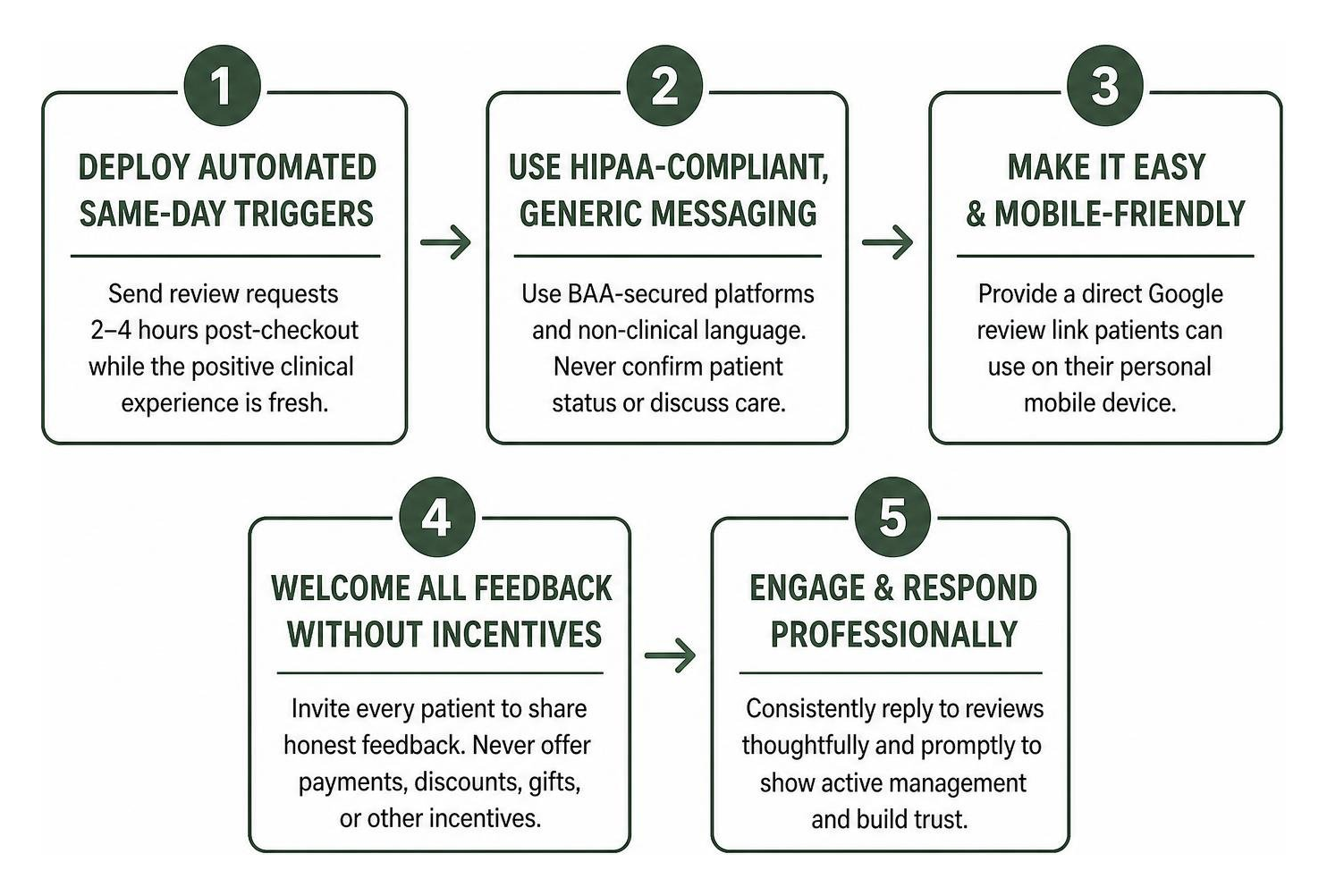
Step 1: Deploy Automated Same-Day Triggers
Timing is everything. Review conversion rates drop dramatically when requests are delayed by even a few days. The highest response rates occur when requests are delivered 2 to 4 hours post-checkout, while the positive clinical interaction is fresh in the patient's mind.
Integrate your practice management software or Electronic Health Record (EHR) system to trigger automated review requests upon appointment checkout or discharge.
- Use Generic Text (SMS): SMS open rates exceed 90%. Keep the copy brief, warm, and entirely devoid of clinical details. Never mention the specialty, provider name, reason for visit, or diagnosis.
- Include a Direct Short Link: Generate your short review link directly from your Google Business Profile dashboard ("Get more reviews" tool). This link must open directly to the review submission text box, eliminating unnecessary clicks.
- Single Follow-Up Protocol: If a patient does not respond, send a single, gentle follow-up email at the 72-hour mark. If they still do not engage, stop all outreach to maintain compliance and avoid patient fatigue.
- Ensure BAA Coverage: Verify that any automated communication software handling patient telephone numbers or emails has an active Business Associate Agreement in place.
Compliant SMS Template:
"Thank you for visiting [Practice Name] today. We appreciate your trust in our care. If you have a moment, please share your feedback on Google: [Direct Link]. To opt out, reply STOP."
Step 2: Optimize Point-of-Care QR Touchpoints
Complement your digital workflow with physical touchpoints throughout the clinic. Well-placed QR codes allow patients to submit reviews voluntarily using their personal smartphones while waiting or completing checkout.

Effective physical touchpoints include:
- Checkout Signage: A small, elegant acrylic stand at the reception desk featuring a high-contrast QR code and a clean prompt.
- Discharge Folders & Appointment Cards: Include a discrete QR code on the back of appointment reminder cards, post-care instruction sheets, or business cards.
- Consultation & Waiting Spaces: Subtle signage in consultation spaces can prompt engaged patients during downtimes.
A spotless, comfortable environment naturally inspires positive commentary. For independent practitioners, creating a five-star patient experience starts with a modern, beautifully designed clinical setting that reflects high professional standards.
Crucial Compliance Note: Never set up a shared in-office tablet, kiosk, or dedicated computer for patient reviews. Google's spam algorithms trace IP addresses and device fingerprints; multiple reviews submitted from the same clinic network or hardware will be flagged and purged for on-premise review manipulation.
Step 3: Train Front-Desk Staff on Pressure-Free Verbal Prompts
Automated systems yield the best results when primed with a friendly verbal touchpoint. Staff should never plead, offer scripted pitches, or make patients feel pressured. Instead, implement a single-sentence verbal mention during standard checkout workflows.
- The Verbal Prime: When handing over post-care summaries or collecting copays, staff can simply state: "It was wonderful seeing you today, [Name]. You’ll receive a quick text message with a link to share feedback about your visit on Google—we'd love your thoughts if you have a minute."
- Responding to Spontaneous Compliments: If a patient says, "Dr. Smith was incredible today, I feel so much better," staff can naturally respond: "We're so glad to hear that! Would you mind sharing that experience in a quick Google review? It helps other patients find our practice."
- Neutral Consistency: Train staff to invite every departing patient across the board, rather than filtering based on perceived mood.
Step 4: Adapt Workflows for Complex Care (Hospice, Home Health, and Multi-Provider Groups)
Standard automated review requests do not work for every clinical discipline. Specialized care settings require nuanced, empathetic modifications:
Hospice and Palliative Care
Automated text messaging after a patient discharge in hospice care can lead to catastrophic communication errors—such as inadvertently sending review requests to a deceased patient's mobile device.
- Replace automated triggers with a bereavement-aware manual workflow.
- Coordinate review requests through a bereavement coordinator or family liaison.
- Time delicate outreach between 4 to 10 months post-loss, aligning communication around annual memorials rather than recent discharges.
- Coordinate outreach around CMS CAHPS hospice surveys (typically distributed 2–3 months following care) to avoid survey fatigue.
Home Health Agencies
Home health agencies serve decision-makers (often adult children) under significant time constraints.
- Set triggers to deliver 5 to 7 days post-discharge, allowing families time to settle back into their routines.
- Address requests to the primary family caregiver when they serve as the operational contact.
Multi-Provider and Group Practices
Managing online reputation for group practices requires a dual-profile strategy:
- Maintain the Practice Profile: The main Google Business Profile represents the clinical facility, brand, location, and collective staff.
- Claim Practitioner Profiles: Individual physicians and specialists are legally eligible to maintain individual Google practitioner profiles at the same address.
- Physician-Name Search Optimization: Individual profiles capture high-intent searches for specific doctor names, while the practice profile dominates broad specialty searches (e.g., "dermatologist near me"). Ensure review links route patients to the appropriate profile based on their primary treating provider.
Step 5: Respond to Every Review with HIPAA-Safe Public Protocols
Responding to reviews demonstrates professionalism, accountability, and strong patient care. However, standard business responses can easily violate HIPAA privacy standards.
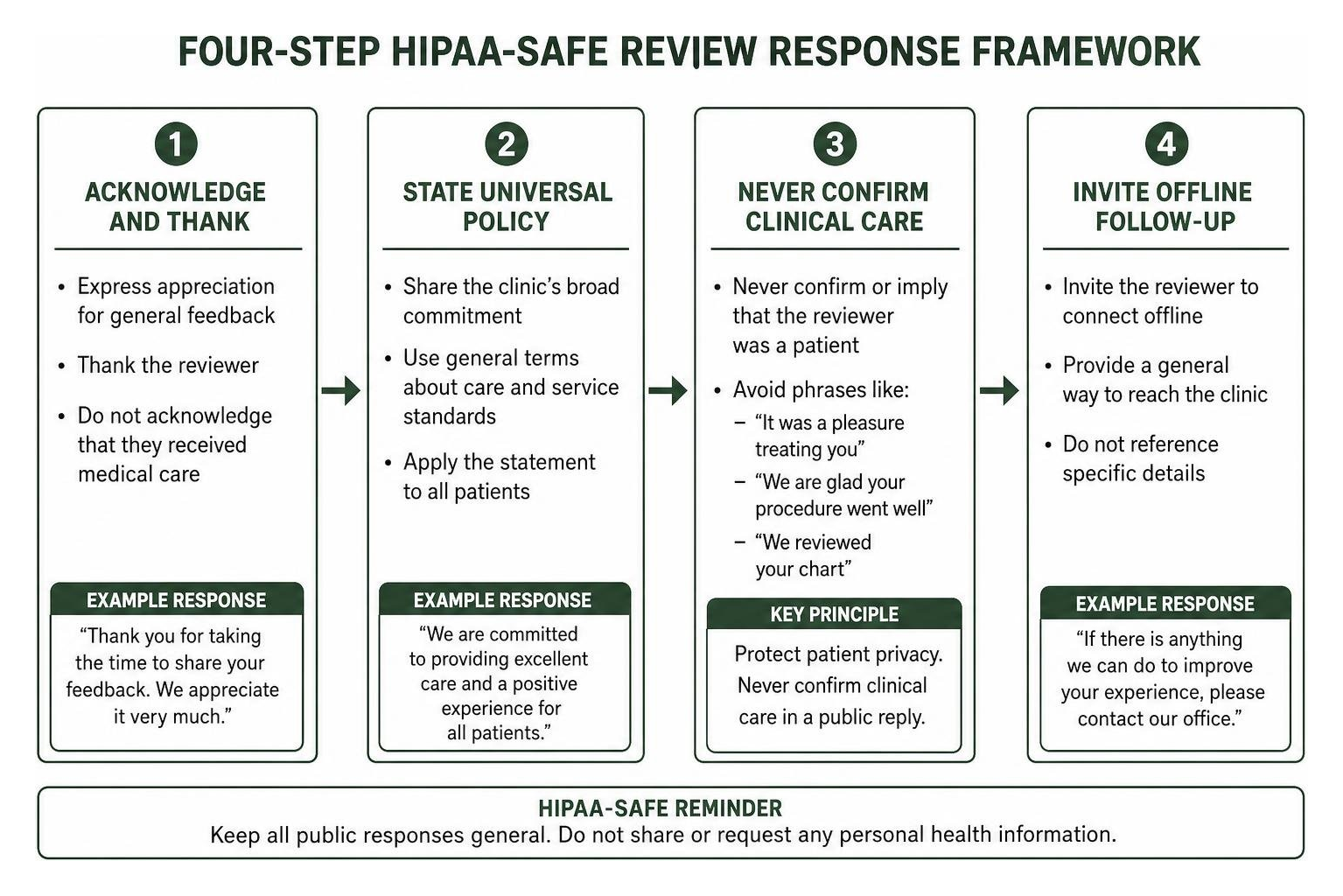
Follow this four-step framework for every public reply:
- Acknowledge and Thank: Express appreciation for general feedback without acknowledging that the reviewer received medical care.
- State Universal Policy: Share the clinic’s broad commitment to patient care and service standards in general terms.
- Never Confirm Clinical Care: Never use phrases like "It was a pleasure treating you," "We are glad your procedure went well," or "We reviewed your chart."
- Redirect Specifics Offline: Provide direct contact details for a practice manager or patient advocate to handle individual concerns privately.
HIPAA-Safe Response Templates
Positive Review Response Template:
"Thank you for taking the time to share your feedback. Our team is dedicated to providing high-quality, compassionate care and an exceptional experience for everyone who visits our clinic. We truly appreciate your support."
Negative Review (General Dissatisfaction) Template:
"Thank you for your feedback. We hold our practice to the highest standards of patient care and operational service, and we take all concerns seriously. Due to federal privacy regulations, we cannot discuss individual patient experiences or verify patient relationships in a public forum. We invite you to contact our Practice Manager directly at [Phone Number] or [Email] so we can understand and address your concerns privately."
Suspected Fake or Inaccurate Review Template:
"We take all community feedback seriously. We have no record of an individual with this name receiving services at our facility, and our strict quality protocols do not align with the experience described. If you visited our practice, please contact our administrative team directly at [Phone Number] so we can assist you."
Frequently Asked Questions About Medical Practice Google Reviews
Is it legal for doctors to directly ask patients for Google reviews?
Yes. Healthcare providers and practice staff can legally invite patients to leave online reviews. However, the request must remain entirely voluntary, free from clinical references (avoid mentioning diagnoses, prescriptions, or specific medical interventions), and conducted without coercion.
Can our medical clinic offer discounts or gift cards for leaving a review?
No. Offering any form of incentive—including gift cards, service discounts, raffle tickets, or complimentary products—violates both Google's terms of service and FTC truth-in-advertising regulations. Doing so can lead to substantial civil monetary penalties, removal of all earned reviews, and suspension of your Google Business Profile.
How should a doctor respond if a reviewer discloses their own medical details publicly?
Even when a patient voluntarily shares detailed diagnostic, clinical, or treatment information in a public review, the healthcare provider remains bound by HIPAA. You cannot acknowledge, validate, or expand upon those medical details. Always use a neutral, generic response template that directs the conversation to a secure, private communication channel.
Conclusion
Building a five-star reputation on Google does not require pushy marketing or regulatory risks. By implementing automated same-day triggers, offering clear point-of-care QR touchpoints, training staff on pressure-free verbal prompts, and using HIPAA-safe response protocols, independent medical practices can build a strong, authentic online presence.
Sustainable practice growth depends on pairing an exceptional digital reputation with an outstanding clinical experience. At Residen, we empower healthcare professionals to practice medicine on their own terms. We provide premium medical coworking spaces in Los Angeles—with locations in Brentwood and Beverly Hills—offering fully equipped, turn-key exam rooms, procedure rooms, and consultation suites.
With flexible hourly, daily, and long-term bookings and no administrative overhead or long-term lease commitments, you can focus entirely on delivering exceptional patient care. Explore our medical coworking spaces to see how our flexible medical office solutions can support your independent practice.