
The Ultimate Guide to Cosmetic Practice Startup
The Booming Market Behind Every Cosmetic and Aesthetic Practice Startup

Planning a cosmetic and aesthetic practice startup is one of the most exciting — and most complex — moves a healthcare professional can make today. Here's what you need to know to get started:
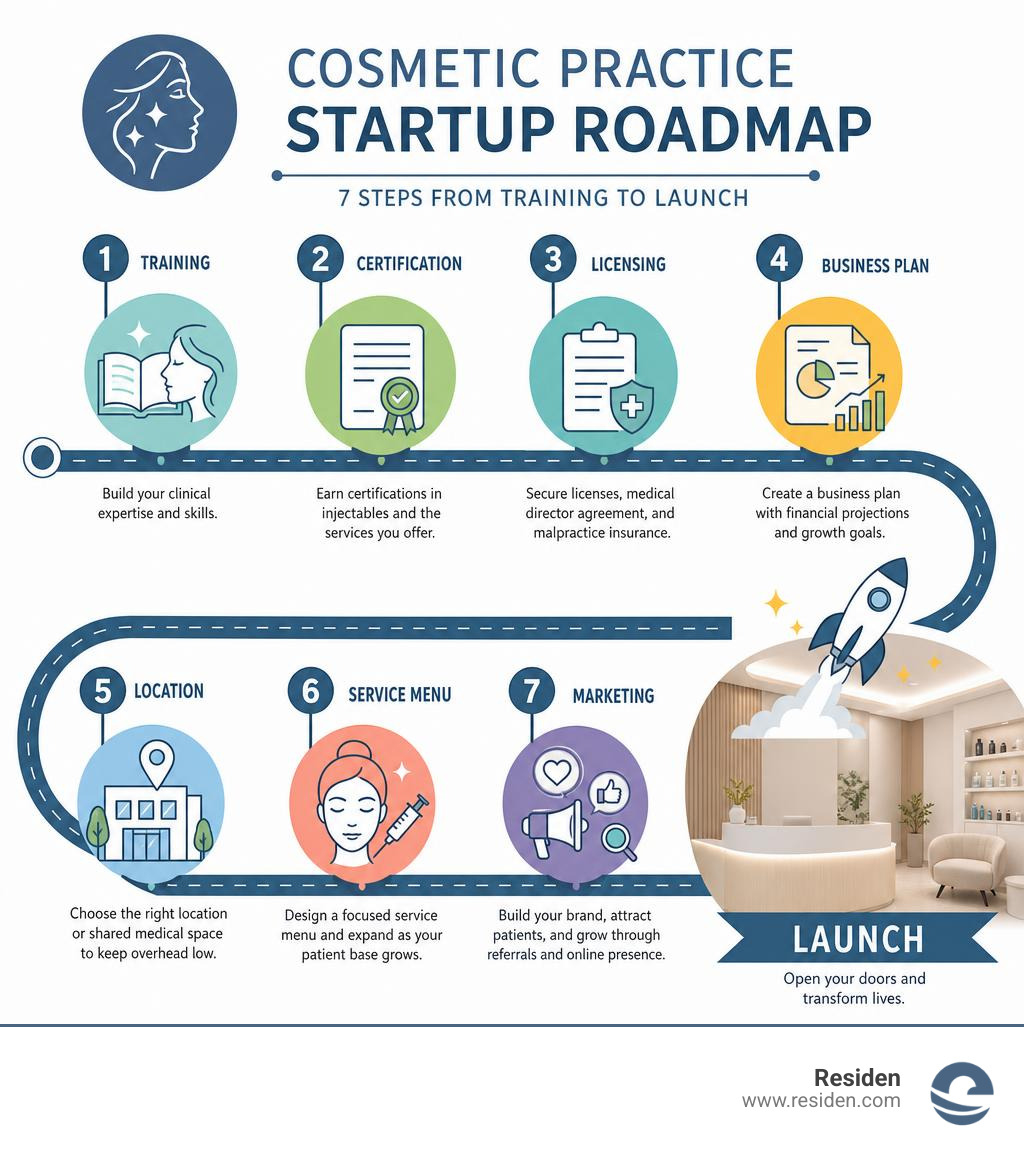
Quick-start checklist for launching a cosmetic or aesthetic practice:
- Define your model — MedSpa, solo injector, or hybrid clinic
- Get certified — Botox, fillers, and any specialty services you plan to offer
- Meet legal requirements — licensing, medical director agreements, malpractice insurance
- Write a business plan — with realistic financial projections and break-even targets
- Choose a location — consider shared medical office space to reduce overhead
- Build your service menu — start lean, then expand as your patient base grows
- Market your practice — local SEO, social media, and referral programs from day one
The demand driving this is real. The non-surgical aesthetics market in the US alone has grown into a $20 billion-plus industry, fueled by consumer appetite for injectables, laser treatments, and energy-based devices. North America's broader cosmetic procedure market is projected to grow at 6.34% through 2028, and specialist careers in this space are expected to grow 17% through 2031 according to the US Bureau of Labor Statistics.
Yet for many independent nurses, nurse practitioners, and physicians, the path from "qualified practitioner" to "open for business" has more steps than anyone prepares you for. The gap isn't clinical — it's business, regulatory, and logistical.
This guide closes that gap.
I'm Dr. Jessica Wu, a Harvard-trained dermatologist with over 20 years of private practice experience in Los Angeles, including serving as a clinical investigator in the FDA approval trials for Juvederm and Latisse. My career has given me a front-row seat to every phase of the cosmetic and aesthetic practice startup journey — from credentialing and compliance to building a loyal patient base — and I'll walk you through exactly what it takes to do it right.
Understanding the Cosmetic and Aesthetic Practice Startup Landscape

Before you buy your first vial of neurotoxin or sign a lease, you need to understand the business model you are entering. A cosmetic or aesthetic practice sits at the intersection of clinical care, patient experience, retail-style service, and strict medical regulation. The choices you make early — who owns the entity, where you see patients, which treatments you offer, and how you manage supervision — shape your startup costs and your legal risk.
A common point of confusion for new entrepreneurs is the difference between a traditional day spa and a medical spa.
- Day spas: Focus on non-clinical, superficial relaxation and beauty treatments, such as basic facials, body wraps, and superficial cosmetic services. These generally do not involve prescription products or medical procedures.
- Medical spas and aesthetic medical practices: Offer medical-grade procedures designed to affect living tissue, such as neuromodulators, dermal fillers, laser resurfacing, medical-grade chemical peels, and IV therapy. These services require appropriate licensure, medical oversight, prescription controls, documentation, and malpractice coverage.
That medical layer is what makes an aesthetic startup different from an ordinary beauty business. Your operational model needs to account for clinical protocols, patient consent, adverse-event planning, product storage, delegation rules, and compliant treatment space from the beginning.
Defining Your Cosmetic and Aesthetic Practice Startup Model
Choosing your practice model is the foundation of your business plan. Are you building a multi-provider clinic, adding aesthetics to an existing medical practice, or starting as a solo injector with a lean schedule?
Many practitioners choose to start small to test the waters. A solo injector model minimizes staffing needs and keeps overhead low. A hybrid model allows an existing clinician to add aesthetic services while maintaining another source of income. Whichever model you choose, the goal is to match your clinical skills, risk tolerance, budget, and target patient base. To understand how an independent setting can reshape your career path, explore The Perks of Private Practice.
Market Research and Competitor Analysis
Never assume that “if you build it, they will come.” A successful practice launch starts with local market research. Review the demographics of your chosen area, identify what patients are already buying, understand common price points, and look for gaps in access or patient experience.
For example, if you plan to open in a highly competitive Los Angeles market, you need to know what nearby practices offer, how quickly patients can get appointments, and where your positioning will be different. Maybe your advantage is flexible evening availability, a more private setting, a narrower specialty focus, or a lower-overhead launch model. The point is not to copy competitors — it is to understand the local landscape well enough to make deliberate decisions.
Legal, Regulatory, and Training Requirements
Navigating the legal side of a cosmetic and aesthetic practice startup is often the most challenging phase of the journey. In California, many medical aesthetic procedures are treated as the practice of medicine, which means ownership, delegation, supervision, and treatment protocols need to be structured carefully.
One of the most important doctrines to understand is the Corporate Practice of Medicine (CPOM). In California, non-physicians cannot simply own and operate a medical practice as if it were a retail business. Depending on the entity structure and provider mix, physician ownership, professional corporation rules, management services agreements, and medical director arrangements may all come into play.
Before signing a lease, buying devices, or advertising services, speak with a healthcare attorney who understands aesthetic medicine in your state. Rules vary widely, and details such as who can inject, who can supervise, who can own the entity, and how medical decisions are controlled can change the entire business structure.
Essential Certifications for a Cosmetic and Aesthetic Practice Startup
Clinical competence is non-negotiable. Even if you have years of experience in an ER, ICU, dermatology office, or surgical setting, aesthetic medicine requires a different combination of anatomy, technique, product knowledge, complication management, and patient communication.
At a minimum, your training plan should include hands-on education in:
- Neuromodulators, such as Botox, Dysport, Xeomin, or similar products
- Dermal fillers, including facial anatomy and vascular-risk zones
- Complication prevention and management
- Patient assessment, photography, consent, and documentation
- Emergency protocols and referral pathways
As you scale, you may choose to add services such as microneedling, platelet-rich plasma, medical weight loss, IV therapy, or energy-based treatments. Add these only when you have the training, protocols, insurance coverage, and patient volume to support them safely.
Licensing and Insurance Protocols
Before you treat your first patient, secure the appropriate insurance policies and operating documents. Standard malpractice coverage may not automatically cover aesthetic procedures, so confirm that your policy matches the exact services you provide.
You may also need:
- Professional liability coverage tailored to injectables, lasers, IV therapy, or other services on your menu
- General liability coverage for the premises
- Written clinical protocols for consultation, consent, treatment, follow-up, and adverse events
- Medical director or supervision agreements where required
- Entity formation and tax guidance from qualified professionals
- HIPAA-compliant systems for intake, documentation, scheduling, and communications
To walk through the foundational steps of setting up a compliant medical entity, consult Residen’s guide to Starting Your Own Practice.
Financial Planning and Startup Costs

How much does it actually cost to launch an aesthetics practice? The honest answer is that it varies widely based on your model. A full brick-and-mortar buildout can require a large upfront investment, while a lean launch using flexible medical office access can reduce the amount of capital you need before seeing your first patients.
Here is a realistic way to think about typical initial versus phased startup costs:
| Expense Category | Solo / Lean Model | Traditional Brick-and-Mortar |
|---|---|---|
| Business Registration & Legal | $1,000 – $3,000 | $3,000 – $10,000+ |
| Facility Lease & Buildout | Minimal upfront facility commitment | $50,000 – $250,000+ |
| Medical Equipment & Furniture | $2,000 – $5,000 | $15,000 – $50,000 |
| Initial Inventory (Injectables) | $5,000 – $10,000 | $10,000 – $25,000 |
| Malpractice & Liability Insurance | $2,000 – $5,000 | $5,000 – $12,000 |
| Branding, Website, & Marketing | $2,000 – $5,000 | $5,000 – $15,000 |
| Total Estimated Startup Capital | $12,000 – $28,000 | $90,000 – $362,000+ |
Building a Solid Business Plan
Your business plan is your roadmap to profitability. It should outline your target patient, service menu, pricing strategy, monthly overhead, startup budget, break-even point, and marketing plan.
Many new practice owners overestimate year-one patient volume and underestimate compliance, supplies, and marketing costs. Keeping overhead low during the first 6 to 12 months is one of the best ways to survive the critical startup phase. If you can prove demand before committing to a large buildout, you give yourself more flexibility and less financial pressure.
Smart Equipment Procurement
It is easy to overspend on capital equipment. Device purchases can be tempting, especially when they promise premium positioning or high treatment prices, but a six-figure platform can become a liability if you do not yet have enough patient demand to support it.
Do not fall into this trap.
Start with low-overhead, high-demand treatments first. If you later decide to offer laser or energy-based treatments, consider whether leasing, renting access, buying refurbished equipment, or delaying the purchase would protect your cash flow. Your first goal is not to own the biggest device menu — it is to build a safe, profitable, repeatable practice model.
Designing Your Service Menu and Phased Launch
When designing your service menu, less is often more. Trying to offer twenty different services on day one can lead to bloated inventory costs, expired products, inconsistent training, and operational confusion. A phased launch gives you room to learn what your patients actually want before you invest heavily.
- Phase 1: Start with high-margin, low-overhead services that require minimal equipment.
- Phase 2: Reinvest profits into advanced devices, body contouring, or specialized treatments once you have an established client base.
A focused menu also makes your marketing clearer. Patients should quickly understand what you do best, who you serve, and why your practice is a good fit for them.
Phase 1: Low-Overhead Core Services
Your core menu should consist of treatments with relatively low equipment requirements and strong patient demand:
- Neurotoxins: A common gateway treatment with efficient appointment times and strong repeat potential.
- Dermal fillers: Useful for patients seeking visible, targeted aesthetic improvement.
- Chemical peels and microneedling: Lower-cost treatments that can support recurring visits and skin health plans.
- Consultations and treatment planning: A valuable service in its own right, especially when patients are new to aesthetics.
By focusing on these services, you can begin generating revenue without taking on unnecessary debt. For a practical guide to getting your clinical operations moving quickly, read How to Start Seeing Patients This Month: 5 Methods.
Phase 2: Advanced Energy-Based Treatments
Once your core business is steady and profitable, you can consider adding advanced services such as:
- Laser skin resurfacing and IPL
- Radiofrequency microneedling
- Non-invasive body contouring
- Hair restoration or regenerative treatments
- Medical weight loss or wellness add-ons, where appropriate
Introduce these services only when your patient demand, training, insurance, and protocols support them. Phasing your growth helps ensure that capital investments are funded by real business momentum rather than hope.
Choosing the Right Location and Practice Model
Location matters in aesthetics. Patients expect a premium, private, and clinical experience. But signing a traditional commercial lease in a prime Los Angeles area can create heavy fixed overhead before you have predictable patient volume.
Before committing to a long-term lease, evaluate the true cost of setting up a physical space, including buildout, furnishings, utilities, cleaning, medical waste, storage, signage, parking, accessibility, technology, and regulatory compliance. To help evaluate those physical requirements, review Residen’s guide to Starting a Medical Office: Your Complete Checklist for Success.
The Part-Time and Hybrid Transition Model
You do not have to quit your day job to start your practice. In fact, many clinicians are better served by a gradual transition.
A part-time or hybrid model allows you to maintain stable income while building your patient base on select days. This can reduce personal financial stress and give you time to refine your service menu, pricing, systems, and patient experience before expanding. To understand how clinicians can structure this balance, explore Residen’s insights on The Hybrid Office.
Medical Coworking Space vs. Traditional Leases
If you want to reduce the financial risk of a traditional lease, a medical coworking space or flexible medical office solution can be a practical alternative.
With a flexible model, you rent fully equipped, medical-grade exam and procedure rooms on an hourly or daily basis. There are no expensive buildouts, long-term lease commitments, or unused rooms sitting empty between patient days. You book space when you need it, allowing overhead to scale with revenue.
To weigh the financial and operational benefits of this model, read about Shared Medical Office Space Pros and Cons for Healthcare Professionals.
Marketing, Client Acquisition, and Ongoing Operations
Once your clinical space and legal structure are in place, your focus shifts to filling the booking calendar. In a crowded market, your brand and digital presence should look trustworthy from day one. Patients often judge the quality of your clinical work by the quality of your website, reviews, educational content, and social media presence.
Patient Acquisition Strategies
To compete with established practices, use a multi-channel marketing strategy:
- Local SEO: Make sure your practice can appear when local patients search for services such as Botox, fillers, skin rejuvenation, or aesthetic consultations near them.
- Google Business Profile: Keep your profile complete with accurate categories, service descriptions, photos, hours, and review responses.
- Social media: Use visual platforms to share education, treatment preparation tips, practice updates, and before-and-after photos when you have proper consent.
- Referral programs: Word-of-mouth is powerful in aesthetics. Encourage happy patients to refer friends while staying compliant with applicable rules.
- Professional referral relationships: Build connections with dermatology, wellness, primary care, and other adjacent providers when appropriate.
Your marketing should not promise unrealistic outcomes or lean on heavy discounts alone. A stronger long-term strategy is to educate patients, show your clinical judgment, and make it easy for the right people to book.
Staffing, Compliance, and Retention
As your practice grows, you may eventually need support staff, such as a front desk coordinator, medical assistant, or patient care coordinator. Hire slowly and train carefully. Your staff represents your brand before the patient ever reaches the treatment room.
Create repeatable systems for intake, consent, charting, follow-up, inventory, cleaning, ordering, adverse-event response, and patient communication. To make sure your operational bases are covered before bringing on your first team member, run through Residen’s Before You Hire Checklist.
Frequently Asked Questions about Cosmetic Practice Startups
What is the difference between a day spa and a medical spa?
A day spa offers non-clinical, superficial relaxation treatments (like facials and massages) performed by licensed aestheticians. A medical spa (MedSpa) offers medical-grade cosmetic procedures (like Botox, fillers, and medical lasers) that require medical supervision, prescription-only products, and licensed medical professionals to administer.
Can a nurse practitioner open an aesthetic practice independently?
This depends heavily on your state's practice authority laws. In California, Nurse Practitioners can operate with full practice authority under specific guidelines, but they must still comply with the Corporate Practice of Medicine (CPOM) doctrine, which requires a professional medical corporation to be owned at least 51% by a licensed physician.
How much does it cost to start a medical aesthetics practice?
A traditional brick-and-mortar buildout can cost between $90,000 and $362,000+. However, by utilizing a shared medical office space model and starting with a lean, injectables-only service menu, you can launch a compliant practice for as little as $12,000 to $28,000.
Launch Your Practice with Residen
If you are ready to turn your cosmetic and aesthetic practice startup dream into a reality without the crushing overhead of a traditional commercial lease, we are here to help.
Residen provides premium, turnkey, and fully compliant shared medical office rentals in the most sought-after medical districts of Los Angeles, including Beverly Hills (located at 433 N Camden Dr Suite 610, Beverly Hills CA) and Brentwood.
With our flexible hourly and daily booking model, you get access to fully equipped, patient-friendly exam and procedure rooms with no long-term leases, no setup costs, and no hidden fees. Keep your day job, protect your capital, and treat your patients in a space that reflects your clinical excellence.
Ready to take the first step? Learn more about our specialized spaces for Residen MedSpa & Nurse Injectors and book your tour today!