
15 Smart Ways to Avoid Costly Ownership Mistakes You’ll Wish You Knew Sooner
Why So Many New Practices Fail (And How to Avoid Being One of Them)

The 15 biggest mistakes new practice owners make can drain your savings, stall your growth, and turn an exciting career milestone into a financial nightmare — often before you see your first patient.
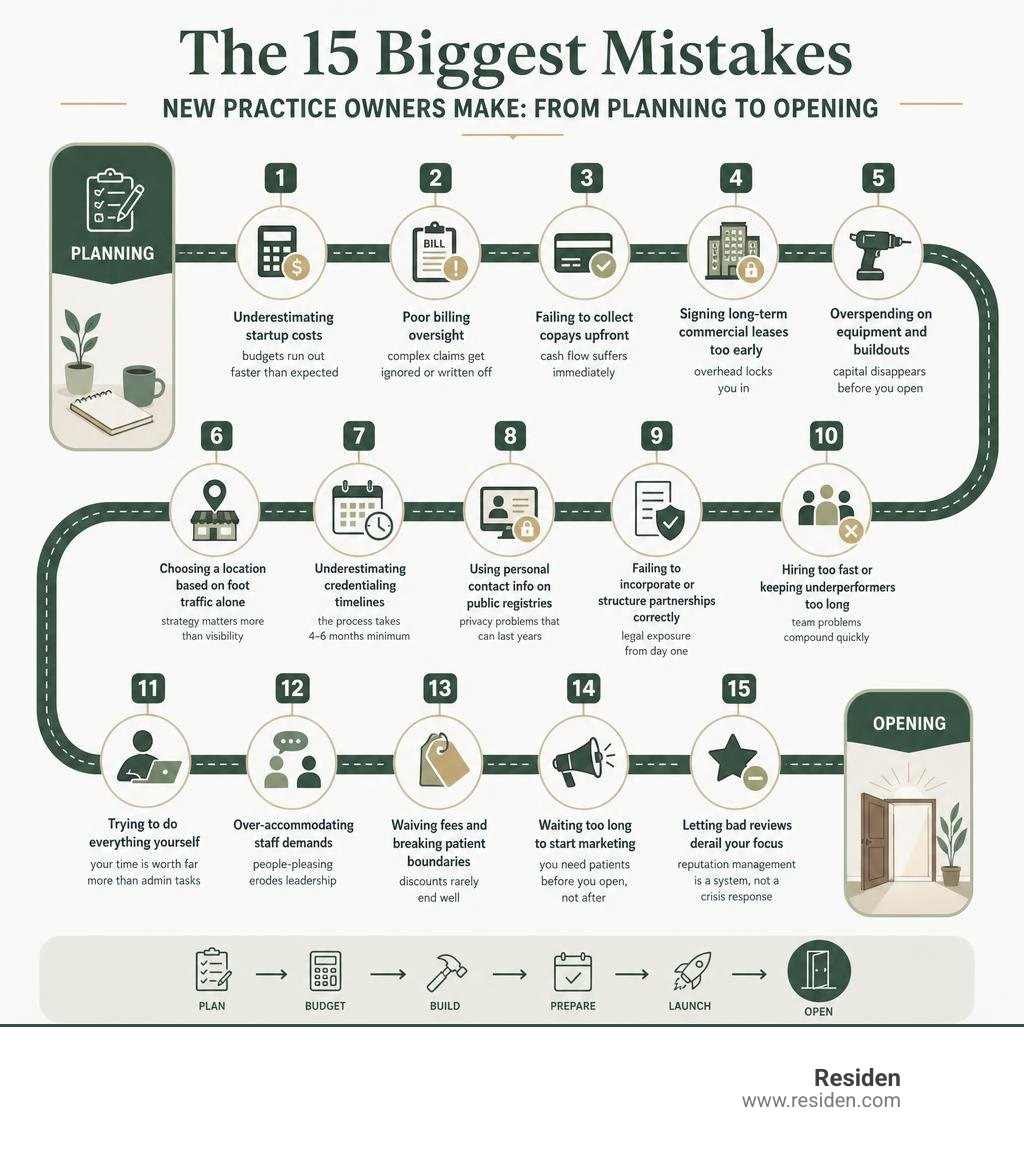
Here's a quick look at what they are:
- Underestimating startup costs — budgets run out faster than expected
- Poor billing oversight — complex claims get ignored or written off
- Failing to collect copays upfront — cash flow suffers immediately
- Signing long-term commercial leases too early — overhead locks you in
- Overspending on equipment and buildouts — capital disappears before you open
- Choosing a location based on foot traffic alone — strategy matters more than visibility
- Underestimating credentialing timelines — the process takes 4–6 months minimum
- Using personal contact info on public registries — privacy problems that can last years
- Failing to incorporate or structure partnerships correctly — legal exposure from day one
- Hiring too fast or keeping underperformers too long — team problems compound quickly
- Trying to do everything yourself — your time is worth far more than admin tasks
- Over-accommodating staff demands — people-pleasing erodes leadership
- Waiving fees and breaking patient boundaries — discounts rarely end well
- Waiting too long to start marketing — you need patients before you open, not after
- Letting bad reviews derail your focus — reputation management is a system, not a crisis response
Most new practice owners are exceptional clinicians. But running a practice is a completely different skill set — and nobody teaches it in medical school.
The gap between clinical training and business readiness is exactly where practices get into trouble. According to U.S. Bank, 80% of small business failures are tied to cash flow problems. And about 65% of new practices open their doors without being contracted with the majority of the insurance companies they want to accept — meaning they're already behind on revenue before they treat a single patient.
The good news? Every one of these mistakes is avoidable with the right information upfront.
I'm Dr. Jessica Wu, a Harvard-trained dermatologist who has been running my own private practice in Los Angeles for over 20 years — and I've seen how the 15 biggest mistakes new practice owners make can quietly undermine even the most talented clinicians. In this guide, I'll walk you through each one so you can build a practice that's financially sound, legally protected, and designed around your life — not just your patients.
The 15 Biggest Mistakes New Practice Owners Make: Financial and Billing Blunders
When we transition from clinical work to business ownership, we quickly realize that cash flow is the lifeblood of our practice. You can be the most brilliant physician in Beverly Hills, but if your billing is broken, you will find yourself Drowning in Debt. Let’s look at the financial traps that catch new owners off guard.
Mistake 1: Underestimating Startup Costs (One of The 15 Biggest Mistakes New Practice Owners Make)
Many clinicians launch their businesses assuming they only need enough capital to cover rent and a few pieces of equipment. In reality, starting a physical therapy or chiropractic practice can easily cost $40,000 to $80,000, while a specialized medical or dental practice can range from $450,000 to over $800,000.
The trap isn't just the upfront cost; it's the lack of working capital. It takes months to build a patient base and wait for insurance reimbursements to arrive. Opening a practice without at least 6 to 12 months of operating cash reserves is a recipe for disaster. To protect your business, read through the 10 Keys to Prevent Bankruptcy for Your New Practice to understand how to align your initial capital with realistic operational runways.
Mistake 2: Poor Billing Oversight and Ignoring Complex Claims
Outsourcing your billing to an external company is a smart move, but failing to audit them is a major mistake. Many billing companies charge a percentage fee but quietly ignore complex or rejected claims because they require too much administrative effort. They might leave these difficult claims in "pending" status indefinitely to keep their clean-claim metrics looking good.
We must audit our billing companies regularly. Ask them directly: How many clients do you assign per biller? If a single biller is managing thirty clinics, your rejected claims are likely gathering dust. One private practice discovered this the hard way, but within the first month of hiring a dedicated, proactive biller, they easily brought in an extra $20,000 from previously rejected claims. Learn how to manage this process by reading What New Physicians Need to Know About Billing Insurance.
Mistake 3: Failing to Collect Copays and Deductibles Upfront
We understand the temptation to let patients pay after their insurance processes. You want to focus on care, not transactions. However, chasing patients for $30 copays or high-deductible balances after they leave your office is incredibly expensive and highly inefficient.
This is even more critical under modern credit laws. Any medical debt under $500 will not go against a consumer's credit score. This means you have virtually no leverage to collect small, outstanding balances once the patient walks out the door. Always collect copays, deductibles, or estimated "guess" amounts upfront.
| Collection Method | Collection Rate | Administrative Cost | Impact on Cash Flow |
|---|---|---|---|
| Upfront Collection | 98% – 100% | Negligible (processed at check-in) | Immediate, predictable cash flow |
| Delayed Billing (Mailed Statements) | 40% – 60% | High (paper, postage, staff time) | Delayed by 30–90 days; high write-offs |
Real Estate and Operational Pitfalls of Starting Solo
Choosing where and how we practice is one of the most expensive decisions we will make. In competitive Southern California markets like Los Angeles, Beverly Hills, and Brentwood, real estate mistakes can sink a practice before it even gets off the ground.

Mistake 4: Signing Long-Term Commercial Leases Too Early
Signing a traditional 5-to-10-year commercial lease for medical office space is incredibly risky for a new business. Commercial landlords often demand personal guarantees, and if your practice growth doesn't match your projections, you are still legally locked into paying thousands of dollars in monthly rent.
Instead of committing to a massive lease, look for flexible options that allow you to scale. Turnkey, shared medical office rentals let you book space by the hour or day without long-term commitments, helping you maintain a Lower Overhead. Avoid the major traps of traditional commercial real estate by reviewing the Five Mistakes Physicians Make When Leasing Medical Office Building for Their Practice.
Mistake 5: Overspending on High-End Equipment and Buildouts
It is easy to fall into the trap of feeling like we "deserve" the absolute best equipment, high-end furniture, and custom buildouts on day one. But spending $100,000 on top-tier specialty chairs or high-end decor before you have a steady stream of patients drains your precious working capital.
Instead, focus on value engineering. Buy high-quality used equipment where appropriate, and only equip the rooms you actually need to start. For example, if you have space for four exam rooms, only fully equip two of them on day one while leaving the others plumbed and wired for future expansion. Keeping your initial footprint lean is one of the most effective Simple Ways to Run the Lean Medical Practice.
Mistake 6: Choosing a Location Based on Foot Traffic Instead of Strategy
Many new owners see a vacant space next to a busy Starbucks and assume it's the perfect spot. But retail foot traffic does not automatically translate to medical practice success.
Instead of focusing on raw visibility, analyze the local demographics, parking accessibility, and clinical strategy. Are your ideal patients actually living or working within a 15-minute drive? Is there convenient parking (a major factor in Los Angeles and Beverly Hills)? Your location must align with your clinical vision and patient demographic data, not just high foot traffic.
Credentialing, Contracting, and Legal Missteps
Setting up the administrative and legal foundations of your practice requires patience and precise execution. Cutting corners here can lead to years of legal headaches and lost revenue.

Mistake 7: Underestimating Credentialing Timelines (Another of The 15 Biggest Mistakes New Practice Owners Make)
One of the 15 biggest mistakes new practice owners make is assuming they can open their doors and start billing insurance companies immediately. In reality, the credentialing and contracting phase of any startup takes roughly 4 to 6 months.
If you try to see patients before your contracts are officially active, you cannot bill the insurance company, and you will be forced to write off those services. Always plan a 6-month runway for credentialing before your target opening date. To make sure you don't miss any critical steps during this pre-launch phase, check out our guide on Starting Your Own Practice.
Mistake 8: Using Personal Contact Info on Public Registries
When you register for PECOS (Medicare credentialing) or submit insurance paperwork, you must provide a business address and phone number. Many new owners mistakenly use their personal cell phone and home address during the setup phase to save a few dollars.
This is a massive privacy risk. Once your personal contact info is entered into insurance databases, it gets scraped by public directories and third-party websites. It can take almost 3 years for the constant spam calls, faxes, and pharmacy inquiries to your personal line to stop. Always use a dedicated business address and a digital VOIP phone number from day one.
Mistake 9: Failing to Incorporate or Structure Partnerships Correctly
Operating as a sole proprietorship under your personal Social Security number exposes you to immense personal liability and highly inefficient tax rates. You must file an LLC, S-Corp, or PLLC early in the process to protect your personal assets.
Additionally, be incredibly careful when starting a practice with friends. Many partnerships formed out of graduate school or residency friendships fail due to mismatched work ethics or changing life goals. If you do enter a partnership, ensure you have a legally binding agreement that clearly outlines buyout terms, responsibilities, and exit strategies.
Staffing, Management, and Delegation Traps
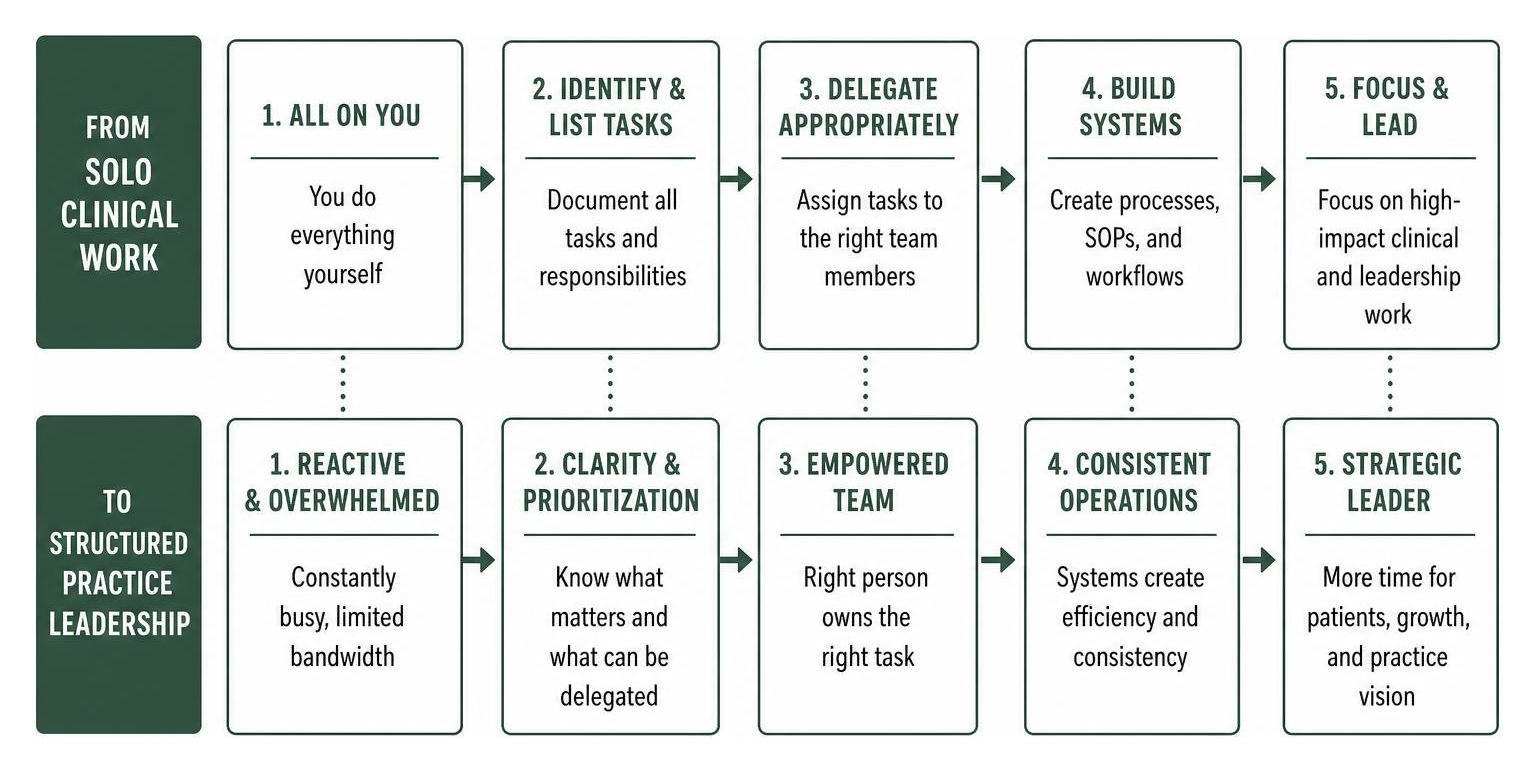
Your team can make or break your practice. As a new owner, learning how to lead, delegate, and manage staff is often one of the steepest learning curves.
Mistake 10: Hiring Too Fast or Keeping Underperforming Staff Too Long
When we open, we often feel rushed to hire a full team. This leads to hiring for speed rather than cultural alignment. Even worse, when a new hire isn't working out, new owners often hesitate to let them go out of conflict avoidance or guilt.
Keeping an underperforming employee or physician on staff can easily cost a practice over $100,000 in lost productivity, errors, and damaged patient relationships. Hire slowly, establish clear performance metrics, and build a standardized coaching-to-termination pipeline. Before making your first hire, walk through our Before You Hire Checklist to avoid common hiring traps, and learn how to manage staffing challenges in The Struggles of Staffing.
Mistake 11: Trying to Do Everything Yourself (The DIY Trap)
Many new practice owners try to save money by acting as the doctor, receptionist, biller, and IT support all at once. While this might seem frugal, it is highly inefficient.
Your time as a licensed practitioner is incredibly valuable. If you spend three hours a day answering phones, filing paperwork, or managing scheduling, you are trading high-value clinical time for low-cost administrative tasks. Hire a virtual assistant or a part-time receptionist to handle administrative duties so you can focus on seeing patients and growing your business.
Mistake 12: Over-Accommodating Staff Demands (People-Pleasing)
It is natural to want our staff to love working for us. However, trying to please everyone often leads to over-accommodating unreasonable demands — whether it's custom office furniture, constant scheduling changes, or overpaying out of guilt.
This lack of boundaries erodes your leadership and drains your capital. Establish clear, written job accountabilities from day one. Be a supportive leader, but maintain firm professional boundaries and hold your team accountable to your practice's standards.
Patient Relations, Marketing, and Boundary Failures
How we communicate with our patients and position our practice in the local market determines our long-term reputation and growth.
Mistake 13: Waiving Fees, Discounting, and Breaking Boundaries
It is tempting to waive copays, offer steep discounts, or give out your personal cell phone number to patients to build goodwill. However, breaking professional boundaries almost always backfires.
Waiving copays can actually violate your contracts with insurance companies. Furthermore, patients who receive steep discounts are often the most demanding and the quickest to leave negative reviews when you eventually try to enforce normal policies. Set fair, sustainable pricing from day one, and stick to it.
Mistake 14: Waiting Too Late to Start Marketing
Many owners assume that once they open their doors, patients will magically find them. This "if you build it, they will come" mindset is a quick path to empty schedules.
You must begin marketing your practice 3 to 6 months before your official opening day. Build a basic, SEO-optimized website, claim your local Google Business Profile, and start networking with referring physicians in your area. Building a pre-launch interest list ensures you have a full schedule on day one. Learn how to build a patient pipeline by reading How to Fill Your Schedule Without Insurance Referrals.
Mistake 15: Letting Bad Reviews Ruin Your Peace of Mind
In the age of online reviews, a single 1-star rating can feel like a personal attack. Many new owners lose sleep, get defensive, or spend hours obsessing over a negative review.
Do not let bad reviews derail your focus. Respond professionally, keeping HIPAA guidelines in mind (never confirm the reviewer was a patient), and focus on drowning out the negative feedback by consistently asking your satisfied patients to leave positive reviews. A robust, automated system for collecting positive reviews is your best defense.
Frequently Asked Questions about Practice Ownership
How much capital is required to start a new practice?
The required capital depends heavily on your specialty and location. A lean chiropractic or mental health practice can start with $40,000 to $80,000. However, a fully equipped medical or dental practice in prime Los Angeles areas like Beverly Hills or Brentwood typically requires $450,000 to over $800,000. In addition to physical setup costs, you should always secure at least 6 months of working capital to cover operational expenses while waiting for insurance reimbursements.
How long does the insurance credentialing process take?
The insurance credentialing and contracting phase typically takes 4 to 6 months minimum. It is a multi-step process that involves verifying your credentials, negotiating fee schedules, and waiting for contracts to be loaded into payer systems. We highly recommend starting this process at least 6 months before your target opening date to avoid cash flow delays.
Should I rent a traditional office space or use a shared medical space?
For most new practices, renting a traditional commercial office space is a major financial risk due to high upfront buildout costs and 5-to-10-year lease commitments. Utilizing a shared, turnkey medical space allows you to book fully equipped exam and procedure rooms by the hour or day. This eliminates overhead, removes the need for long-term leases, and lets you grow your practice in premium locations like Beverly Hills without high financial risk.
Conclusion
Avoiding the 15 biggest mistakes new practice owners make comes down to keeping your overhead low, protecting your time, and building solid operational systems from day one. You don't have to take on massive debts or sign long-term commercial leases to build your dream practice.
At Residen, we help healthcare professionals bypass these costly real estate and operational traps. We provide fully equipped, turnkey, shared medical office rentals in premier Southern California locations, including Beverly Hills and Brentwood. With our flexible model, you can book exam, procedure, or consultation rooms by the hour or day — with no long-term leases, no hidden fees, and zero setup costs.
By eliminating traditional overhead, you can focus on what you do best: providing exceptional care to your patients. Discover The Perks of Private Practice on your own terms, and Get Started with Residen today to launch your practice with confidence.