
Don't Get Audited Out of Style in Beverly Hills
Compliance Audits Beverly Hills Clinics Can't Afford to Ignore

Compliance audits Beverly Hills clinics face are among the most complex in the country — and the stakes have never been higher than in 2026.
Here's a quick overview of what Beverly Hills clinics need to stay on top of:
| Audit Type | Governing Body | Key Risk for Beverly Hills Clinics |
|---|---|---|
| HIPAA Security & Privacy | HHS / OCR | PHI breaches, missing SRAs, weak BAAs |
| California CMIA | CA State | Stricter breach rules beyond federal HIPAA |
| OSHA | Federal / Cal/OSHA | Bloodborne pathogens, hazard communication |
| Medical Coding & Billing | CMS / Payers | Overcoding, undercoding, claim denials |
| FDA (Compounding) | FDA | Prescription violations, labeling failures |
Los Angeles County is the largest healthcare market in the western US. That makes it a prime target for federal and state regulators. Small and mid-sized practices — including solo practitioners and boutique aesthetics clinics — are increasingly in the crosshairs of OCR audits.
The regulatory environment here isn't just complex. It's layered. Federal rules like HIPAA sit on top of California-specific laws that add their own requirements. Miss one layer, and you're exposed.
I'm Dr. Jessica Wu, a dermatologist who has practiced privately in Los Angeles for over 20 years and participated in FDA-regulated clinical trials — giving me insight into the compliance pressures that define compliance audits Beverly Hills clinics navigate daily. Whether you're running a solo aesthetics practice or a multi-provider concierge medicine office, this guide will walk you through exactly what you need to know.
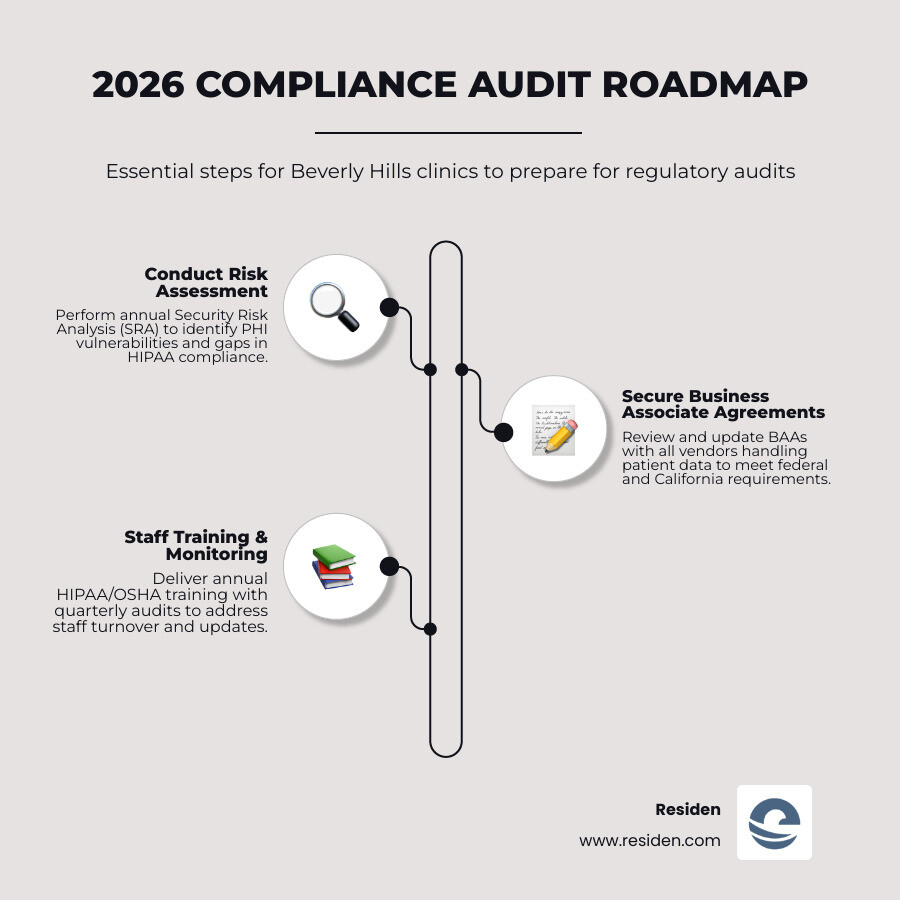
Critical Types of Compliance Audits Beverly Hills Clinics Must Navigate

Navigating the regulatory landscape in 90210 requires more than just a good lawyer; it requires a proactive strategy across several distinct categories. While we often think of "compliance" as a single bucket, compliance audits Beverly Hills clinics encounter are usually specialized.
HIPAA Privacy and Security
The Office for Civil Rights (OCR) has shifted its focus. While they used to hunt for "big fish" hospital systems, they are now actively auditing small and mid-sized practices in dense markets like Greater Los Angeles. The #1 cited violation? The lack of a documented, annual Security Risk Assessment (SRA).
Under the HIPAA Privacy Rule, clinics must protect all "Protected Health Information" (PHI), which includes everything from a patient’s name and address to their medical history and test results. Many local practices, such as Beverly Hills Aesthetics, maintain detailed policies to ensure they meet these federal standards, but an audit will look for the documentation of these actions, not just the existence of a policy.
OSHA and Workplace Safety
If your clinic handles needles, lasers, or chemicals, OSHA (and its state counterpart, Cal/OSHA) is watching. These audits focus on bloodborne pathogens, hazard communication, and fire safety. Ensuring your team is trained and your facility is up to code is non-negotiable for staying operational.
FDA and Compounding Regulations
Beverly Hills is a hub for specialized medicine, including customized skincare and wellness treatments. However, the FDA has been clear that compounding pharmacies and clinics must follow strict rules under Section 503A of the FDCA. A real-world example of this is the FDA Warning Letter issued to The Compounding Pharmacy of Beverly Hills, which highlighted the risks of producing drugs without patient-specific prescriptions. When a clinic loses its 503A exemption, it can be hit with violations regarding "misbranded" drugs and "unsanitary conditions."
Medical Coding and Billing
Even if your clinical care is perfect, your paperwork might not be. Coding audits ensure that you aren't "upcoding" (billing for a more expensive service than provided) or "undercoding" (leaving money on the table). These audits are often triggered by insurance payers or government programs like Medicare and Medi-Cal.
Why Beverly Hills Healthcare Providers Face Elevated Audit Risks
Why is our neighborhood such a target? It comes down to the nature of the practices here. Beverly Hills is the global capital of concierge medicine and high-end aesthetics. This creates a "perfect storm" for regulatory scrutiny.
- High-Profile Data: We treat celebrities, business moguls, and international dignitaries. The PHI we hold is incredibly sensitive. A breach in a Beverly Hills clinic isn't just a legal headache; it's a front-page news story.
- Market Density: With 13.2 million people in the Greater Los Angeles area, the OCR and other agencies view this region as a high-impact zone for enforcement.
- Rapid Growth of Wellness Clinics: New "longevity" and "IV drip" clinics are popping up everywhere. Often, these businesses grow faster than their compliance infrastructure, making them easy targets for inspectors.
- The "Deep Pocket" Perception: Regulators and litigators often assume Beverly Hills clinics have the resources to pay significant fines, leading to more aggressive enforcement.
To mitigate these risks, a solid Business Associate Agreement (BAA) is essential for any vendor you work with, from your cloud storage provider to your cleaning crew.
Navigating California’s Complex Regulatory Environment in 2026
In 2026, being "HIPAA compliant" is only half the battle. California healthcare providers must also answer to the Confidentiality of Medical Information Act (CMIA).
The CMIA is often stricter than HIPAA. For example, while HIPAA provides a general framework for breach notifications, California law typically mandates a 45-day deadline for notifying individuals of a data breach. If you miss this window, you face state-level penalties that can far exceed federal fines.
Practices like Beverly Hills-Wilshire Cosmetic explicitly mention the role of auditors in their privacy notices, acknowledging that state licensing boards may review records to ensure the clinic is fit to operate in California. We recommend that all providers maintain clear Internal Practice Policies that address both federal and state requirements to avoid being caught in the gap between the two.
Preparing for Compliance Audits in Beverly Hills Clinics

Preparation is the best defense. You don't want to be scrambling for paperwork when an inspector walks through your door at 433 N Camden Dr.
Essential Documentation for Compliance Audits in Beverly Hills Clinics
When an auditor arrives, they will ask for your "Compliance Binder." This should be a living document (digital or physical) that includes:
- Annual Security Risk Assessment (SRA): This must be dated and documented every single year.
- Training Logs: Proof that every staff member who touches PHI has completed annual HIPAA and OSHA training.
- Business Associate Agreements (BAAs): A complete list of all vendors with signed agreements.
- Incident Response Plan: A written guide on what happens if a laptop is stolen or a server is hacked.
- Policies and Procedures: Detailed documents like those found at the office of Allen Foulad MD, which outline patient rights and clinic duties.
Before bringing on new team members, use a Before You Hire Checklist to ensure they are vetted and ready to follow these protocols. Additionally, we suggest keeping an ADA and OSHA Checklist handy to ensure your physical space remains compliant.
The Role of Medical Coding Audits in Revenue Protection
Medical coding audits aren't just about staying out of "billing jail"; they are about protecting your bottom line. An external audit of your E&M (Evaluation and Management) levels can identify if your staff is consistently under-coding, which can cost a mid-sized clinic tens of thousands of dollars in lost revenue annually. Conversely, catching over-coding errors early can prevent a "clawback" where an insurance company demands years of payments back at once. If you have questions about how this fits into a shared office environment, check our FAQs.
The Financial Reality: Costs and Penalties of Non-Compliance
The cost of compliance is a fraction of the cost of failure.
For solo practitioners in Beverly Hills, there are now affordable, self-service SRA platforms starting as low as $499 per year. These tools allow you to complete a mandatory risk assessment in just a few days. On the other hand, hiring a full-service compliance consultant can cost anywhere from $3,000 to $15,000 depending on the size of your practice.
Compare that to the penalties:
- HIPAA Violations: Can range from $100 to over $50,000 per violation, with annual caps in the millions.
- CMIA Fines: California state fines can be $2,500 per person whose data was exposed in a negligent breach.
- Reputational Damage: In a town built on image, a public "Wall of Shame" listing by the OCR can be a death sentence for a boutique clinic.
Frequently Asked Questions about Compliance Audits in Beverly Hills Clinics
How often should our clinic conduct internal audits and training?
At a minimum, you must conduct a Security Risk Assessment and staff training annually. however, we recommend quarterly monitoring of your billing and coding. If you have high staff turnover, you must ensure that new hires are trained immediately — you cannot wait until the "annual" date to get them up to speed.
What are the most common compliance failures in Beverly Hills?
The most frequent fail is the "set it and forget it" mentality. Many clinics have a HIPAA policy from 2015 that hasn't been updated to reflect 2026 technology. Other common issues include:
- Failing to encrypt laptops or mobile devices.
- Improperly compounding medications without patient-specific prescriptions (as seen in recent FDA letters).
- Leaving PHI visible on computer screens in high-traffic areas.
Are there affordable compliance solutions for solo practitioners?
Yes. You don't need a six-figure compliance department. Between self-service SRA platforms ($499 range) and turnkey medical spaces that handle the heavy lifting of facility compliance (like OSHA and ADA standards), solo practitioners can stay fully compliant on a budget.
Conclusion
In the world of Beverly Hills medicine, compliance is the foundation that allows your practice to thrive. You’ve worked hard to build your reputation; don’t let a paperwork error or a missing risk assessment take it all away.
At Residen, we understand the unique pressures of the Los Angeles healthcare market. We provide turnkey, shared medical office rentals in the heart of Beverly Hills that are designed to be patient-friendly and professionally equipped. By using our flexible hourly or daily bookings, you can focus on patient care and compliance while we handle the complexities of the medical real estate.
Ready to see how a compliant, flexible space can transform your practice? Get Started - Beverly Hills