
The Ultimate ADA and OSHA Checklist for Your Clinic
Are Sinks Required in Medical Exam Rooms? Here's What Compliance Actually Looks Like

Are sinks required in medical exam rooms — and the short answer is: it depends on who regulates your space.
Here's a quick breakdown:
| Authority | Sink Required in Exam Room? |
|---|---|
| Federal OSHA | Not always — only if bodily fluid contact is possible |
| FGI Guidelines / Joint Commission | Yes — one handwashing station per exam or treatment room |
| California CBC (2022) | Yes — and it must meet strict accessibility standards |
| State licensure (varies) | Often yes — check your state's specific rules |
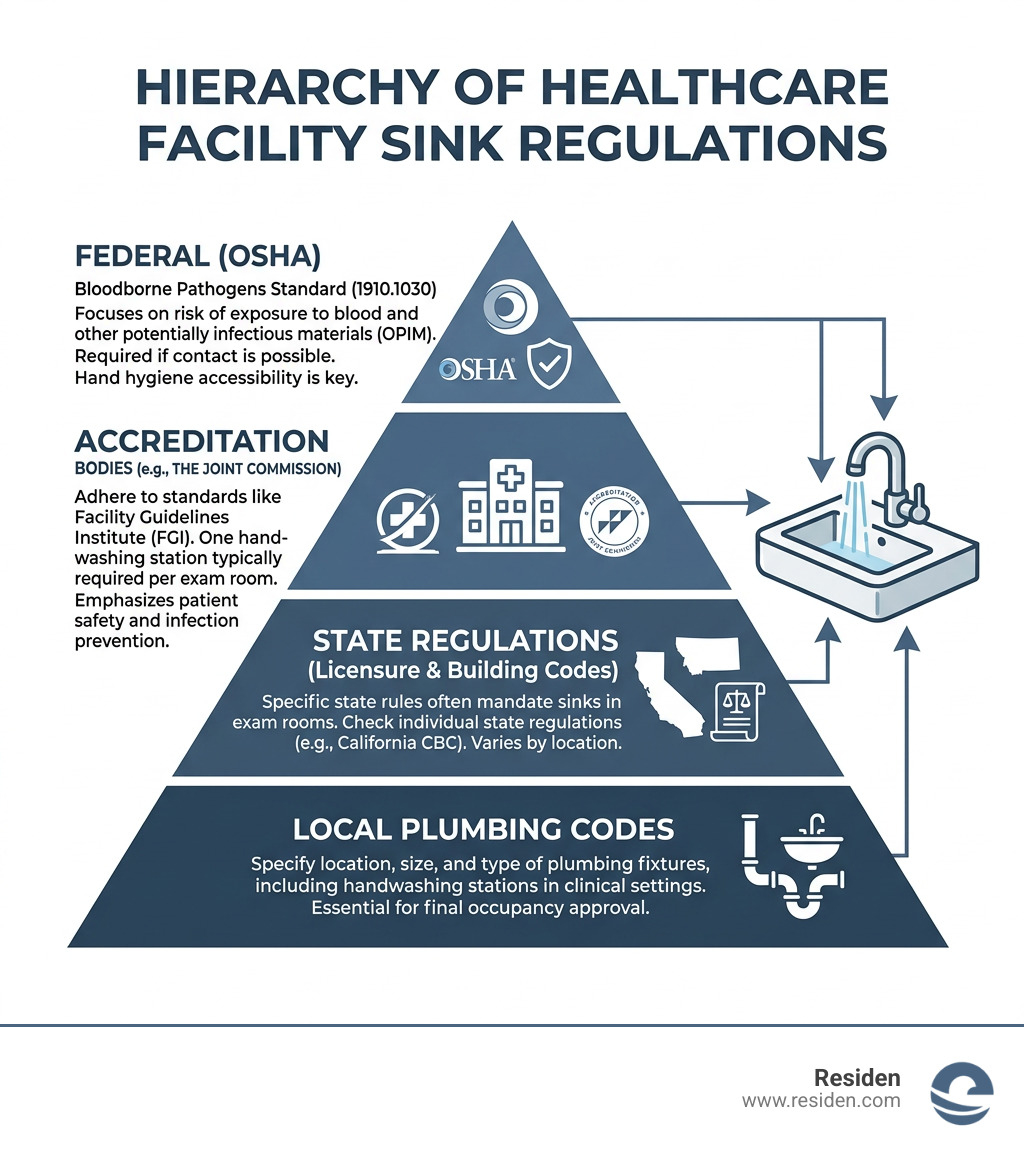
The rules come from several directions at once: federal OSHA standards, accreditation bodies like The Joint Commission, state building codes, and local plumbing codes. They don't always agree — and the gaps between them are exactly where compliance problems hide.
For independent healthcare professionals renting or building out clinical space, this matters a lot. Getting it wrong can mean failed inspections, lost accreditation, or costly retrofits.
This guide cuts through the complexity so you know exactly what's required, who requires it, and when exceptions apply.
Federal and OSHA Standards: Are Sinks Required in Medical Exam Rooms?
When we look at federal regulations, the primary authority is the Occupational Safety and Health Administration (OSHA). Specifically, OSHA standard 1910.1030(d) covers the Bloodborne Pathogens standard.
You might be surprised to learn that OSHA does not explicitly state, "Every single exam room must have a porcelain sink." Instead, OSHA focuses on the risk of exposure. According to official OSHA interpretation letters, if an examination room is strictly restricted to procedures where there is absolutely no possibility of contact with blood or other potentially infectious materials (OPIM), a sink inside that specific room is not federally mandated. For example, a room used solely for consultations or blood pressure checks might technically bypass the requirement.
However—and this is a big "however"—the moment a procedure involves the potential for fluid contact, OSHA requires that handwashing facilities be "readily accessible."
The "Readily Accessible" Rule
What does "readily accessible" mean in a clinical setting? It means that employees must be able to wash their hands immediately after removing gloves or following contact with blood. While some practitioners argue that a sink in the hallway is "close enough," OSHA generally prefers the sink to be in the immediate area where the exposure occurs to prevent the spread of contaminants through the facility.
Soap and Water vs. Alcohol-Based Sanitizers
We often get asked if a bottle of hand sanitizer on the counter fulfills the OSHA requirement. The answer is: only partially.
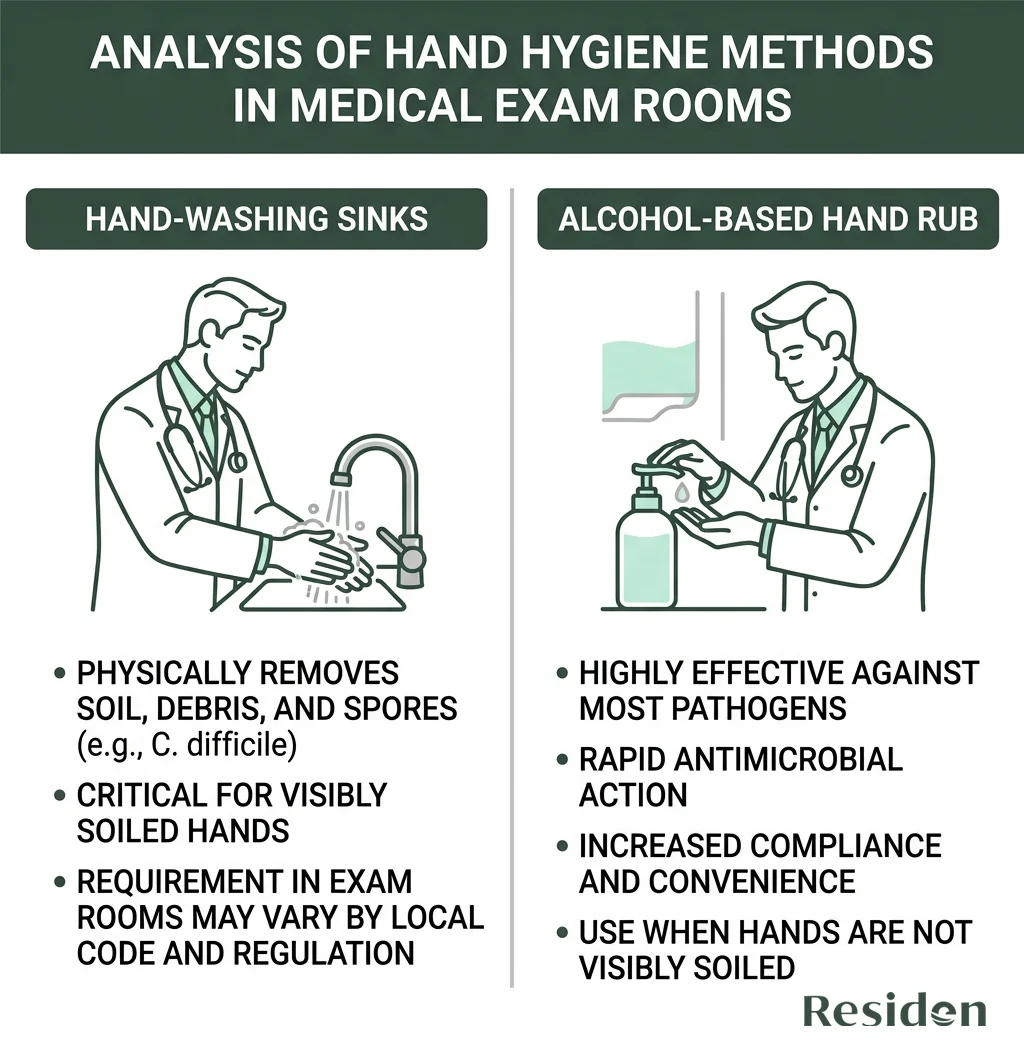
- Alcohol-based hand rubs: These are excellent for routine hand hygiene between patients when hands are not visibly soiled.
- Soap and Water: OSHA mandates washing with soap and water as soon as possible if hands are visibly contaminated with blood or OPIM. If you don't have a sink in the room, and an accidental splash occurs, the staff member has to navigate doors and hallways while contaminated to find a sink. That is a major compliance red flag.
State Building Codes and California CBC Compliance
Since we are focusing on Los Angeles and the surrounding areas like Beverly Hills and Brentwood, the California Building Code (CBC) is our "North Star." California is famous (or perhaps infamous) for having some of the strictest building codes in the nation, particularly regarding accessibility.
In California, the question of whether are sinks required in medical exam rooms moves from "maybe" to "almost certainly yes" due to state licensing and specific code sections.
CBC 11B-223.4 and 11B-805.6
Under the 2022 CBC, professional offices of healthcare providers must follow very specific rules. Section 11B-805.6 states that all handwashing fixtures, lavatories, and sinks must comply with Section 11B-606.
This is where things get "headache-inducing," as some code consultants say. Section 11B-606 requires a forward approach. This means:
- The sink cannot just be a bowl dropped into a standard kitchen-style cabinet.
- There must be knee and toe clearance underneath the sink so a person in a wheelchair can pull right up to it.
- The plumbing must be shielded to prevent burns.
The "Employee Work Area" Myth
A common argument we hear is: "The sink is only for the doctor to use, not the patient, so it doesn't need to be ADA accessible."
In many other states, that might fly. But in California, the CBC is much more specific. Because an exam room is a "patient room," the fixtures within it are generally held to a higher standard. HCAI (formerly OSHPD) interpretations and local Los Angeles Department of Building and Safety (LADBS) inspectors often rule that because a patient could be directed to use that sink, or because a healthcare provider with a disability might work there, the sink must be accessible.
California Plumbing Code and Scrub Sinks
There is one notable exception: Scrub sinks. As defined in the California Plumbing Code Section 221.0, scrub sinks used for surgical preparation do not necessarily have to meet the same forward-approach accessibility requirements as standard handwashing stations. However, standard exam room sinks do not qualify as scrub sinks.
Accreditation Standards and FGI Design Guidelines
If your practice seeks accreditation from The Joint Commission or is located within a facility that follows FGI Guidelines, the rules become even more rigid.
The Facility Guidelines Institute (FGI) publishes the Guidelines for Design and Construction of Outpatient Facilities. This is the gold standard for healthcare architecture. Section 2.1-7.2.2.8 of the FGI guidelines explicitly requires a handwashing station in each exam or treatment room.
The Role of ICRA
The Joint Commission emphasizes the use of an Infection Control Risk Assessment (ICRA). This is a process conducted during the programming and design stage of a clinic. The ICRA helps determine the number and placement of handwashing stations based on the type of care being provided.
For outpatient settings in Los Angeles, the Joint Commission's stance is clear: you must comply with state rules first, and in the absence of specific state rules, you follow the latest FGI Guidelines. Since California has robust rules, the FGI guidelines act as a secondary layer that reinforces the need for a sink in every exam room.
Clinical Sinks vs. Handwashing Sinks
It is important to distinguish between a handwashing station and a "clinical sink." In a medical-surgical unit or a soiled workroom, you might see a flushing-rim clinical service sink (often called a "hopper"). These are used for disposing of liquid clinical waste. While you won't usually need a hopper in a standard exam room, you will need a dedicated handwashing station that is separate from any sink used for cleaning instruments or disposing of waste.
ADA Accessibility and Employee Work Area Exceptions
The Americans with Disabilities Act (ADA) ensures that patients and employees with disabilities have equal access to healthcare facilities. When we design or evaluate Medical Exam Rooms, the sink is a major focal point of ADA compliance.
The 5% Rule and Beyond
Federal ADA standards suggest that if multiple sinks are provided in a cluster, at least 5% must be accessible. However, in a medical office, this is often interpreted as meaning at least one sink in each "type" of room must be accessible. In California, as we discussed, the requirement is effectively 100% of exam room sinks.
Key Dimensions for Accessible Sinks
To be considered compliant under the ADA Medical Care Mobility Guide, a sink must meet these criteria:
- Counter Height: 28 inches minimum to 34 inches maximum above the finished floor.
- Forward Approach: A clear floor space (30" x 48") must be provided for a forward approach.
- Knee Clearance: 27 inches high minimum at a depth of 8 inches, tapering down to the floor.
- Toe Clearance: 9 inches high minimum.
- Faucets: Must be operable with one hand, without tight grasping or twisting of the wrist (lever-operated, electronic, or foot-pedal operated are common choices).
Built-In Cabinets
Many practitioners prefer built-in cabinets for a clean look and extra storage. If you install a sink into a cabinet, the cabinet must have a removable front or a recessed "apron" to allow for the required knee clearance. If the sink is in a "professional office of a healthcare provider," CBC 11B-805.7 requires that these built-in cabinets and work surfaces also be accessible.
Frequently Asked Questions about Clinic Sink Compliance
Navigating the intersection of OSHA, ADA, and CBC can feel like trying to solve a Rubik's Cube that's also on fire. Here are the most common questions we hear at Residen.
Can hand sanitizer dispensers substitute for sinks in exam rooms?
Under OSHA, sanitizer is considered an "adjunct" to handwashing, not a total replacement. If your room is used for low-risk procedures (like a therapy session or a simple consultation), a sanitizer dispenser may be sufficient for routine hygiene. However, if there is any chance of glove removal after contact with blood, or if hands become visibly soiled, you must have access to a sink with soap and water. In the eyes of California building inspectors and FGI-compliant facilities, a sanitizer dispenser does not count as the required handwashing station for an exam room.
Are sinks required in medical exam rooms under the ADA?
The ADA itself doesn't mandate that you must have a sink. Instead, it says that if you have a sink, it must be accessible to people with disabilities. However, because other codes (like the CBC and FGI Guidelines) mandate the sink's presence, the ADA (and CBC Chapter 11B) then dictates exactly how that sink must be installed. For any room where a patient might be treated, the sink should be designed for a forward approach with a 28-34 inch rim height.
How does the 2022 CBC define if sinks are required in medical exam rooms?
The 2022 California Building Code treats healthcare facilities as a special category. Section 11B-805.6 effectively requires handwashing fixtures in all areas where "professional offices of healthcare providers" operate. While the code is technically an "accessibility" code, local health departments and the California Department of Public Health (CDPH) use these building standards as a baseline for licensing. If you are opening a licensed clinic in Los Angeles, you should assume a sink is required in every exam room unless you have a very specific, documented exemption from your local Authority Having Jurisdiction (AHJ).
Practical Benefits of Sinks in Exam Rooms
Even if you could find a legal loophole to avoid installing a sink, there are several practical reasons why almost every modern clinic includes them:
- Physician Efficiency: It saves the provider from having to leave the room, find a sink, wash, and return. This shaves minutes off every patient encounter, which adds up to hours over a week.
- Patient Perception: Patients equate handwashing with safety. Seeing a doctor wash their hands in the room builds trust.
- Infection Control: It is the single most effective way to prevent healthcare-associated infections (HAIs).
- Resale/Lease Value: A medical office without sinks in the exam rooms is significantly harder to lease or sell to other practitioners.
Conclusion
Compliance is about more than just checking a box; it's about creating a safe, accessible environment for both your patients and your staff. While federal OSHA rules offer a tiny bit of wiggle room for "dry" exam rooms, the combination of California's CBC 2022 and accreditation standards like the FGI Guidelines makes sinks a functional necessity in Los Angeles.
Navigating these requirements is a massive undertaking, especially for independent doctors who just want to focus on patient care. This is exactly why we created Residen.
At Residen, we provide turnkey, shared Medical Exam Rooms in Los Angeles, Beverly Hills, and Brentwood. We take the guesswork out of compliance. Our spaces are designed to meet the highest standards of ADA and OSHA regulations, featuring fully compliant handwashing stations, accessible layouts, and patient-friendly designs.
Whether you need a room for an hour or a full day, you can step into a space that is already "inspection-ready." No long-term leases, no build-out costs, and no "code-induced headaches." We handle the sinks so you can handle the science.
If you're looking for a compliant, professional home for your practice in LA, come visit us at 433 N Camden Dr Suite 610 in Beverly Hills and see what a truly compliant clinic looks like.