
The Rise of Medical Coworking: A Smarter Way to Practice Medicine

A medical coworking space is a shared clinical environment where independent healthcare professionals rent fully equipped, HIPAA-compliant rooms — by the hour, day, or month — without the burden of a traditional long-term lease.
Here's what you need to know at a glance:
- What it is: Shared clinical space designed specifically for healthcare providers
- Who it's for: Solo practitioners, therapists, specialists, surgeons, and wellness providers
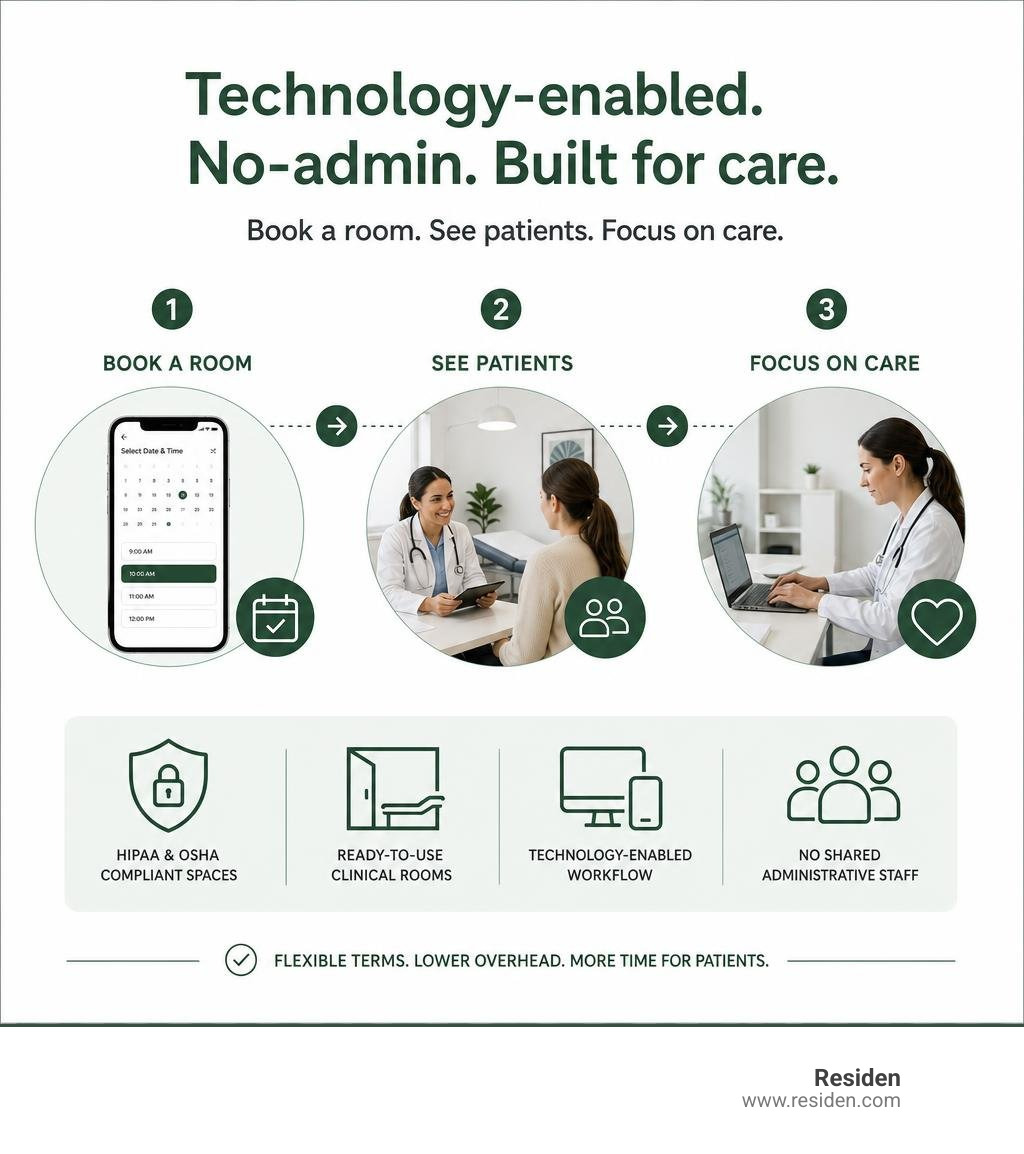
- Key benefit: Lower overhead, flexible scheduling, and technology-enabled operations without shared administrative staff
- How it works: Book a room when you need it — exam rooms, procedure suites, and consultation spaces are ready to use
- Compliance: Spaces are built to support HIPAA and OSHA standards
Healthcare is changing fast. For decades, doctors had two main options: work for a hospital system or carry the full cost of running a private practice. Neither is easy. In fact, for the first time ever, less than half of U.S. physicians owned their own practice as of 2016 — and the pressure has only grown since then.
Meanwhile, nearly 25% of physicians inside large health systems are actively looking for a way out. They want more autonomy. More time with patients. Less paperwork and overhead.
That's exactly the gap medical coworking fills.
Think of it like WeWork — but built for medicine. Instead of hot desks and open lounges, you get private exam rooms, procedure suites, sterilization areas, and technology that supports room booking, access, and day-to-day practice logistics without a shared admin team. You show up, use the space you booked, see your patients, and leave.
And this isn't a niche trend. The broader coworking industry grew from roughly 17,000 spaces in 2018 to a projected 42,000 by 2024, according to Statista. Medical coworking is riding that same wave — and accelerating.
What is Medical Coworking and Why is it Growing?
At its heart, a medical coworking space is the evolution of the traditional medical office. Historically, if you wanted to open a practice in a prime location like Beverly Hills, you had to sign a 5-to-10-year lease, spend six figures on a "tenant improvement" build-out, buy expensive equipment, and build operational systems before you even saw your first patient.
Medical coworking flips that script. It is a shared clinical environment where the infrastructure is already built, the equipment is already in place, and the technology is designed to support a no-admin space. You simply plug your practice into an existing, high-end ecosystem.
The Numbers Behind the Shift
The growth of this model isn't accidental; it’s a response to massive shifts in the healthcare economy. According to Statista, the number of coworking spaces nationwide was forecasted to hit nearly 42,000 by 2024. While much of this was initially driven by tech and creative industries, the medical sector is catching up rapidly.
Why? Because the traditional model is breaking. A Bain & Co survey found that nearly 25% of physicians in health system-led organizations are contemplating a change in employers, with many seeking more autonomy in physician-owned settings. However, with for-profit insurers controlling 43 percent of the market and 60 percent of community hospitals being part of massive enterprise systems, going "independent" feels impossible for many.
Modern Trends Driving Adoption
We are also seeing a convergence of technology and work habits. Telemedicine has made the "full-time" office unnecessary for many providers. A therapist might see patients virtually three days a week and only need a physical Consultation Room for two days. A specialist from another part of California might want to establish a "satellite" presence in Los Angeles without the risk of a new lease.

By offering geographic expansion with zero "start-up" risk, the medical coworking space model allows practitioners to follow the patient demand rather than being stuck behind a desk they're paying for 24/7.
Core Benefits of the medical coworking space Model
The most immediate "win" for any practitioner moving into a shared space is the dramatic reduction in financial stress. When you choose a medical coworking space, you aren't just renting a room; you're opting into a Lower Overhead lifestyle.
Flexibility and Scalability
Traditional real estate is rigid. If your practice grows, you have to move. If it slows down, you’re still stuck with the rent. In our model, scalability is built-in. You can start with one afternoon a week in a Medical Exam Room and scale up to five full days as your patient list grows. This flexibility is one of the primary Benefits of Medical Coworking for Healthcare Professionals, allowing for a truly lean business model.
Fighting Physician Burnout
There is a human cost to the traditional practice model. Research on doctor burnout shows that administrative burdens and the "loneliness" of solo practice are major contributors to professional exhaustion. By removing the need to manage a permanent office — from lease commitments to facility logistics — Residen helps doctors focus on why they went to med school in the first place: treating people.
Enhancing Patient Care Through a medical coworking space
Collaboration is often the "secret sauce" of coworking. In a traditional office, you are siloed. In a medical coworking space, you might have a dermatologist, a plastic surgeon, and a physical therapist all working down the hall from one another.
This proximity naturally fosters:
- Interdisciplinary Collaboration: Spontaneous discussions about complex cases.
- Referral Networks: A therapist can easily refer a patient to a wellness provider in the same building, improving the patient experience.
- Care Convergence: Patients appreciate the "one-stop-shop" feel of a high-end medical hub.
Financial Efficiency in a medical coworking space
Let's talk numbers. When you share a space, you share the costs. Utilities, high-speed HIPAA-conscious internet, janitorial services, and technology-enabled booking are built into the model.
Our Pricing models are designed to preserve your capital. Instead of a $10,000 monthly overhead, you pay for what you use. This pay-per-use model is a game-changer for new practices, allowing them to remain profitable from month one. It’s a strategy that prioritizes Lower Overhead and maximizes the "The Residen Difference."
Essential Amenities and Compliance Requirements
What makes a medical coworking space different from a standard office? It’s the clinical readiness. You can't just put a medical table in a WeWork and call it a day. The space must be medically zoned and functionally equipped.
| Feature | Traditional Medical Office | Residen Medical Coworking |
|---|---|---|
| Lease Term | 5–10 Years | Hourly / Daily / Monthly |
| Upfront Costs | $100k+ (Build-out/Equip) | $0 |
| Staffing | You hire/manage everyone | No shared admin model supported by technology |
| Compliance | Your sole responsibility | Built-in HIPAA/OSHA-conscious infrastructure |
| Flexibility | Fixed square footage | Scale up or down instantly |
Medical-Grade Facilities
A true medical coworking environment includes specialized rooms that meet the needs of diverse practitioners:
- Medical Exam Rooms: Fully furnished with exam tables, sinks, and cabinetry.
- Medical Procedure Rooms: Larger spaces designed for minor surgeries, aesthetics, or specialized treatments.
- Staff Stations: Dedicated areas for your medical assistants or for you to finish your charting between patients.
Navigating HIPAA and OSHA Compliance
Compliance is the non-negotiable foundation of healthcare. Operating in a shared space requires a sophisticated approach to HIPAA and OSHA compliance.
Residen’s model supports providers with:
- Data Privacy: Secure, encrypted Wi-Fi networks help protect electronic health records (EHR).
- Patient Confidentiality: Sound-conscious Consultation Rooms help private conversations stay private.
- OSHA-Conscious Setup: Proper biohazard disposal, sharps containers, and sterilization protocols support a safe clinical environment.
- ADA Accessibility: Spaces are accessible to patients with mobility challenges, supporting a welcoming environment for everyone.
How to Choose and Join a Shared Medical Facility
If you are looking for a medical coworking space in Los Angeles, location and "vibe" are everything. Your patients expect a certain level of professionalism and convenience, especially in high-end markets.
Location Strategy
Your office address says a lot about your practice. We focus on prime areas that are easily accessible for patients:
- Beverly Hills Location: Located at 433 N Camden Dr, this puts your practice in the heart of the world's most famous medical district.
- Brentwood Location: Perfect for reaching the Westside patient base in a sophisticated, professional setting.
The Onboarding Process
Joining a medical coworking space shouldn't be as hard as buying a house. We’ve streamlined the process:
- Book a Tour: Come see the rooms and meet the team.
- Choose Your Plan: Whether you need a few hours a month or a full-time suite, we have a tier that fits.
- Set Up Your Medical Business Address & Mailbox: Even when you aren't in the office, you have a professional presence to receive mail and build your brand.
- Start Booking: Use our intuitive software to reserve your rooms and manage your schedule.
Frequently Asked Questions about Medical Coworking
Who is the ideal user for these spaces?
The beauty of the medical coworking space is its diversity. We see everyone from solo practitioners just starting out to established specialists opening a satellite office.
- Therapists and Counselors: Who need quiet, beautiful consultation rooms.
- Aesthetic Injectors: Who require medical-grade procedure rooms but don't want the overhead of a full med-spa.
- Surgeons: Who need a professional place for pre-op and post-op consultations.
- Wellness Providers: Including nutritionists and IV therapy specialists.
How does patient check-in work in a no-admin shared environment?
Residen is designed around a no-admin model. Instead of relying on shared administrative staff, providers use technology-enabled systems and flexible room access to keep the visit experience efficient. Patients arrive at a polished, professional medical space, and providers can focus on care without carrying the overhead of a traditional front desk team.
Can I perform minor surgeries in a coworking space?
Yes, provided they fall under the category of "office-based" procedures that do not require a full ambulatory surgery center (ASC) license. Our Medical Procedure Rooms are designed with extra space and specialized lighting to accommodate minor procedures, aesthetics, and diagnostic tests.
Conclusion: The Future of Healthcare is Flexible
The days of being "owned" by a hospital system or "trapped" by a 10-year lease are coming to an end. The medical coworking space revolution is about giving power back to the practitioner. It’s about creating a world where you can be a doctor first and a business owner second—without sacrificing your income or your autonomy.
At Residen, we are proud to be at the forefront of this shift in Los Angeles. Whether you are looking to launch your first private practice or expand your existing brand into Beverly Hills or Brentwood, we provide the turnkey, high-end infrastructure you need to thrive.
Ready to see how the modern medical office looks? The Residen Difference is waiting for you.
- Book a Tour today to see our spaces in person.
- Explore our Los Angeles locations and find the perfect home for your practice.
- Get Started on your journey to a lower-overhead, higher-autonomy career.